Nalanda: The University the World Forgot That Once Taught It Everything
Nalanda was ancient India's largest university, drawing about 10,000 students from across Asia before Bakhtiyar Khilji's forces destroyed it in 1193 CE.
Nine Million Books Burned in Three Months
In 1193 CE, Bakhtiyar Khilji’s cavalry rode into Bihar and set fire to a complex so vast that it took three months for the libraries to stop burning. Nine million manuscripts, on medicine, astronomy, philosophy, logic, grammar, and mathematics, turned to ash. The monks who hadn’t fled were killed. The students scattered across Asia. The teachers, many of them elderly men who had spent decades mastering a single discipline, were put to the sword.
What Khilji destroyed wasn’t a temple or a palace. It was a university. The oldest, largest, and most sophisticated university the world had ever seen. A place where 10,000 students from Korea, Japan, China, Tibet, Indonesia, Persia, and Turkey came to study. Where the entry exam was so difficult that only 2 out of 10 applicants were admitted. Where the curriculum was so advanced that it wouldn’t be matched anywhere in the world for another 800 years.
Its name was Nalanda. And for 800 years before it burned, it was the intellectual capital of the world.
The fire wasn’t an accident of war. It was a targeted destruction of knowledge. Khilji’s forces reportedly asked local people what the buildings were. When told they were a university, they burned them anyway, or perhaps because of it. The Tibetan historian Taranatha, writing centuries later, recorded that the smoke from Nalanda’s burning libraries was visible for days, and that the ashes of nine million manuscripts drifted across the plains of Bihar like grey snow.
The destruction of Nalanda stands alongside the burning of the Library of Alexandria as one of the greatest losses of human knowledge in history. But while Alexandria’s destruction is mourned globally, Nalanda’s remains largely unknown outside South Asia. The world remembers what Europe lost. It forgets what India lost.
A University Before the Word Existed
Nalanda was founded in the 5th century CE under the Gupta dynasty, roughly 700 years before Oxford (1096 CE) and 800 years before Cambridge (1209 CE). The concept of a residential university where scholars lived, studied, debated, and conducted original research didn’t exist anywhere else on Earth at that time. Europe was in the early medieval period. The great Arab centres of learning, Baghdad’s House of Wisdom, Cairo’s Al-Azhar, were centuries away from being established.
Nalanda didn’t just predate these institutions. It influenced them. The knowledge systems that flowed from Nalanda through Buddhist monks to China, Tibet, and Southeast Asia, and through Arab traders and scholars to the Middle East, helped shape the intellectual foundations on which later centres of learning were built.
Feature | Nalanda (5th-12th century CE) | Oxford (founded 1096 CE) |
|---|---|---|
Students | ~10,000 | ~3,000 (by 14th century) |
Teachers | ~2,000 | ~100 (by 14th century) |
Library | 9 million manuscripts (3 buildings, 9 stories) | ~1,000 volumes (by 14th century) |
Subjects | Medicine, astronomy, mathematics, logic, grammar, philosophy, theology, law | Theology, law, medicine (initially) |
Entry | Oral examination at the gate (80% rejection rate) | Wealth and clerical connections |
Funding | Royal endowments from multiple dynasties + 200 villages | Church and royal patronage |
International students | Korea, Japan, China, Tibet, Indonesia, Persia, Turkey, Sri Lanka | Primarily English, some European |
Duration | ~800 years continuous operation | ~930 years (still operating) |
The campus spread across 14 hectares, larger than most modern universities. Archaeological excavations have uncovered 11 monasteries and 6 temples, built in a precise, planned layout with lecture halls, meditation rooms, dormitories, gardens, and lakes. The architecture featured multi-storied buildings with indoor plumbing, sophisticated drainage systems, and central heating through underground channels, engineering that Europe wouldn’t match for centuries.
Each monastery followed a standard design: a central courtyard surrounded by cells on all four sides, with a shrine at one end and a lecture hall at the other. The cells were small, roughly 3 metres by 3 metres, with stone beds, niches for lamps, and shelves for manuscripts. Students lived, slept, studied, and meditated in these spaces. The simplicity was deliberate: Nalanda was not a place of luxury but a place of learning.
The funding model was remarkably sophisticated. Rather than depending on a single patron, Nalanda received endowments from multiple dynasties across centuries, the Guptas, the Palas, the Harsha empire, as well as revenue from 200 villages assigned to the university. This diversified funding insulated Nalanda from political instability. When one dynasty fell, another took up patronage. The university outlasted empires.
What They Taught at Nalanda
Nalanda wasn’t a religious seminary. While Buddhist philosophy was central, the curriculum was astonishingly broad, more diverse, in fact, than most European universities would offer until the 19th century:
- The Vedas, Hindu sacred texts were studied alongside Buddhist philosophy. Nalanda was interfaith before the concept existed. Jain scholars were also present. The university’s approach to religious texts was academic, not devotional: texts were analysed, debated, and critiqued, not simply memorised and accepted.
- Logic and debate (Nyaya), Nalanda’s debating tradition was legendary. Scholars had to defend their ideas publicly against opponents who were trained to find every logical flaw. Losing a debate could mean expulsion, or worse, having to join the victorious opponent’s school of thought. The rigour of Nalanda’s logical training influenced Buddhist philosophy across Asia and, through Arab intermediaries, contributed to the development of formal logic in the Islamic world.
- Medicine (Ayurveda and beyond), Ayurvedic medicine was taught alongside surgical techniques that were centuries ahead of European practice. Nalanda’s medical faculty is believed to have practiced inoculation, cataract surgery, and rhinoplasty, procedures that wouldn’t appear in European medical texts for another thousand years. The surgical traditions pioneered by Sushruta were preserved and advanced here.
- Astronomy and cosmology, Aryabhata, who proposed that the Earth rotates on its axis and calculated the value of pi to four decimal places, is believed to have been the head of Nalanda’s astronomical observatory. His work, the Aryabhatiya, was studied at Nalanda and transmitted to the Arab world, where it influenced Islamic astronomy. The observatory tracked planetary movements, predicted eclipses, and maintained astronomical records over centuries.
- Mathematics, The concept of zero, the decimal system, and advanced algebra were developed and taught here. Nalanda was one of the primary centres through which Indian mathematical knowledge, including the numeral system now used worldwide, was transmitted to the rest of the world.
- Grammar and linguistics (Vyakarana), Panini’s Ashtadhyayi, perhaps the most sophisticated grammar ever written for any language, was studied and taught at Nalanda. The linguistic analysis conducted here was so advanced that modern computational linguists have compared Panini’s rule system to a programming language.
- Languages, Sanskrit, Pali, and Tamil, plus the languages of visiting scholars from China, Tibet, and Southeast Asia. Nalanda functioned in multiple languages simultaneously, an international institution in the truest sense.
- Yoga and meditation, Not the exercise-class version but rigorous contemplative practices tied to philosophical systems. Meditation at Nalanda was a form of inquiry, not relaxation.
The Chinese scholar Xuanzang, who spent five years at Nalanda (631-636 CE), described the entry examination: candidates had to answer questions posed by a gatekeeper-scholar at the university’s entrance. The questions were deliberately obscure, covering multiple disciplines. Xuanzang recorded that seven or eight out of ten candidates failed and turned away. Those who passed entered a community where intellectual rigour was the only currency that mattered, not caste, not wealth, not nationality.
The teaching method at Nalanda combined lectures, seminars, and one-on-one mentorship. Senior scholars supervised small groups of students, much like the tutorial system that Oxford and Cambridge would adopt centuries later. Students were expected to master not just their primary subject but multiple disciplines. A mathematics student would also study logic; a philosophy student would also study grammar. The ideal was not specialisation but comprehensive understanding.
The Library That Held the World’s Knowledge
Nalanda’s library, called Dharmaganja (“Treasury of Truth”), was the most famous library in the ancient world after the Library of Alexandria. It consisted of three buildings, each named to reflect its purpose:
- Ratnasagara (“Ocean of Jewels”), Nine stories tall, the main repository of sacred texts. This was the tallest building in the complex and housed the most precious manuscripts, original compositions by Nalanda’s own scholars, rare texts from across Asia, and works that existed nowhere else.
- Ratnodadhi (“Sea of Jewels”), Focused on philosophy and logic, containing the accumulated writings of centuries of debate and argumentation.
- Ratnaranjaka (“Jewel-Adorned”), Focused on science and medicine, housing astronomical observations, medical treatises, mathematical proofs, and engineering texts.
The library contained an estimated nine million manuscripts, copied by hand on palm leaves and birch bark. Each manuscript was painstakingly prepared: palm leaves were dried, treated with oil to prevent insect damage, cut to uniform size, and inscribed with a metal stylus. A single text could require hundreds of leaves, bound together with string through holes punched at the margins.
A dedicated corps of scribes worked continuously to copy deteriorating manuscripts onto fresh leaves. This was the ancient world’s version of data backup, and it was the only reason knowledge survived at all. When a palm leaf deteriorated (which happened within 100-200 years in Bihar’s humid climate), the text was lost unless it had been copied.
Scholars from across Asia came specifically to copy texts and bring them home. Much of what we know about ancient Indian science, mathematics, and philosophy survived only because Chinese and Tibetan monks copied Nalanda manuscripts before the destruction. Xuanzang alone carried 657 texts back to China on 20 horses. The Korean monk Hyecho visited in the 8th century and brought back texts that shaped Korean Buddhism. Japanese monks carried Nalanda’s teachings to Nara and Kyoto.
The irony is devastating: the knowledge that Nalanda generated was preserved by foreign scholars who valued it enough to copy and carry it thousands of miles. The originals were burned. The copies, scattered across monasteries in China, Tibet, Korea, and Japan, became the only surviving record of what Nalanda’s scholars had known.
The Scholars Who Walked Its Halls
Nalanda produced and attracted some of the greatest minds of the ancient world. To call them “academics” in the modern sense diminishes what they were, they were polymaths, philosopher-scientists who worked across disciplines in ways that modern academia, with its rigid departmental boundaries, would find almost inconceivable:
- Nagarjuna (2nd century CE), Founded the Madhyamaka school of Buddhist philosophy. His concept of shunyata (emptiness) influenced both Eastern philosophy and, indirectly, the mathematical concept of zero. His logical framework, which used a four-cornered system of negation (catuskoti), anticipated developments in formal logic that Western philosophers wouldn’t reach for 1,800 years. He was also an alchemist and medical practitioner whose work on metallurgy and pharmacology was studied for centuries.
- Aryabhata (5th century CE), Mathematician and astronomer who calculated Earth’s circumference with 99.8% accuracy, proposed that the Earth rotates on its axis (heliocentrism, 1,000 years before Copernicus), and developed the concept of place-value notation that underlies the modern numeral system. His Aryabhatiya was translated into Arabic as Zij al-Arjabhar and influenced Islamic astronomy for centuries.
- Dharmakirti (7th century CE), Logician whose work on epistemology, how we know what we know, influenced both Buddhist and Hindu philosophy for centuries. His Pramanavartika (“Commentary on Valid Cognition”) is still studied in Tibetan monasteries today. He developed a theory of inference so rigorous that modern philosophers have compared it to Bayesian probability.
- Xuanzang (7th century CE), Chinese monk whose detailed accounts of Nalanda remain our best primary source. He spent five years studying logic, grammar, and Buddhist philosophy under Nalanda’s abbot, Silabhadra, who was reportedly 106 years old. Xuanzang’s journey inspired the Chinese classic Journey to the West, one of the most beloved works of Chinese literature. His translations of Indian texts into Chinese formed the basis of the Faxiang school of Buddhism.
- Shilabhadra (6th-7th century CE), The abbot during Xuanzang’s time. A Bengali Brahmin who converted to Buddhism, he was said to have mastered every major philosophical system taught at Nalanda. He was reportedly over 100 years old when he took Xuanzang as his personal student, spending 15 months teaching him Yogacara philosophy.
- Atisha (11th century CE), Bengali scholar who brought Nalanda’s Buddhist teachings to Tibet in its final years, shaping Tibetan Buddhism as we know it. Without Atisha, the intellectual tradition of Nalanda would have been almost entirely lost. His Bodhipathapradipa (“Lamp for the Path to Enlightenment”) became the foundation text for Tibetan Buddhist practice.
- Padmasambhava (8th century CE), Believed to have studied at Nalanda before travelling to Tibet, where he is credited with establishing Buddhism. He is revered as a “second Buddha” in Tibetan tradition. His esoteric teachings, rooted in Nalanda’s tantric curriculum, shaped the distinctive character of Vajrayana Buddhism.
The International Character of Nalanda
Perhaps the most remarkable aspect of Nalanda was its internationalism. In an era when most people never travelled more than a few miles from their birthplace, Nalanda attracted students from across the known world. Chinese monks walked for years along the Silk Road to reach it. Korean scholars sailed across treacherous seas. Tibetans crossed the Himalayas on foot. Indonesian students came via maritime trade routes.
The university maintained hostels for foreign students, provided translators, and adapted its teaching to accommodate different languages. Xuanzang’s accounts describe a cosmopolitan campus where Chinese, Tibetan, Korean, Japanese, Central Asian, and Southeast Asian students lived and studied alongside Indian scholars from every region of the subcontinent.
This international character wasn’t incidental, it was central to Nalanda’s identity. The university saw itself not as an Indian institution but as a universal one. Knowledge had no nationality. A mathematical proof was equally valid whether discovered by a Bengali Brahmin or a Chinese monk. A philosophical argument had to be defended on its merits, not on the authority of the person making it.
This principle, that knowledge belongs to everyone, was radical in the 5th century. It remains radical today.
The Destruction and the Silence
When Khilji’s forces burned Nalanda in 1193, they didn’t just destroy buildings. They severed a transmission line of knowledge that had been continuous for 800 years. The monks who survived scattered to Tibet, Nepal, and Southeast Asia, carrying what fragments they could remember or had copied. Some made it to Vikramashila, another great Buddhist university 150 kilometres away, but Vikramashila itself was destroyed soon after.
The destruction wasn’t instant. Archaeological evidence suggests that Nalanda experienced a gradual decline in the decades before Khilji’s invasion. Patronage had decreased as Buddhist influence waned in North India. Student numbers were falling. Some buildings were already in disrepair. But the final destruction was sudden, violent, and total.
India’s intellectual tradition didn’t die with Nalanda, it continued in other centres and in the courts of various kingdoms. Sanskrit learning flourished in South India. Mathematical and astronomical traditions continued in Kerala. Islamic scholars brought new intellectual currents. But the scale of the loss is difficult to comprehend. Nine million manuscripts contained knowledge that may never be recovered. Medical texts describing surgical procedures. Astronomical observations spanning centuries. Mathematical proofs that would take the world another millennium to rediscover. Philosophical arguments of extraordinary sophistication. All gone.
What survived did so only because foreign scholars had copied Nalanda’s texts and taken them home. The Tibetan Buddhist canon, the Kangyur and Tengyur, contains thousands of texts translated from Sanskrit originals that were once housed at Nalanda. Chinese translations preserve works whose Sanskrit originals no longer exist. Korean and Japanese temple libraries hold copies of copies of texts that monks carried from Bihar across the Himalayas and the seas.
The silence after the destruction was almost as damaging as the destruction itself. For centuries, Nalanda’s location was forgotten. The ruins were covered by jungle. Local villagers used the ancient bricks for their own construction. It wasn’t until 1812 that the Scottish surveyor Francis Buchanan-Hamilton identified the site, and not until 1861 that Alexander Cunningham of the Archaeological Survey of India confirmed it as Nalanda.
Nalanda Reborn
In 2014, India reopened Nalanda University as a modern international institution near the original site in Rajgir, Bihar. The new Nalanda is small, a few hundred students across five schools (Historical Studies, Ecology and Environment Studies, Buddhist Studies, Philosophy and Comparative Religion, Languages and Literature), but symbolically significant. It’s a statement that the tradition Khilji tried to end is not finished.
The modern university faces challenges its ancient predecessor never did: bureaucratic delays, funding disputes, political interference, and the fundamental question of whether a university can be meaningfully “revived” 800 years after its destruction. Critics argue that attaching the Nalanda name to a new institution is symbolic rather than substantive. Supporters counter that every great university starts small, Oxford began with a handful of teachers, Cambridge with a breakaway group from Oxford, and that what matters is the commitment to the principles that made the original Nalanda extraordinary.
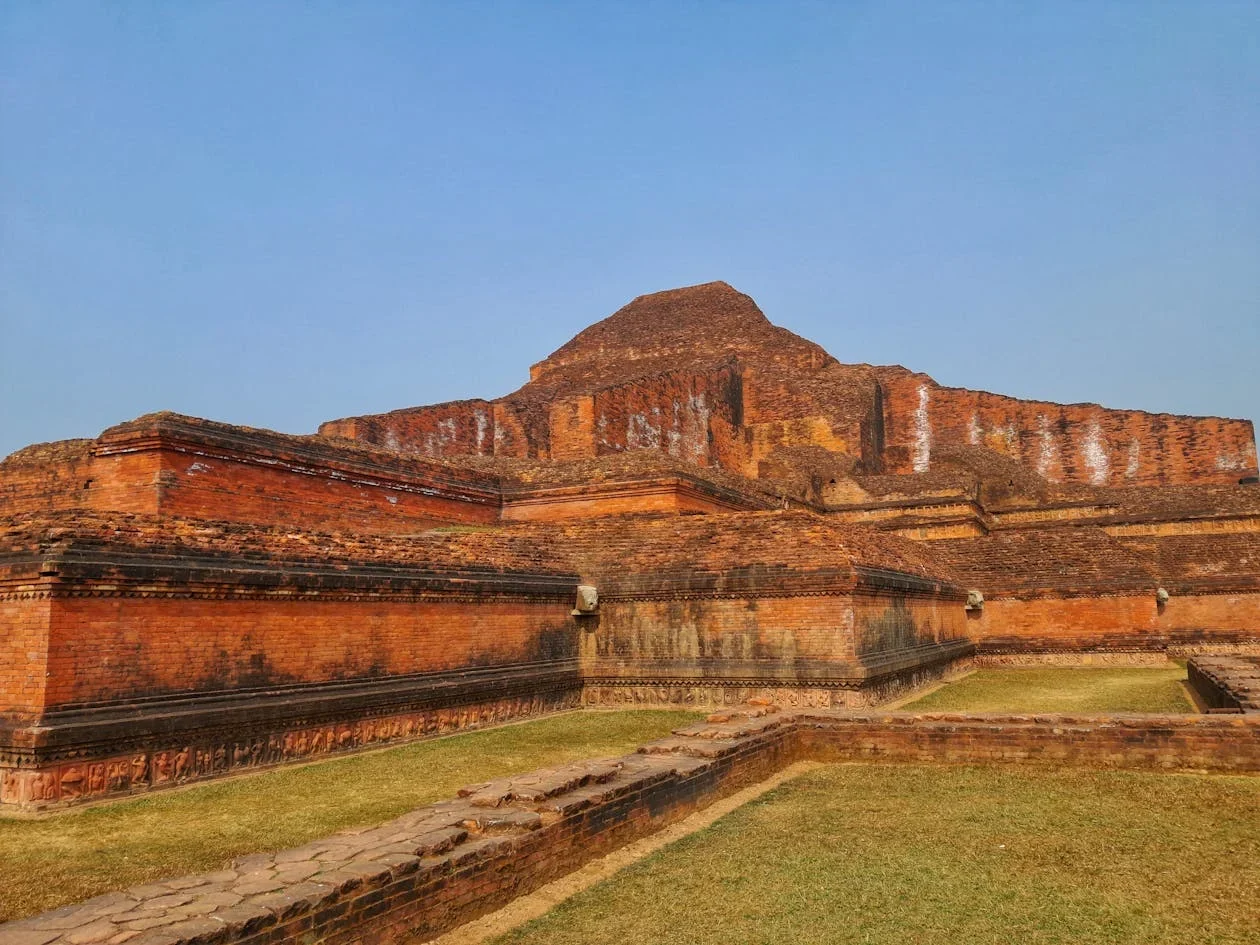
The original Nalanda’s ruins are now a UNESCO World Heritage Site, designated in 2016. Walking through the excavated foundations, you can see the meditation cells (each with a stone bed and a lamp niche), the lecture halls (with raised platforms where teachers sat), the remains of the multi-story monasteries (their brick walls still standing to shoulder height after 800 years). What you can’t see is what was lost, the nine million manuscripts, the knowledge of a thousand scholars, the intellectual heritage of eight centuries.
Excavations have uncovered only about 10% of the estimated site. Under the fields and villages surrounding the exposed ruins, the rest of Nalanda lies buried, more monasteries, more temples, possibly more libraries. What those unexplored areas might reveal remains one of Indian archaeology’s most tantalising questions.
What Nalanda Says About India
Nalanda’s legacy lives in unexpected places. Tibetan Buddhism carries Nalanda’s philosophical tradition almost intact. Japan’s temple universities were modelled on Nalanda’s residential system. The very concept of a residential research university, which Oxford, Cambridge, Harvard, and every modern university follows, was pioneered at Nalanda a thousand years before any of them existed.
More specifically:
- The tutorial system, One-on-one mentorship between senior scholars and students, now the hallmark of Oxford and Cambridge, was standard at Nalanda 700 years earlier.
- The research university model, The idea that a university should not just teach existing knowledge but generate new knowledge through original research was Nalanda’s foundational principle. European universities didn’t adopt this model until the 19th century (the Humboldtian model).
- Interdisciplinary education, Nalanda required students to study across disciplines. The modern push toward interdisciplinary education is a return to what Nalanda practiced 1,500 years ago.
- International education, The idea that students should travel to learn from the best scholars regardless of nationality was Nalanda’s operating principle. The modern international university exchange system echoes this.
- Meritocratic admission, Admission based on intellectual ability rather than social status, wealth, or religious affiliation. Most European universities didn’t adopt this principle until the 20th century.
But Nalanda’s story is also a warning. India had the world’s greatest centre of learning, and lost it. The loss wasn’t just physical (buildings can be rebuilt) or textual (texts can be rewritten). It was systemic. The network of scholars, students, libraries, and traditions that made Nalanda possible took centuries to build and was destroyed in weeks. India has never fully recovered that network.
Today, India’s higher education system struggles with quality, access, and relevance. Not one Indian university consistently ranks in the global top 100. A country that invented the university 1,500 years ago now sends its brightest students to universities in countries that didn’t exist when Nalanda was at its peak.
The question Nalanda forces India to confront is not about the past but about the future: can India build institutions worthy of its intellectual heritage? Can it create places of learning that attract the world’s best minds, as Nalanda once did? Can it invest in knowledge with the same commitment that the Gupta and Pala dynasties showed, not for one government’s term, but across generations?
India didn’t just have a university before anyone else. India invented the university. The question is whether it can reinvent it.
This article is part of unite4india’s “India’s Great Universities” series, exploring the institutions that shaped India and the world.
What you can do
- Share the evidenceSend this to one person who should know about this issue.Share on WhatsApp
- Give an afternoonTeach, mentor, clean up, or lend your professional skills.Ways to volunteer
- Tell us what's missingKnow a story, a fact we got wrong, or a solution worth spotlighting?Suggest a story
Politically neutral. Every claim sourced. Report a correction.

No comments yet