When India Became a Republic26 January 1950
On 26 January 1950, India became a republic. This is the complete history of that day: the Constitution, Ambedkar's speech, Rajendra Prasad, and what it means today.
On the morning of 26 January 1950, India ceased to be a dominion under the British Crown and became a sovereign democratic republic. The transition took effect at 10:18 AM, when Dr. Rajendra Prasad was sworn in as the first President of India in a ceremony held at the Durbar Hall of Government House in New Delhi. With that oath, a document nearly three years in the making the Constitution of India, the longest written constitution of any sovereign nation came into force. The date was not chosen at random. It carried the weight of exactly twenty years of struggle.
Why 26 January? The Purna Swaraj Declaration of 1930
To understand why the framers of the Constitution chose 26 January as Republic Day, you need to travel back twenty years to the banks of the Ravi river in Lahore. The Indian National Congress, under the presidency of Jawaharlal Nehru, held its annual session there in December 1929. On 31 December 1929, at the stroke of midnight, Congress passed the historic Purna Swaraj resolution, declaring complete independence from British rule as India’s political goal. The tricolour flag was unfurled by Nehru himself.
Congress designated 26 January 1930 as the first Independence Day, with the expectation that Indians across the country would read the Declaration of Independence and take a pledge of commitment to Purna Swaraj. That first observance was marked with public meetings, flag-hoisting, and the reading of the pledge drafted by Mahatma Gandhi. Through the 1930s and 1940s, 26 January continued to be observed as Independence Day by nationalist organisations.
When India actually achieved independence on 15 August 1947, the date was determined by Lord Mountbatten based on the anniversary of Japan’s surrender in World War II. The Indian leadership chose to preserve the significance of 26 January by reserving it for the day the Constitution would come into force. This conscious act of historical memory gave Republic Day a depth that went beyond celebration. It was a bridge between the long struggle for self-rule and the formal architecture of a new nation.
The Constituent Assembly: Three Years of Building a Nation’s Foundation
The Constituent Assembly of India held its first sitting on 9 December 1946. It met in the Central Hall of Parliament House in New Delhi, the same hall where debates had taken place under colonial rule. The assembly was not elected by universal adult franchise. Its members were elected by the provincial legislative assemblies that had been constituted under the Government of India Act, 1935. This limitation was acknowledged by the assembly itself, and it shaped the pressure to complete the Constitution quickly and hold fresh elections under the new framework.
The assembly comprised 299 members at the time the Constitution was adopted. The membership included representatives from British India’s provinces and the princely states. Among the most prominent members were Jawaharlal Nehru, Sardar Vallabhbhai Patel, Rajendra Prasad who served as the assembly’s president, Maulana Abul Kalam Azad, Alladi Krishnaswami Ayyar, K.M. Munshi, T.T. Krishnamachari, and the architect of the Constitution himself, Dr. B.R. Ambedkar.
The Constituent Assembly held 11 sessions between December 1946 and November 1949. The drafting process involved absorbing constitutions from around the world. Ambedkar and his Drafting Committee studied the constitutions of the United States, Canada, Ireland, Australia, the United Kingdom, France, the Soviet Union, Japan, and South Africa, among others. The result was a document that drew the best features of multiple democratic traditions while being tailored to India’s specific social and political conditions.
The Drafting Committee, chaired by Ambedkar, was appointed on 29 August 1947, just two weeks after independence. The committee submitted its first draft in February 1948. The draft was then circulated for public discussion and comment. Around 7,635 amendments were proposed. Of these, the assembly considered 2,473. The sheer volume of debate reflected both the diversity of opinion within the assembly and the assembly’s commitment to thorough deliberation.
Dr. B.R. Ambedkar: The Principal Architect
No discussion of India’s Constitution and Republic Day is complete without a close look at B.R. Ambedkar’s role. Bhimrao Ramji Ambedkar was born on 14 April 1891 in Mhow, in what is now Madhya Pradesh. He faced severe caste discrimination from childhood but went on to earn multiple doctorates, including a DSc from the London School of Economics and a PhD from Columbia University, where he was taught by the economist John Dewey.
Ambedkar was a fierce critic of the caste system and had spent decades advocating for the rights of Dalits and other marginalized communities. His presence as the chairman of the Drafting Committee was therefore not merely a legal appointment. It was a statement about whose hands would hold the pen when writing the rules of the new India.
Ambedkar brought a precise legal mind and a deep social conscience to the drafting process. He worked tirelessly despite severe health problems, often working through the night. His personal secretary, Narayan Kajrolkar, later recalled that Ambedkar slept only four hours a night during the drafting period. The breadth of the Constitution, covering fundamental rights, directive principles, emergency provisions, the federal structure, and the schedule of languages, bears testimony to the depth of his preparation.
Ambedkar’s Closing Speech: A Warning the Nation Needed to Hear
On 25 November 1949, one day before the Constitution was adopted, Ambedkar delivered what many historians consider the most important speech in Indian parliamentary history. The closing speech to the Constituent Assembly runs to thousands of words and contains passages that remain prescient more than seven decades later.
Ambedkar opened by acknowledging the critics who had charged that the Constitution was “too large.” He responded that the size was a function of the detail required to protect fundamental rights in a country where executive power could easily override individual liberty. He then posed a question that every republic must ask itself: what is the difference between political democracy and social democracy?
“On the 26th of January 1950, we are going to enter into a life of contradictions. In politics we will have equality and in social and economic life we will have inequality. In politics we will be recognising the principle of one man one vote and one vote one value. In our social and economic life, we shall, by reason of our social and economic structure, continue to deny the principle of one man one value. How long shall we continue to live this life of contradictions? How long shall we continue to deny equality in our social and economic life? If we continue to deny it for long, we will do so only by putting our political democracy in peril.”
Dr. B.R. Ambedkar, Constituent Assembly, 25 November 1949
This passage is not merely quoted at Republic Day ceremonies. It is a test. Every anniversary of 26 January is an occasion to measure how far India has moved, or failed to move, toward resolving those contradictions.
Ambedkar also warned against what he called hero worship. He said: “Bhakti in religion may be the road to salvation of the soul. But in politics, bhakti or hero-worship is a sure road to degradation and to eventual dictatorship.” The assembly received this warning with sober attention. Ambedkar was cautioning a newly independent nation against handing too much power to any individual, no matter how respected. Democratic institutions, he argued, were more important than any leader.
He closed with a call to fraternity, describing it as the principle that gave unity and solidarity to social life. He argued that fraternity was not just a clause in a constitution. It was a way of living together that had to be cultivated by citizens day after day.
The Adoption of the Constitution: 26 November 1949
The Constitution of India was formally adopted by the Constituent Assembly on 26 November 1949. This date is now observed as Constitution Day, or Samvidhan Diwas. The final text contained 395 articles, 8 schedules, and a preamble. When it came into force on 26 January 1950, some provisions were added and the total grew. The Constitution as enacted in 1950 had 395 articles organised into 22 parts and 8 schedules.
The original Constitution of India is hand-written in both English and Hindi. The calligraphy in the English version was done by Prem Behari Narain Raizada in a flowing italic style. Each page was decorated with paintings by the Shantiniketan artist Nand Lal Bose and his students. The document was signed by 284 members of the Constituent Assembly on 24 January 1950, two days before it came into force. The original copies are preserved in helium-filled cases in the Library of Parliament in New Delhi.
The Preamble is worth quoting in full because it captures the founding intentions of the republic in fewer than one hundred words: “We, the People of India, having solemnly resolved to constitute India into a Sovereign Democratic Republic and to secure to all its citizens: Justice, social, economic and political; Liberty of thought, expression, belief, faith and worship; Equality of status and of opportunity; and to promote among them all Fraternity assuring the dignity of the individual and the unity of the Nation; In Our Constituent Assembly this twenty-sixth day of November, 1949, do hereby Adopt, Enact and Give to Ourselves this Constitution.”
The words “Socialist” and “Secular” were added to the Preamble by the 42nd Amendment in 1976 during the Emergency period. The original Preamble, as adopted in 1949, read “Sovereign Democratic Republic.” This distinction matters for understanding the Constitution’s original text versus its amended form.
Dr. Rajendra Prasad: The First President
Dr. Rajendra Prasad was elected as India’s first President by the Constituent Assembly on 24 January 1950. He was born on 3 December 1884 in Zeradei, Bihar. A lawyer by training, Prasad joined the Indian independence movement after meeting Mahatma Gandhi and became one of the Congress party’s most trusted leaders.
Prasad had presided over the Constituent Assembly as its President for the entire duration of the drafting process, a role that required him to manage debates involving India’s most formidable legal and political minds. He brought to the task patience, fairness, and a deep reverence for parliamentary process.
When he took the oath of office as President on 26 January 1950, Prasad became the head of state of the world’s largest democracy by population. He served as President for two terms, from 1950 to 1962. He was the first and only person to serve two full terms as President of India. In 1962, he was awarded the Bharat Ratna, India’s highest civilian honour.
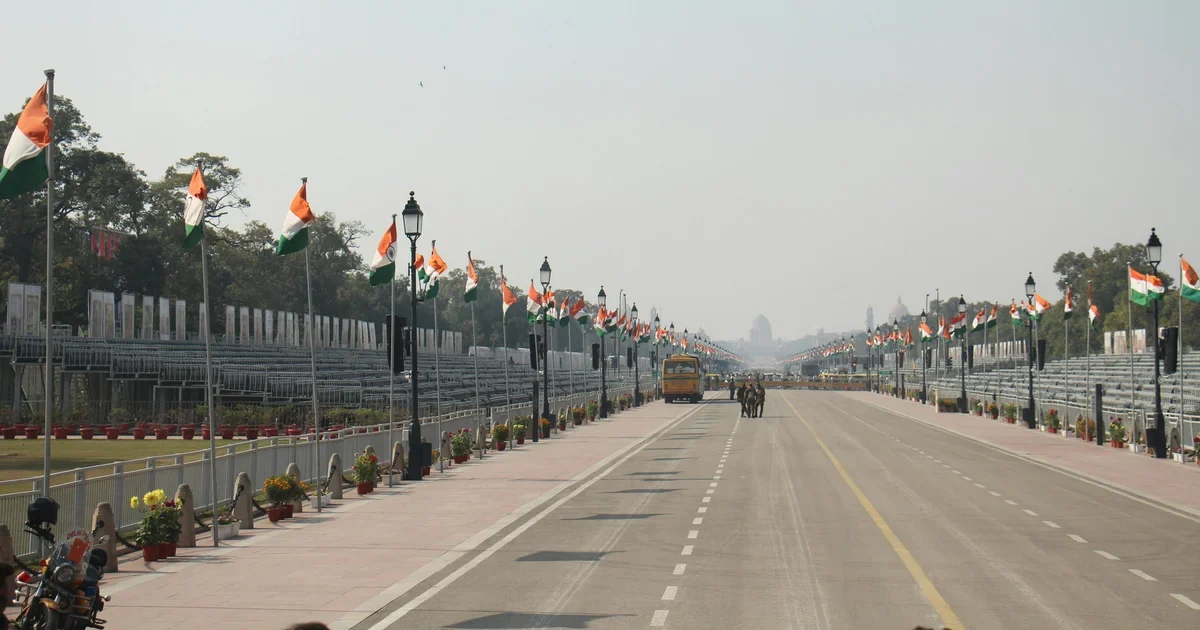
The swearing-in ceremony on 26 January 1950 was followed by a parade. The Republic Day parade has been held every year since, typically on Kartavya Path (formerly Rajpath) in New Delhi. The parade showcases India’s military strength, cultural diversity, and national achievements. The Chief Guest at the first Republic Day parade was President Sukarno of Indonesia.
What the Constitution Gave India
The Constitution of India did several things simultaneously that no single document had ever attempted for India before. It abolished untouchability and made its practice a punishable offence under Article 17. It guaranteed freedom of speech and expression, freedom of religion, the right to equality before law, and the right against exploitation. It set up the framework for a secular state in which no religion would have official primacy.
The Directive Principles of State Policy, laid out in Part IV of the Constitution, articulated the social and economic goals the state was expected to pursue. These included equal pay for equal work, adequate means of livelihood, the right to work, education, and public assistance, and the promotion of cottage industries. While these principles were not justiciable, meaning courts could not compel the government to implement them, they provided a moral and legislative roadmap for governance.
The Constitution also established universal adult franchise immediately and without conditions. India became the first large democracy in the world to grant every adult citizen the right to vote from the very first election. In comparison, the United States, the United Kingdom, France, and most other democracies had introduced universal suffrage gradually, often excluding women, minorities, or the propertyless for decades before full inclusion. India’s first general election was held in 1951 and 1952, with around 173 million people eligible to vote.
Fundamental Rights: The Core of the Republic
Part III of the Constitution, containing Fundamental Rights, was the most debated portion of the document. The rights guaranteed included the right to equality (Articles 14-18), the right to freedom (Articles 19-22), the right against exploitation (Articles 23-24), the right to freedom of religion (Articles 25-28), cultural and educational rights (Articles 29-30), and the right to constitutional remedies (Article 32).
Article 32, described by Ambedkar as the heart and soul of the Constitution, gave citizens the right to directly approach the Supreme Court for the enforcement of their fundamental rights. This was a deliberate design choice: the framers did not want fundamental rights to be meaningless on paper. They built a direct judicial avenue to enforce them.
The Right to Information Act, passed decades later in 2005, drew its philosophical foundation from Article 19’s guarantee of freedom of speech and expression, which courts had interpreted to include the right to information from the state. This lineage from constitutional right to legislative implementation is how the republic’s founding document continues to shape India’s governance landscape.
The Republic in Its Global Context, 1950
When India became a republic on 26 January 1950, the world was in the grip of the Cold War. The Soviet Union and the United States were competing for influence across Asia, Africa, and Latin America. China had just completed its communist revolution in October 1949. Korea was less than six months away from war. Against this backdrop, India’s choice to be neither aligned with Washington nor Moscow was a significant declaration.
Nehru articulated the policy of non-alignment, which India pursued as a founding principle of its foreign policy. India became a founding member of the Non-Aligned Movement, which formally came into being at the Bandung Conference in 1955. The republic’s founding thus had a geopolitical dimension: India saw itself as a leader of the newly independent world, a model of decolonization that chose democracy over one-party rule.
In 1950, India had a population of approximately 359 million people. Literacy stood at around 18 percent. Life expectancy at birth was approximately 32 years. Per capita income was among the lowest in the world. The challenges facing the new republic were extraordinary. The partition of 1947 had caused the largest mass migration in human history, with an estimated 10 to 20 million people displaced and between 200,000 and 2 million killed in the violence. The republic was born carrying that wound.
The Reformers Who Made the Republic Possible
India’s republic did not emerge from a single moment of political will. It was the product of at least a century of social reform movements that challenged the structural barriers within Indian society. Any honest account of how India became a republic must include the reformers who prepared the ground for a constitution that guaranteed equality.
Jyotirao Phule, born in 1827, challenged the caste order and opened schools for girls and lower-caste students in the 1840s, decades before any government education policy addressed these communities. Savitribai Phule, his wife and collaborator, became India’s first female teacher and ran schools for girls from communities that had been denied education for generations. Their work prefigured Article 21A, which eventually made education a fundamental right.
Ram Mohan Roy had earlier challenged sati and advocated for women’s education in the early nineteenth century. Gopal Krishna Gokhale advocated for free and compulsory elementary education as early as 1911 in the Imperial Legislative Council. The social reform tradition fed directly into the constitutional vision of an India where caste, religion, and gender would not determine a citizen’s legal standing.
Ambedkar himself had converted to Buddhism on 14 October 1956, months before his death in December that year, taking with him 600,000 followers in the largest mass religious conversion in the twentieth century. He described his conversion as a return to a faith rooted in reason and equality. This act, coming after he had already given India its Constitution, underlined his view that the republic’s written commitments needed to be backed by a social revolution in values.
Republic Day Through the Decades
The Republic Day parade has evolved considerably since 1950. The first parade took place on a route that ran from Irwin Amphitheatre, now Rajpath, past the India Gate. The parade grew in scale and complexity over the decades. Military tableaux, civilian floats from each state, performances by schoolchildren, fly-pasts by the Indian Air Force, and displays of missile systems all became part of the annual spectacle. The parade’s route was renamed Kartavya Path in 2022.
The tradition of inviting a foreign head of state or government as the Chief Guest was established from the very first Republic Day. Sukarno of Indonesia in 1950 was followed by Queen Elizabeth II in 1961, President John F. Kennedy’s invitation was declined but Vice President Lyndon Johnson attended in 1961, and over the decades, leaders from the United States, Russia, China, France, Japan, and neighbouring South Asian countries have graced the ceremony.
The parade also serves as a platform for projecting India’s military capabilities. The display of missiles, tanks, aircraft, and naval vessels has grown more sophisticated over the decades, reflecting India’s defence modernisation. The Rajpath parade is complemented by similar events in each state capital, where the Chief Minister unfurls the flag and reviews the state parade.
The Constitution as a Living Document
India’s Constitution has been amended 106 times as of 2024. The amendment process, set out in Article 368, requires a two-thirds majority in both Houses of Parliament, and in some cases, ratification by at least half of the state legislatures. The most significant amendments include the 1st Amendment (1951), which added restrictions to free speech and introduced the concept of land reform; the 42nd Amendment (1976), which added “Socialist” and “Secular” to the Preamble during the Emergency; and the 44th Amendment (1978), which reversed several Emergency-era changes.
The Supreme Court of India has also shaped the Constitution through interpretation. In the Kesavananda Bharati case of 1973, a thirteen-judge bench ruled by a 7-6 majority that Parliament cannot amend the basic structure of the Constitution. This basic structure doctrine became the cornerstone of India’s constitutional jurisprudence. The doctrine held that democracy, secularism, federalism, judicial independence, and fundamental rights were part of a basic structure that could not be destroyed even by a constitutional amendment.
What Republic Day Means in 2026
India celebrated its 77th Republic Day on 26 January 2026. The republic is now 76 years old. In those seven decades, India has conducted sixteen general elections under universal adult franchise, all peaceful transfers of power included. It has a free press, an independent judiciary that has on multiple occasions ruled against the government in power, and a civil society tradition that stretches from the independence movement to the present day.
The contradictions Ambedkar identified in 1949 have not been fully resolved. India’s economic inequality remains among the steepest in the world. The gap between constitutional promise and lived reality for Dalit, tribal, and other marginalised communities is measurable in literacy rates, land ownership, income, and access to justice. At the same time, the Constitution has been used repeatedly as a tool by citizens seeking to hold the state accountable. PILs, writ petitions, and constitutional litigation have changed policy, overturned administrative decisions, and protected individuals from state overreach.
Republic Day in 2026 is also observed against the backdrop of India’s emergence as the world’s fifth-largest economy, its leadership in the G20, and its growing role in global diplomacy. The republic that was born poor, partitioned, and illiterate has become the most populous country in the world and one of its fastest-growing major economies. These achievements, whatever their uneven distribution, are built on the institutional foundation laid on 26 January 1950.
Key Facts at a Glance
- Date: India became a republic on 26 January 1950 at 10:18 AM.
- First President: Dr. Rajendra Prasad, sworn in on 26 January 1950.
- Constitution adopted: 26 November 1949 by the Constituent Assembly.
- Members who signed: 284 members signed the Constitution on 24 January 1950.
- Constitutional articles at adoption: 395 articles in 22 parts with 8 schedules.
- Constituent Assembly first sitting: 9 December 1946.
- Drafting Committee Chairman: Dr. B.R. Ambedkar, appointed 29 August 1947.
- Amendments proposed: 7,635 total, 2,473 discussed in assembly.
- First Republic Day Chief Guest: President Sukarno of Indonesia.
- Significance of the date: 26 January 1930 was the first Purna Swaraj Day observed by the Indian National Congress.
- Constitutional amendments to date: 106 (as of 2024).
- India’s population in 1950: Approximately 359 million.
- Literacy rate in 1950: Approximately 18 percent.
The Preamble: Still the North Star
If there is one passage every Indian should know by heart, it is the Preamble to the Constitution. At the 2026 Republic Day ceremony, as in every year since 1950, the Preamble was read aloud at schools, government offices, and public gatherings across the country. The words are simple. The ambition they express is not.
Justice. Liberty. Equality. Fraternity. Four words arranged as a compass. Each one pointing toward a direction the republic has not yet fully reached but has never officially abandoned. That gap between the constitutional ideal and the daily reality is not evidence of the Constitution’s failure. It is the agenda for each succeeding generation.
When Ambedkar placed his pen on that document, he understood that he was not writing a conclusion. He was writing a beginning. Republic Day, every year, is the date on which India renews that beginning.
Featured image: A Republic Day parade scene in New Delhi. Photo by Unsplash. Used under the Unsplash License.
What you can do
- Share the evidenceSend this to one person who should know about governance.Share on WhatsApp
- Give an afternoonTeach, mentor, clean up, or lend your professional skills.Ways to volunteer
- Tell us what's missingKnow a story, a fact we got wrong, or a solution worth spotlighting?Suggest a story
Politically neutral. Every claim sourced. Report a correction.

No comments yet