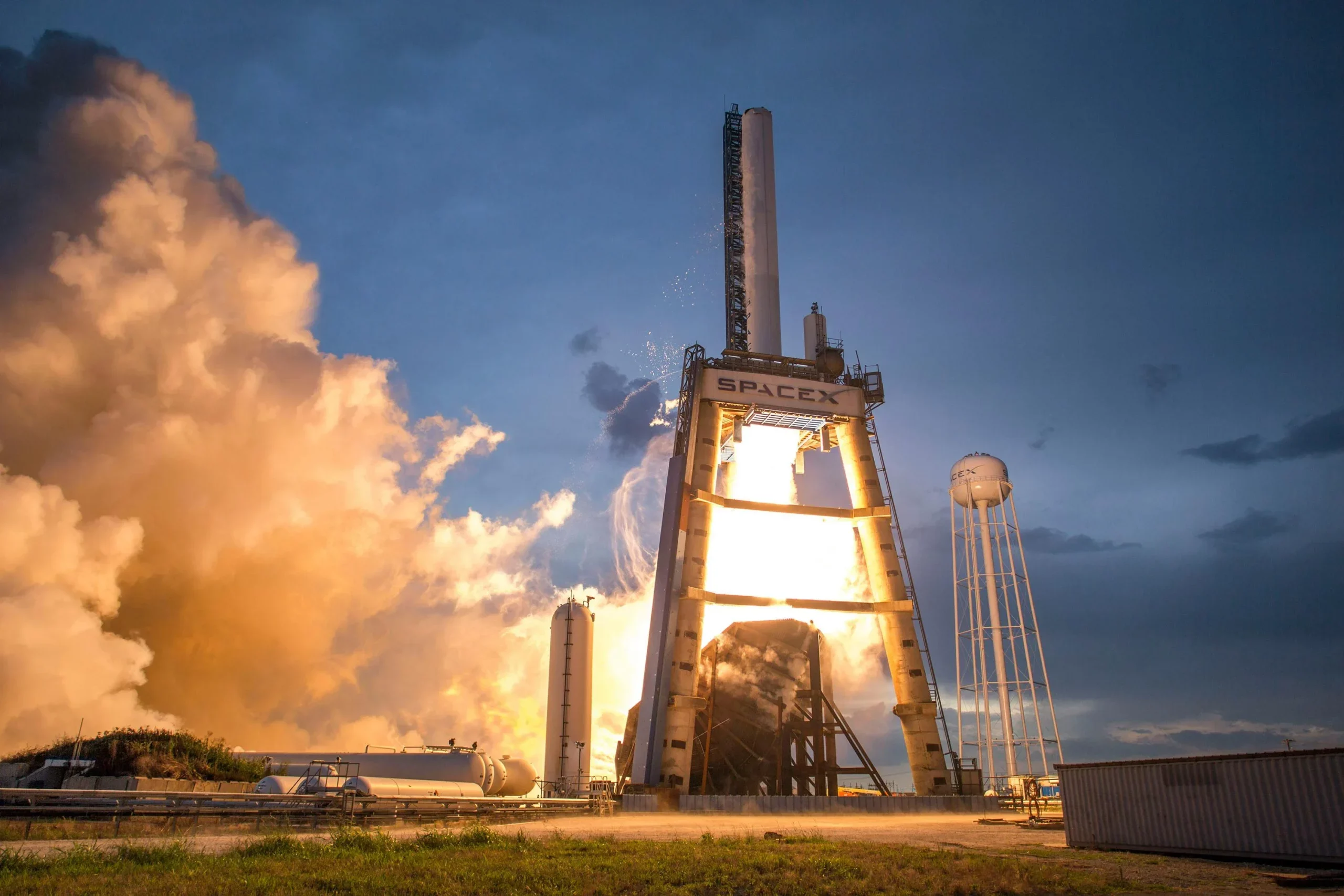
Vikram Sarabhai: The Night They Launched a Rocket from a Church
On 21 November 1963, Indian scientists launched a NASA-supplied Nike-Apache sounding rocket from a church vestry at Thumba, Kerala, led by Vikram Sarabhai.
The Scene
November 21, 1963. Thumba, a fishing village on the coast of Kerala, just south of Thiruvananthapuram. The Arabian Sea stretches grey and endless to the west. Coconut palms line the shore. Fishing boats are pulled up on the sand. And in the converted vestry of the St. Mary Magdalene Church, a team of Indian scientists is preparing to launch a rocket.
The rocket is a Nike-Apache sounding rocket, supplied by NASA as part of a cooperation agreement. It stands nine metres tall. By the standards of what America and the Soviet Union are launching in 1963, intercontinental ballistic missiles, manned capsules, satellites, it is tiny. It will not reach orbit. It will not carry a payload. It will fly to an altitude of 200 kilometres, release sodium vapour to study the upper atmosphere’s wind patterns, and fall into the sea. The entire flight will last about six minutes.
But the man standing behind this launch treats it as though India’s future depends on it. Because it does.
His name is Vikram Ambalal Sarabhai. He is forty-four years old. He is the son of one of India’s wealthiest industrial families, the Sarabhais of Ahmedabad, whose textile mills employ thousands. He holds a PhD in cosmic ray physics from Cambridge. He could be running a business empire. He could be living in comfort in Ahmedabad or London. Instead, he is standing on a beach in Kerala, supervising a rocket launch from a church.
The church was not chosen for symbolism, though the symbolism is hard to ignore. Thumba was selected because it sits near the magnetic equator, the optimal location for studying the equatorial ionosphere. The church and its buildings were the only structures in the area large enough to serve as a workshop, a laboratory, and a launch control centre. The Bishop of Thiruvananthapuram, Reverend Peter Bernard Pereira, agreed to hand over the church and its grounds after Sarabhai personally visited him and explained what India was trying to do.
That conversation deserves its own monument. A Cambridge-educated physicist from a Jain industrialist family sits in the bishop’s house in Thiruvananthapuram and tells a Catholic bishop that India needs his church to launch rockets. The bishop asks why. Sarabhai explains: India is a poor country with enormous problems, communications, weather prediction, natural resource mapping, education. Satellites can help solve these problems. But before India can build satellites, it needs to understand the upper atmosphere. And before it can study the upper atmosphere, it needs to launch rockets. And to launch rockets, it needs this church.
The bishop gives him the church. The parishioners are relocated. The confessional becomes a workshop. The bishop’s house becomes the office of the director. The cattle shed becomes a laboratory. The first rocket parts are transported on the back of a bicycle. A hydrogen-oxygen payload is carried on the head of a technician who walks to the launch pad along a dirt path shared with fishermen.
This is not how a space programme is supposed to begin. The Americans have Cape Canaveral. The Soviets have Baikonur. India has a church, a bicycle, and a fishing village.
At 6:25 PM on November 21, 1963, the Nike-Apache lifts off from Thumba. It flies for six minutes. The sodium vapour experiment works. The data is good. The rocket falls into the sea. The scientists cheer.
India has entered the space age.
The Backstory
Vikram Sarabhai was born on August 12, 1919, in Ahmedabad, into a family that was, by any measure, extraordinary. The Sarabhais were Jain industrialists who ran some of India’s largest textile mills. But unlike most industrial families of the era, they were also intellectuals, philanthropists, and patrons of culture. Vikram’s mother, Sarla Devi, hosted Rabindranath Tagore, Jawaharlal Nehru, and Mahatma Gandhi at the family home. Education was not just valued, it was the family religion.
Vikram showed scientific aptitude early. He studied at Gujarat College in Ahmedabad, then at Cambridge University, where he worked under the Nobel laureate C.V. Raman at the Indian Institute of Science before going to the Cavendish Laboratory. His doctoral thesis, completed in 1947, was on cosmic rays in tropical latitudes, research that would later inform his understanding of the upper atmosphere and, eventually, lead him to space.
He could have stayed in England. Cambridge was offering positions. The scientific establishment was welcoming. But 1947 was the year India became independent, and Sarabhai, like Ramanujan before him, like Homi Bhabha, like hundreds of brilliant Indians who chose their country over their careers, went home.
He returned to an India that was desperately poor, newly independent, and facing challenges that seemed insurmountable. Four hundred million people. Eighty percent illiterate. Life expectancy of 32 years. No industrial infrastructure to speak of. A GDP per capita lower than most of sub-Saharan Africa. The country needed food, medicine, roads, schools. It did not, by any conventional analysis, need a space programme.
Sarabhai’s genius was to see that the conventional analysis was wrong.
His argument was radical and simple: space technology was not a luxury for rich nations. It was a necessity for poor ones. India was too large, too geographically diverse, and too desperately in need of rapid development to rely on ground-based infrastructure alone. Satellites could provide weather forecasting for farmers who lost crops to unpredicted monsoons. Satellites could provide communications to villages that had no telephone lines and wouldn’t get them for decades. Satellites could map natural resources, water tables, mineral deposits, forest cover, faster and cheaper than any ground survey.
“There are some who question the relevance of space activities in a developing nation,” Sarabhai wrote in a statement that has become the founding charter of Indian space policy. “To us, there is no ambiguity of purpose. We do not have the fantasy of competing with the economically advanced nations in the exploration of the moon or the planets or manned space-flight. But we are convinced that if we are to play a meaningful role nationally, and in the community of nations, we must be second to none in the application of advanced technologies to the real problems of man and society.”
This was the vision: space for development, not space for prestige. Every rupee spent on rockets should return tenfold in services for the poor. The space programme would justify itself not by planting flags on other worlds but by improving life on this one.
The Turning Point
In 1962, Sarabhai established the Indian National Committee for Space Research (INCOSPAR), the precursor to ISRO. His first challenge was not scientific but political: convincing the Indian government, which was spending every available rupee on food imports and border defence (the 1962 war with China was a national trauma), that space research was worth funding.
Nehru, to his credit, understood. He had supported Homi Bhabha’s nuclear programme on similar logic, that a poor country needed advanced science precisely because it was poor, not despite it. Nehru gave Sarabhai his backing, though the budget was modest by any standard.
With minimal funding and no existing infrastructure, Sarabhai had to build everything from scratch. The Thumba Equatorial Rocket Launching Station (TERLS) was his first creation, the church, the bicycle, the fishing village. But Thumba was just the beginning.
In 1965, he established the Space Science and Technology Centre (SSTC) in Thiruvananthapuram, which would eventually become the Vikram Sarabhai Space Centre (VSSC), India’s primary rocket development facility. He created the Experimental Satellite Communication Earth Station at Ahmedabad. He planned the Satellite Instructional Television Experiment (SITE), a programme that would use a NASA satellite to beam educational television programmes directly to rural villages across India.
SITE, which was finally executed in 1975-76 (after Sarabhai’s death), was one of the most ambitious educational technology experiments ever attempted. For one year, 2,400 villages across six Indian states received television broadcasts covering agriculture, health, family planning, and national integration, directly from a satellite, bypassing the need for ground-based television infrastructure that India didn’t have and couldn’t afford. Farmers who had never seen a television set received direct-to-village broadcasts about crop rotation, weather patterns, and new agricultural techniques.
The experiment proved Sarabhai’s thesis: satellite technology could reach places that roads and telephone lines couldn’t. The cost per village was a fraction of what ground infrastructure would have required. SITE demonstrated that space was not a rich country’s toy but a poor country’s shortcut.
The Institution Builder
What separates Sarabhai from many brilliant scientists is that he didn’t just do science, he built institutions. He understood that India’s scientific future depended not on individual genius but on systems that could nurture thousands of scientists across generations.
The list of institutions Sarabhai founded or co-founded is staggering:
- Physical Research Laboratory (PRL), Ahmedabad, India’s premier space and physics research institute, founded 1947
- Indian Institute of Management (IIM), Ahmedabad, Co-founded in 1961 with Harvard Business School. Now India’s top business school.
- Community Science Centre, Ahmedabad, India’s first interactive science museum for the public
- Darpana Academy of Performing Arts, Founded with his wife Mrinalini, a classical dancer, because Sarabhai believed science and art were inseparable
- ATIRA (Ahmedabad Textile Industry’s Research Association), Bringing scientific research to India’s textile industry
- Operations Research Group (ORG), India’s first market research firm
- Indian Space Research Organisation (ISRO), Established in 1969, with Sarabhai as its founding chairman
The range is telling. A space scientist who founded a business school, a textile research lab, a performing arts academy, and a science museum was not a specialist. He was a systems thinker, someone who understood that India’s development required not just technology but management, not just engineering but culture, not just rockets but the human infrastructure to make rockets meaningful.
He recruited brilliantly. Many of the scientists who built ISRO into the powerhouse it is today were personally identified and mentored by Sarabhai. A.P.J. Abdul Kalam, who would become India’s Missile Man and eventually President, was a young engineer whom Sarabhai spotted, encouraged, and gave responsibility to far beyond his age and experience. Satish Dhawan, who succeeded Sarabhai as ISRO chairman and led the organisation through its most critical growth phase, was another Sarabhai protégé.
The Ripple Effect
On December 30, 1971, Vikram Sarabhai died in his sleep at a hotel in Thiruvananthapuram. He was fifty-two years old. The cause was cardiac arrest. He had been working, as always, on multiple projects simultaneously, the SLV (satellite launch vehicle) programme, the satellite communications project, and the planning of what would become the Indian Remote Sensing programme.
He did not live to see India launch its first satellite (Aryabhata, 1975), its first indigenous launch vehicle (SLV-3, 1980), its first operational communications satellite (INSAT-1B, 1983), or any of the achievements that built ISRO into the organisation that could send a probe to Mars for less than the budget of a Hollywood movie.
But every single one of those achievements was built on the foundation Sarabhai laid. The frugal engineering philosophy, achieving world-class results at a fraction of the cost, was Sarabhai’s philosophy. The focus on applications over exploration, weather satellites, communication satellites, earth observation, was Sarabhai’s priority. The democratic ethos of space for the common citizen, not for generals or glory, was Sarabhai’s vision.
Consider what ISRO has become:
- Mars Orbiter Mission (Mangalyaan, 2014), India’s first Mars probe, successful on the first attempt. Budget: $74 million, less than the movie Gravity.
- Chandrayaan-3 (2023), India became the fourth country (and the first to land near the lunar south pole) to soft-land on the Moon.
- 104 satellites in a single launch (2017), A world record at the time, achieved by the PSLV rocket.
- NavIC, India’s own satellite navigation system, reducing dependence on American GPS.
- INSAT/GSAT series, The communications satellites that enable everything from DTH television to disaster warnings across India.
The comparison between ISRO and NASA reveals the legacy of Sarabhai’s frugal philosophy, India achieves space milestones at a fraction of what other nations spend because the culture Sarabhai created valued resourcefulness over resources.
All of this traces back to a church in Thumba, a bicycle, and a man who believed that the most impoverished country in the world needed to reach for the stars, not because it was rich enough to afford the dream, but because it was poor enough to need it.
Sarabhai’s legacy is not just ISRO. It is the idea that a developing country does not have to wait until it is wealthy to pursue advanced science. That the purpose of technology is not national prestige but human welfare. That the most patriotic thing a scientist can do is build institutions that will outlast him.
He built institutions that outlasted him by fifty years and counting. The rocket that launched from a church in 1963 was the ancestor of the rocket that reached Mars in 2014. The bicycle that carried rocket parts to the launch pad was the beginning of a logistics chain that now launches commercial satellites for dozens of countries. The fishing village that became a launch station is now the Thumba International Space Museum, and the church has been restored as the kind of monument to learning that Sarabhai would have appreciated.
India’s space programme has sent probes to the Moon and Mars, launched hundreds of satellites, and built a commercial launch business that competes with SpaceX. None of it was inevitable. All of it was the consequence of one man’s conviction that a poor country’s most urgent need is ambition.
“We do not have the fantasy of competing with the economically advanced nations in the exploration of the moon or the planets. But we are convinced that if we are to play a meaningful role nationally, and in the community of nations, we must be second to none in the application of advanced technologies to the real problems of man and society.”, Vikram Sarabhai
This article is part of unite4india’s “Builders of Modern India” series, cinematic stories of the people who shaped the nation.
What you can do
- Share the evidenceSend this to one person who should know about this issue.Share on WhatsApp
- Give an afternoonTeach, mentor, clean up, or lend your professional skills.Ways to volunteer
- Tell us what's missingKnow a story, a fact we got wrong, or a solution worth spotlighting?Suggest a story
Politically neutral. Every claim sourced. Report a correction.

No comments yet