Road Deaths in India: 1.77 Lakh a Year and What Cuts Them
India lost about 1.77 lakh people on its roads in 2024, most of them riders, pedestrians and young men. Here is what causes the deaths and what has worked.
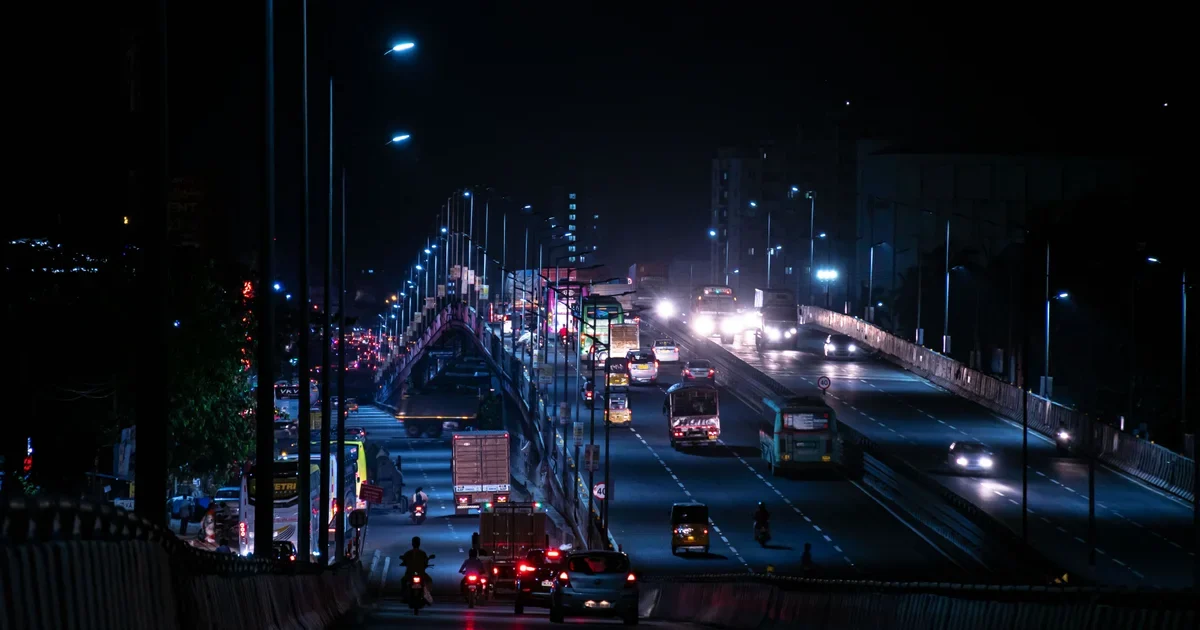
Photo by PRETTY PRASHANTH on Pexels
In this story
How many people die on India’s roads, and who are they?
About 1.77 lakh people died in road crashes in India in 2024, according to the Ministry of Road Transport and Highways (MoRTH) report Road Accidents in India, summarised by ETV Bharat. That is roughly 485 deaths a day, or one person every three minutes. The report counted about 4.88 lakh crashes in the year. The year before, police records showed 4,80,583 crashes and 1,72,890 deaths, so the toll has been climbing, not falling.
Numbers this large lose their meaning quickly. A better way to see them is to ask who is in the statistic. The people who die on Indian roads are mostly not the people we picture in a car pile-up on an expressway.
Who | Share of deaths, 2024 | Source |
|---|---|---|
Two-wheeler riders and pillion passengers | 46.2% | MoRTH, via Policy Edge |
Pedestrians | 20.6% | MoRTH, via Policy Edge |
People aged 18 to 45 | 66.1% | MoRTH, via Policy Edge |
Deaths on rural roads | 70.8% | MoRTH, via Policy Edge |
Two-wheeler riders and pedestrians together make up more than two-thirds of all road deaths. These are people on the least protected end of traffic, with no steel frame around them. Two out of three victims are in the age group that earns, supports children and ageing parents, and pays most of the household bills. When a 28-year-old rider dies, the loss is not one life. It is often the income of a whole family.
The National Crime Records Bureau counts road deaths separately from police first information reports, and its shares differ a little. For 2024 it reported that two-wheelers accounted for 48.3 per cent of road deaths and pedestrians for 14.7 per cent, as reported by Deccan Chronicle. The sources disagree on the exact split. They agree on the story: riders first, pedestrians second, working-age adults throughout.
Is India worse than other countries?
The World Health Organization’s 2023 global status report estimated that about 1.19 million people die on roads worldwide every year, and that the burden falls hardest on low and middle income countries. India reports one of the largest absolute tolls in the world. Counting is not even across countries, and many deaths in India are thought to go unrecorded, so the real figure may be higher than the official one.
What causes the deaths?
Road deaths are rarely a single mistake. They come from a chain: a vehicle going too fast, a rider without a helmet, a road with no footpath, and a hospital too far away. Remove any link and the outcome often changes. That is good news, because it means there are many places to act.
Is speed the biggest factor?
Yes. MoRTH attributes nearly 70 per cent of crashes, injuries and deaths to over-speeding. Speed matters for a simple reason of physics. The energy of a crash rises with the square of speed, so a vehicle at 60 kilometres an hour hits with four times the energy of one at 30. A pedestrian hit at 30 kilometres an hour survives most of the time. At 50 the odds shift sharply against them.
Speed also interacts with design. A highway built for 100 kilometres an hour that runs straight through a village market, with no service road or crossing, turns every local errand into a gamble. India’s national highways are a small share of the road network but carry a disproportionate share of deaths, because speed and mixed traffic meet there.
How much do helmets and seat belts matter?
A great deal. The 2023 MoRTH report recorded 54,568 deaths of two-wheeler riders and passengers who were not wearing helmets, and 16,025 deaths of people not wearing seat belts, as summarised in a PTI report on the data. Among the helmet-less dead, 39,160 were riders and 15,408 were pillion passengers. Pillion riders are the group least likely to wear a helmet, and a family of four on one scooter often has two or three unprotected heads.
Global evidence on helmets is strong. A proper helmet reduces the risk of death for a rider substantially and the risk of severe head injury even more. A seat belt cuts the risk of death for a front-seat occupant by roughly half. These are among the cheapest safety devices in existence. The problem is not knowledge. It is habit, enforcement and the quality of the helmet itself, since a cheap half-helmet without a certification mark offers little protection.
Why are pedestrians so exposed?
Many Indian roads were designed around vehicles, with the pedestrian as an afterthought. Footpaths are broken, taken over by parked vehicles or hawkers, or simply missing. Crossings are far apart, so people cross where it is convenient and dangerous. Children walking to school, older people crossing a state highway and migrant workers walking along an expressway shoulder are all in the same position: sharing a lane with a truck.
Pedestrian deaths are also a health inequality. People who walk are, on the whole, poorer than people who drive. Road design that ignores walkers is design that ignores the poor. This is also why the story links to the question of how cities spend their money. Our piece on why Indian municipalities cannot fund the roads they promise shows how thin local budgets leave footpaths and crossings unbuilt.
What about drink driving, fatigue and phones?
Drink driving, truck driver fatigue and distraction from mobile phones all add to the toll. Long-haul drivers often work very long hours under delivery pressure. Night driving on poorly lit highways, parked trucks with no reflectors and wrong-side driving are common contributors that rarely make headlines but appear again and again in crash reports.
Why do road conditions matter so much?
Poorly designed junctions, missing medians, unmarked speed breakers and black spots (stretches where crashes repeat) are engineering failures that can be fixed. A black spot is a measurable thing: a stretch of road where several serious crashes happen within a few years. Identify it, correct it, and the deaths stop. This is the logic behind some of the best results India has seen, which we turn to below.
Why does a crash so often become a death?
The first hour after a serious injury is called the golden hour. Heavy bleeding, a blocked airway or a head injury can kill within minutes, and treatment given in that window changes the outcome more than almost anything done later. In many countries a trauma victim reaches a trained team within minutes. In much of India, the victim lies on the roadside while bystanders hesitate.
Bystanders hesitated for a reason. For years, people who took an injured stranger to hospital risked being detained for questioning, asked to pay deposits or dragged into court cases as witnesses. Hospitals sometimes refused to treat patients without payment or without a police report. Many people decided it was safer to walk away.
What does the law say now about helping a crash victim?
The Supreme Court addressed this directly in 2016 in the case brought by the SaveLIFE Foundation, issuing guidelines to protect Good Samaritans. Parliament then wrote the protection into law through the Motor Vehicles (Amendment) Act, 2019, which added section 134A. A person who helps an injured road user in good faith is not liable for civil or criminal action arising from the help. Hospitals cannot demand payment before giving emergency care, and bystanders cannot be forced to reveal their identity.
In 2025 the Ministry notified a cashless treatment scheme. It covers treatment up to Rs 1.5 lakh per person, per accident, for up to seven days after the crash, for victims of any motor vehicle accident, whether or not they have health insurance, as described by The Hitavada. The National Health Authority runs it with empanelled hospitals, and claims are paid from the Motor Vehicle Accident Fund. The scheme goes to the heart of the delay problem, since a hospital that knows the bill will be paid has no reason to hesitate at the door.
A law that exists on paper still has to be known. Surveys by road safety groups have repeatedly found that many ordinary people do not know the Good Samaritan protection exists. A rule that nobody has heard of cannot change what a bystander does at 11 at night on a highway.
What has actually worked?
India has examples of both failure and success. The most useful ones are those where deaths fell and stayed down.
What did Tamil Nadu do?
Tamil Nadu is the best-known success story. After 2016, the state treated road deaths as a managed problem. Police and the highways department mapped crash locations on a grid and recorded them on the state’s geographical information system. Black spots got speed breakers, signs, lighting and more patrols. Ambulances of the 108 service were positioned near the most dangerous stretches, and the 108 app let callers share their location without having to describe it. Reported response times came down to about 13 minutes in cities and 17 minutes in rural areas, according to an account in The Better India.
The state also funded a scheme, Innuyir Kaappom Thittam, with its Nammai Kaakkum 48 programme, which pays for the first 48 hours of emergency treatment for road crash victims. Reports from the period, summarised by The Swaddle, say road deaths fell by more than 54 per cent from the 2016 baseline, beating a Supreme Court committee target of a 50 per cent cut by 2020.
An honest reading needs a caution. MoRTH data for 2024 shows Tamil Nadu recorded the highest number of crashes in the country, 67,526, and 18,449 deaths, the second highest, as reported by The South First. Part of this is better recording. A state that counts every crash will look worse than one that hides them. Part of it is more vehicles and more travel. The lesson is not that Tamil Nadu solved the problem for good. It is that data, engineering, fast ambulances and funded emergency care together bent the curve, and that the gains need constant work to hold.
What changed under the Motor Vehicles (Amendment) Act, 2019?
The 2019 Act raised penalties for many offences, including helmet violations, drink driving and dangerous driving, added liability for contractors and road agencies when poor design causes a crash, and made the Good Samaritan protection statutory. It also required a Motor Vehicle Accident Fund and set up a framework for cashless treatment of victims during the golden hour. Higher fines can deter, but only if people believe they will be caught. The strongest evidence from around the world is that the certainty of enforcement matters more than the size of the fine. A modest fine collected every time works better than a huge fine collected rarely.
What is iRAD, and why does it matter?
The Integrated Road Accident Database (iRAD) is a national platform where police, highway engineers and hospitals record the details of each crash: the location, the road type, the vehicles, the cause and the injuries. The point is to replace guesswork with a map. If the database shows that six of last year’s twelve deaths on a particular stretch happened at one junction after dark, the fix becomes obvious. Its value depends entirely on the quality of the entries. Where officers fill in the form carefully, black spots emerge. Where they do not, the database stays empty.
Do helmets and seat belts get enforced?
Evidence from other countries suggests helmet use can go from patchy to near-universal within a few years when enforcement is steady, helmets are affordable and standards are checked. Cameras and automated challans can help, provided the fine reaches the right person and the system treats everyone alike. In India, enforcement runs into capacity limits: too few traffic police for the number of vehicles, and too many crashes to investigate properly.
What would a serious national effort look like?
The global model for this is the Safe System approach, backed by the World Health Organization and adopted in the United Nations decade of action for road safety. It starts from a simple admission: people make mistakes, so roads, vehicles and speeds should be designed so that a mistake does not cost a life. For India that translates into a handful of priorities.
- Slow the speeds where people live. Speed limits of 30 kilometres an hour near schools, markets and village stretches of highways, backed by physical measures like raised crossings and rumble strips, not just signs.
- Fix black spots on a schedule. Treat every high-crash stretch as a defect with a deadline, owner and budget, the way a utility treats a power outage.
- Build for walkers and cyclists. Continuous footpaths, safe crossings and protected lanes on every road that receives public money.
- Make helmets and seat belts normal. Certified helmets sold cheaply, school campaigns for children who ride pillion, and steady enforcement.
- Get the injured to care fast. Ambulances placed along the highways with the worst records, trauma centres within an hour of every major corridor and cashless care that hospitals trust.
- Count honestly. Complete, public, crash-level data so that citizens and researchers can see which stretches kill people.
None of this is a mystery, and much of it costs less than the economic damage of the deaths. The World Bank and Indian researchers have estimated that road crashes cost India a few per cent of GDP each year, though estimates vary and we do not quote a single figure here. What the numbers show is that prevention pays for itself.
What about vehicles themselves?
Vehicle safety has improved over the last decade. Rules now require airbags and anti-lock brakes on more vehicles, and crash-test ratings under the Bharat NCAP programme let buyers compare cars on safety. These gains reach car buyers first. The two-wheeler, which is most of India’s fleet and most of its victims, has seen fewer safety gains. Combined braking systems and anti-lock brakes on motorcycles are steps in the right direction, but a rider on a scooter remains exposed in a crash.
Public transport also plays a role in safety that is easy to miss. A city that moves people by bus and metro puts fewer riders on motorcycles. Our look at Curitiba’s bus rapid transit system describes how a mid-sized city can give people a fast, safe alternative to a two-wheeler.
Why do road rules feel optional?
There is a cultural layer that law alone cannot reach. Many Indians accept the risk of riding without a helmet for a short trip, jumping a signal when the road looks empty or overloading a vehicle. The same people complain loudly about the state of the roads. We explored this gap between demanding better services and following the rules those services rely on in Everyone Wants the System Fixed. Nobody Wants to Queue. Road safety is a place where the gap kills people. Cultural change is slow, but it has happened before with seat belts in Europe and with drink driving in many countries, usually after a mix of law, enforcement, public campaigns and stories from real families.
What can you do?
Road safety can feel like a problem only governments can fix. Individuals do matter, on the road and in their neighbourhoods.
- Wear a certified helmet every time, including for short trips, and make sure your pillion passenger wears one too. Check for the ISI mark.
- Insist on seat belts in the back seat as well as the front, and use proper child restraints for young children.
- Keep to the speed limit near schools, markets and residential streets, and slow down at night and in rain.
- Never drive after drinking, and never ride with someone who has been drinking. Plan a driver or a cab in advance.
- Learn the Good Samaritan law. If you see a crash, call 112 or the ambulance number, help if you safely can and know that the law protects you. You do not have to pay at the hospital and you do not have to give your name.
- Learn basic first aid. Pressing firmly on a bleeding wound and keeping an injured person still until help arrives can save a life. Local Red Cross and St John Ambulance units run short courses.
- Report a dangerous stretch. If a junction near you has repeated crashes, write to the local traffic police and the road-owning agency with the location, photographs and dates. Share it with your ward councillor or resident welfare association.
- Push for pedestrian space. Ask local bodies for footpaths, crossings and slower speeds near schools. Attend ward meetings and budget consultations.
- Support families and groups working on road safety, including survivor networks that help crash victims with legal and medical aid.
Frequently asked questions
How many people die on Indian roads every year?
MoRTH reported about 1.77 lakh deaths in 2024 and 1,72,890 in 2023, from police records. Actual deaths may be higher because not every crash is reported.
Who is most at risk?
Two-wheeler riders (46.2 per cent of deaths in 2024) and pedestrians (20.6 per cent), and people aged 18 to 45, who accounted for 66.1 per cent of deaths.
Does wearing a helmet really help?
Yes. In 2023, MoRTH recorded 54,568 deaths of riders and passengers who were not wearing a helmet. A certified, properly fastened helmet cuts the risk of head injury and death sharply.
Am I legally protected if I help an accident victim?
Yes. Section 134A of the Motor Vehicles Act, added in 2019 after a 2016 Supreme Court ruling, protects Good Samaritans from civil and criminal liability for helping in good faith. Hospitals cannot demand payment before emergency care.
What is the cashless treatment scheme for road accident victims?
Under a scheme in force from May 2025, victims of motor vehicle crashes can receive treatment up to Rs 1.5 lakh for up to seven days at empanelled hospitals without paying upfront, whether or not they have health insurance.
Did Tamil Nadu really cut road deaths?
Tamil Nadu reported a fall of more than half in road deaths from its 2016 level through data-led black spot fixes, ambulance placement and funded emergency care. Its 2024 numbers are high again, so the work needs to continue.
What is the golden hour?
It is the first hour after a serious injury, when fast treatment has the greatest chance of saving a life.
The bottom line
India does not lose 1.77 lakh people a year because of fate. It loses them to speed, unprotected bodies, roads built without people in mind and ambulances that arrive late. Each of those is a decision that someone made, and each can be made differently. States like Tamil Nadu have shown that data, engineering and fast emergency care can pull deaths down in a few years. The citizen’s part is smaller but real: a helmet, a seat belt, a phone call to 112, and a letter about the junction that keeps killing people.
Sources: Ministry of Road Transport and Highways, Road Accidents in India (2023 and 2024 editions, via the linked reports); National Crime Records Bureau, Accidental Deaths and Suicides in India 2024 (via Deccan Chronicle); World Health Organization, Global Status Report on Road Safety 2023; Supreme Court of India, SaveLIFE Foundation v. Union of India (2016); Motor Vehicles (Amendment) Act, 2019.
What you can do
- Share the evidenceSend this to one person who should know about governance.Share on WhatsApp
- Give an afternoonTeach, mentor, clean up, or lend your professional skills.Ways to volunteer
- Tell us what's missingKnow a story, a fact we got wrong, or a solution worth spotlighting?Suggest a story
Politically neutral. Every claim sourced. Report a correction.


No comments yet