ISRO Explained: Full Form, Headquarters, Centres and How It Is Organised
ISRO full form, headquarters in Bengaluru, all 13 centres and units, and how the Space Commission, Department of Space and ISRO fit together.
In this story
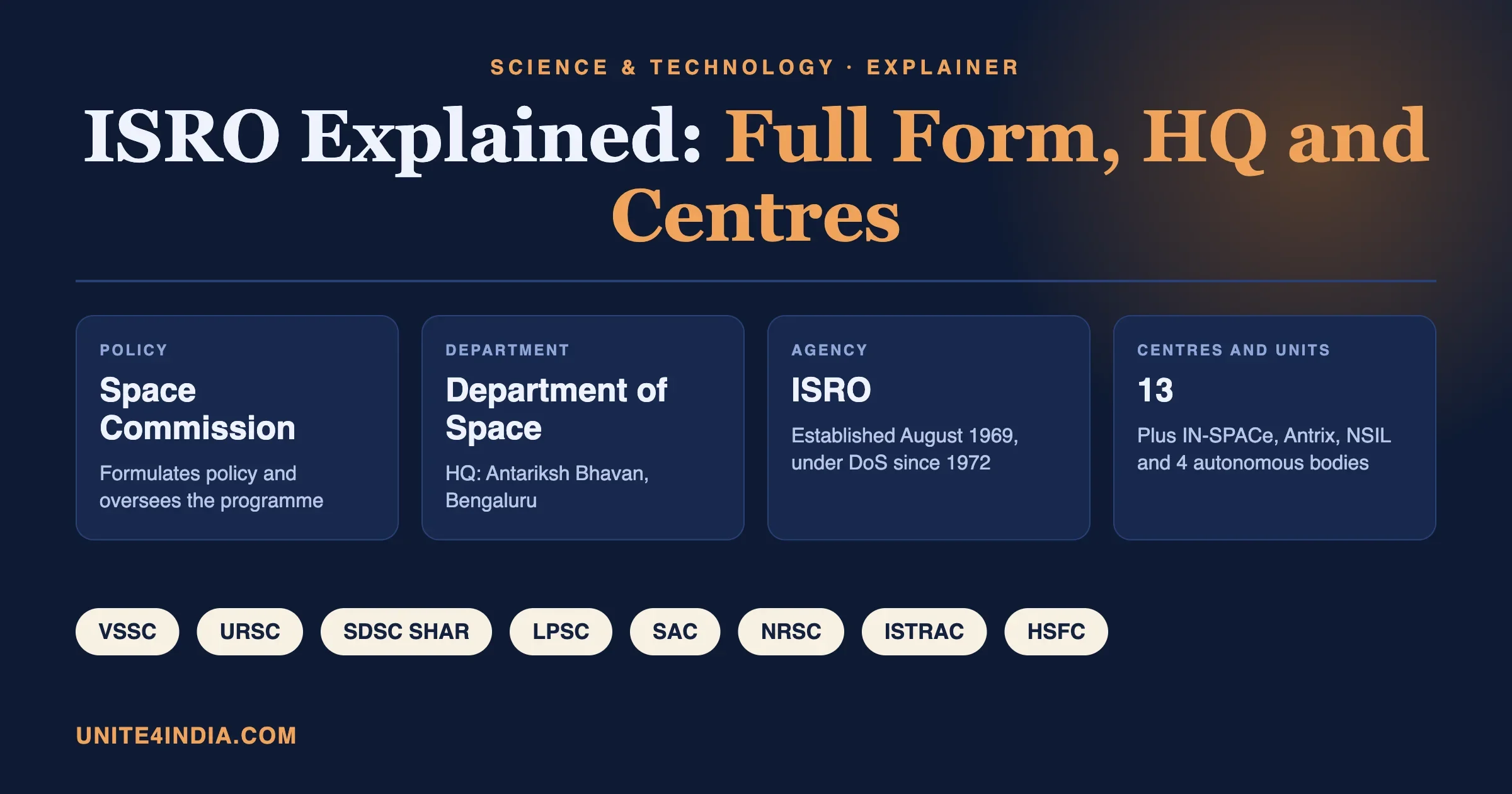
Short answer: the ISRO full form is Indian Space Research Organisation. Its headquarters is in Bengaluru, at Antariksh Bhavan on New BEL Road, and the same building holds the secretariat of the Department of Space. ISRO was set up in August 1969. It has 13 centres and units, and it works with a wider family of bodies that includes IN-SPACe, Antrix, NewSpace India Limited and four autonomous institutes. This guide explains what each one does, using ISRO’s own website.
ISRO full form and what the name means
ISRO is short for Indian Space Research Organisation. In Hindi it is Bharatiya Antariksh Anusandhan Sangathan. It is India’s national space agency. ISRO’s own site describes it as the space agency of India, involved in science, engineering and technology to harness the benefits of outer space for the country.
People often use “ISRO” and “Department of Space” as if they were the same thing. They are not. ISRO is the main executing agency. The Department of Space (DoS) is the government department that ISRO belongs to. We explain the difference below.
ISRO headquarters: where is it?
The headquarters of ISRO is in Bengaluru (Bangalore), Karnataka. The address on ISRO’s site is:
- Department of Space and ISRO Headquarters
- Antariksh Bhavan, New BEL Road
- Bangalore 560 231
The DoS secretariat and ISRO Headquarters are both in Antariksh Bhavan. The headquarters has programme offices that coordinate work across the whole system. These include satellite communication, earth observation, launch vehicles, space science, disaster management support, sponsored research, contracts, international cooperation, safety and reliability, publications, budget, civil engineering and human resource development.
Many people think ISRO is based at Sriharikota, because that is where rockets lift off. Sriharikota is the launch site, not the headquarters. We cover it in the centre list below.
A short history, from 1962 to 1972
ISRO’s site gives a clear timeline of how the organisation was built:
- 1962: The Indian National Committee for Space Research (INCOSPAR) was set up, and space activities began in the country. In the same year, work started on the Thumba Equatorial Rocket Launching Station near Thiruvananthapuram.
- August 1969: The Indian Space Research Organisation was established.
- June 1972: The Government of India formed the Space Commission and set up the Department of Space.
- September 1972: ISRO was brought under the Department of Space.
- 1992: Antrix Corporation was set up as a government-owned company to market space products and services.
For a longer story of how a rocket launched from a fishing village grew into Mars and Moon missions, see our piece on India’s space programme from bullock carts to Mars.
How ISRO is organised: three layers
It helps to think of the system in three layers.
Layer 1: The Space Commission sets policy
According to ISRO, the Space Commission formulates the policies and oversees how the Indian space programme is carried out. Its aim is to promote the development and use of space science and technology for the social and economic benefit of the country.
Layer 2: The Department of Space runs the programmes
The Department of Space has one main goal: to promote the development and application of space science and technology for all-round development of the nation. For that, it has built four main programmes:
- A launch vehicle programme, so India can launch its own spacecraft.
- The INSAT programme, for telecommunications, broadcasting, meteorology and education.
- A remote sensing programme, which uses satellite images for development work.
- Research and development in space science and technology, aimed at national development.
The department carries out these programmes mainly through ISRO, the Physical Research Laboratory, the National Atmospheric Research Laboratory, the North Eastern Space Applications Centre and the Semi-Conductor Laboratory. Antrix markets the products and services.
Layer 3: ISRO centres do the work
This is where rockets are designed, satellites are built, data is received and missions are flown. ISRO’s list names the headquarters plus 13 centres and units, and we describe each one next.
ISRO’s own news items also show that the head of ISRO holds three roles together: Chairman of ISRO, Secretary of the Department of Space and Chairman of the Space Commission. We do not name the current office-holder here, because the post changes over time. If you need the current name, ISRO’s website lists it.
ISRO centres and units: the full list
ISRO’s website lists these centres and units, with the location of each. The one-line roles are taken from each centre’s own page.
Centre or unit | Location | What it does |
|---|---|---|
Department of Space and ISRO HQ | Bengaluru | Policy, programme offices and coordination |
Vikram Sarabhai Space Centre (VSSC) | Thiruvananthapuram | Lead centre for launch vehicle design and development |
U R Rao Satellite Centre (URSC) | Bengaluru | Lead centre for building satellites; formerly ISRO Satellite Centre (ISAC) |
Satish Dhawan Space Centre (SDSC) SHAR | Sriharikota, Nellore district, Andhra Pradesh | India’s spaceport; launch base, solid propellant and range operations |
Liquid Propulsion Systems Centre (LPSC) | Thiruvananthapuram and Bengaluru | Liquid propulsion stages for launch vehicles |
ISRO Propulsion Complex (IPRC) | Mahendragiri, Tamil Nadu | Assembly, integration and testing of engines and stages |
ISRO Inertial Systems Unit (IISU) | Thiruvananthapuram | Inertial navigation systems, gyros and sensors |
Space Applications Centre (SAC) | Ahmedabad | Payloads and instruments for communication, navigation and remote sensing |
National Remote Sensing Centre (NRSC) | Hyderabad | Earth observation data reception, processing and disaster support |
ISRO Telemetry, Tracking and Command Network (ISTRAC) | Bengaluru | Tracking support for all ISRO satellite and launch missions |
Master Control Facility (MCF) | Hassan (Karnataka) and Bhopal (Madhya Pradesh) | Monitors and controls geostationary satellites |
Laboratory for Electro-Optics Systems (LEOS) | Bengaluru | Attitude sensors and optical systems |
Human Space Flight Centre (HSFC) | Bengaluru | Implements the Gaganyaan human spaceflight project |
Indian Institute of Remote Sensing (IIRS) | Dehradun | Education and training in remote sensing and geo-informatics |
The launch side: VSSC, LPSC, IPRC and SDSC
VSSC in Thiruvananthapuram is the lead centre for launch vehicle technology. It works on aeronautics, avionics, materials, mechanisms, propulsion, structures and reliability, and it designs, manufactures, analyses and tests subsystems for missions.
LPSC designs and builds the liquid propulsion stages for ISRO’s launch vehicles, plus valves, transducers and propellant management devices. It works from two campuses: Valiamala in Thiruvananthapuram, and Bengaluru.
IPRC at Mahendragiri tests and assembles engines and stages. It was formerly known as LPSC Mahendragiri and was raised to IPRC on 1 February 2014.
SDSC SHAR at Sriharikota is called the Spaceport of India. It has facilities for solid propellant processing, static testing of solid motors, launch vehicle integration and launch operations, and range operations including tracking and a mission control centre. ISRO’s page for the centre says it has two launch pads, from which PSLV and GSLV are launched. ISRO’s home page also links to a note on a Cabinet approval for a third launch pad, so the number of pads is changing.
The satellite side: URSC, LEOS, IISU and SAC
URSC, formerly ISAC, is the lead centre for building satellites. Its spacecraft serve communication, navigation, meteorology, remote sensing, space science and interplanetary missions. It has facilities to build satellites end to end.
LEOS is in Peenya Industrial Estate, Bengaluru, where India’s first satellite was fabricated in 1975, according to ISRO. It makes attitude sensors for low-earth, geostationary and interplanetary missions, and optical systems for remote sensing and weather payloads.
IISU designs inertial systems, which tell a rocket or satellite how it is moving and turning. These include navigation systems based on mechanical and optical gyros, rate gyro packages and accelerometer packages.
SAC in Ahmedabad builds instruments and payloads for space and for aircraft, mainly for communication, navigation and remote sensing. It also contributed to Chandrayaan-1 and the Mars Orbiter Mission.
The data and operations side: NRSC, ISTRAC, MCF and IIRS
NRSC in Hyderabad receives and processes satellite data and supports disaster management. Its ground station at Shadnagar, near Hyderabad, takes in data from Indian and foreign earth observation satellites.
ISTRAC provides tracking support for all satellite and launch vehicle missions of ISRO. It also runs mission operations for the operational remote sensing and scientific satellites, and gives telemetry, tracking and command services from lift-off until the satellite is placed in orbit.
MCF has two sites, Hassan in Karnataka and Bhopal in Madhya Pradesh. It monitors and controls ISRO’s geostationary satellites through the whole life of each one, including raising the orbit, testing the payload and manoeuvres to keep it in place.
IIRS in Dehradun trains people in remote sensing. It also hosts the Centre for Space Science and Technology Education in Asia and the Pacific, which is affiliated with the United Nations.
The human spaceflight side: HSFC
The Human Space Flight Centre was inaugurated on 30 January 2019 at the ISRO Headquarters campus in Bengaluru. ISRO says it implements the Gaganyaan project, which covers end-to-end mission planning, engineering systems for crew survival in space, crew selection and training, and work towards sustained human spaceflight.
The wider family: not ISRO, but part of the Department of Space
Several bodies work with ISRO but are not ISRO centres. ISRO’s site lists them under separate headings.
Body | Type | Location | Role |
|---|---|---|---|
IN-SPACe | Authorisation and promotion body | Ahmedabad | Listed on ISRO’s site as part of the Department of Space system |
Antrix Corporation Limited | Government company (CPSE) | Bengaluru | Markets space products and services |
NewSpace India Limited (NSIL) | Government company (CPSE) | Bengaluru | Listed on ISRO’s site as a Department of Space company |
Indian Institute of Space Science and Technology (IIST) | Autonomous body | Thiruvananthapuram | Undergraduate, postgraduate and doctoral programmes in space science and technology |
National Atmospheric Research Laboratory (NARL) | Autonomous body | Tirupati | Atmospheric research, technology for probing the atmosphere, weather and climate modelling |
North Eastern Space Applications Centre (NE-SAC) | Autonomous body | Ri Bhoi district, Meghalaya | Joint initiative of the Department of Space and the North Eastern Council to support the region using space technology |
Physical Research Laboratory (PRL) | Autonomous body | Ahmedabad | Basic research in physics, astronomy, earth, planetary and atmospheric sciences |
For how private firms now fit into this picture, read our explainer on India’s new space economy. For how ISRO’s budget and results compare with NASA’s, see ISRO vs NASA.
ISRO, DoS, IN-SPACe and NSIL: who does what?
- ISRO builds and flies. It designs rockets and satellites, runs launches and operates satellites in orbit.
- Department of Space is the parent department. It sets the programmes and holds the budget and the secretariat.
- Space Commission sets the policies and oversees them.
- Antrix was set up in 1992 to sell space products and services.
- NSIL and IN-SPACe appear on ISRO’s list of Department of Space bodies. ISRO’s own pages do not spell out their roles in the pages we read, so for exact rules check each body’s website.
How the centres fit together on a typical mission
A satellite mission needs almost every centre. This walk-through uses the roles above and does not describe one particular launch. It shows how the pieces connect from design to daily use.
- Design and build the rocket. VSSC leads the launch vehicle design. LPSC supplies the liquid propulsion stages, and IPRC at Mahendragiri tests and assembles engines and stages. SDSC SHAR produces solid propellant boosters.
- Build the satellite. URSC leads the satellite build and integration. SAC supplies the payloads, such as communication transponders and sensors. LEOS provides attitude sensors and optics, and IISU provides inertial systems and gyros.
- Launch. The rocket and satellite are integrated and launched at Sriharikota. ISTRAC gives tracking and command support from lift-off until the satellite is placed in orbit.
- Operate in orbit. For geostationary satellites, the Master Control Facility at Hassan and Bhopal controls the satellite for its whole life. ISTRAC runs mission operations for the operational remote sensing and scientific satellites.
- Use the data. NRSC receives and processes earth observation data. SAC builds many of the applications. IIRS trains the people who use the data.
A human spaceflight mission adds one more layer. The Human Space Flight Centre plans the mission end to end, builds the systems that keep a crew alive, and selects and trains the crew. That is why Gaganyaan sits in its own centre in Bengaluru and not inside one of the older ones.
Names and changes to watch for
ISRO’s pages show that names and units have changed over time, so older articles can confuse readers. The U R Rao Satellite Centre was formerly known as the ISRO Satellite Centre (ISAC). The ISRO Propulsion Complex was formerly LPSC Mahendragiri, and it was raised to its present name on 1 February 2014. The Human Space Flight Centre was inaugurated on 30 January 2019. Sriharikota’s centre carries the name of the scientist Satish Dhawan, and the Thiruvananthapuram centre carries the name of Vikram Sarabhai. If a news story uses an older name, match it to the current one in the table above.
A closer look at what the centres do
The one-line roles in the table hide a lot of detail. These points come from the centres’ own pages on isro.gov.in.
Sriharikota has a mandate with three parts
ISRO says the Satish Dhawan Space Centre has three jobs. First, it produces solid propellant boosters for ISRO’s launch vehicle programmes. Second, it provides the infrastructure to qualify subsystems and solid rocket motors and to carry out tests. Third, it provides launch base infrastructure for satellites and launch vehicles. It also has a separate launch pad for sounding rockets, which are small research rockets, and it handles the assembly, integration and launch of those rockets and their payloads.
The satellite centre has built more than 100 satellites
The U R Rao Satellite Centre says that since it began it has built more than 100 satellites for scientific, communication, navigation and remote sensing uses. Its integration and test unit, ISITE, has clean rooms and test equipment under one roof, including a 6.5 metre thermo vacuum chamber, a 29 ton vibration facility, a compact antenna test facility and an acoustic test facility. All communication and navigation spacecraft are assembled, integrated and tested there. ISRO also says many private and public sector firms now supply standard satellite hardware to the centre.
Ahmedabad builds the eyes and the radio links
The Space Applications Centre builds communication transponders for the INSAT and GSAT satellite series. ISRO says government and private users rely on them for VSAT, direct-to-home television, internet, broadcasting and telephones. The centre also designs optical and microwave sensors, image processing software and GIS software. Its earth observation applications cover geosciences, agriculture, environment and climate change, oceans, atmosphere, ice and water. It also runs nine-month postgraduate diploma courses for students from the Asia Pacific region, in satellite meteorology and communication.
Hyderabad turns satellite pictures into maps
NRSC does more than receive data. Its aerial services and digital mapping unit offers aerial photography, digital mapping, infrastructure planning, aeromagnetic surveys, and large-scale base, topographic and cadastral maps. Regional Remote Sensing Centres support projects in their own regions across natural resources, build software for local needs and train users in digital image processing and GIS.
ISTRAC has ground stations around the world
ISTRAC’s network of ground stations is at Bengaluru, Lucknow, Mauritius, Sriharikota, Port Blair, Thiruvananthapuram, Brunei and Biak in Indonesia, plus the Deep Space Network stations. ISRO says the centre also supports deep space missions, develops radar for launch vehicle tracking and weather uses, runs the ground segment of the Indian Regional Navigational Satellite System, and provides search and rescue and disaster management services. It supports space-based services such as telemedicine, village resource centres and tele-education as well.
Thiruvananthapuram and Bengaluru share the liquid engine work
At Valiamala in Thiruvananthapuram, LPSC does research, system design, engineering and project management. Its entities for fluid control components, materials and manufacturing, earth-storable propulsion and cryogenic propulsion are located there. The Bengaluru campus designs propulsion systems for remote sensing and communication satellites and other scientific missions, and makes transducers and sensors.
What ISRO’s work is used for
ISRO’s centres and programmes exist for practical uses as well as exploration. The Department of Space lists telecommunications, broadcasting, meteorology and education under its INSAT programme, and satellite images for development under its remote sensing programme. Its centres run disaster management support, and NRSC supports decisions during disasters. The North Eastern Space Applications Centre uses space technology for development in the north-east. These are everyday uses, from television signals to maps, that most people never trace back to a space agency.
Tracking and control are part of this work too. ISTRAC tracks launches from lift-off, and the Master Control Facility keeps geostationary satellites in their slots through their working life. Without those two roles, a satellite that has been launched successfully would still not be usable.
For a plain-language picture of where the programme is heading, our piece on what ISRO’s next decade looks like covers the planned missions.
ISRO full form and other common questions
What is the ISRO full form?
The ISRO full form is Indian Space Research Organisation. People often search for the ISRO full form in Hindi too: Bharatiya Antariksh Anusandhan Sangathan.
Where is the ISRO headquarters?
In Bengaluru, Karnataka, at Antariksh Bhavan, New BEL Road.
Where does ISRO launch rockets from?
From the Satish Dhawan Space Centre SHAR at Sriharikota in Andhra Pradesh. The much earlier Thumba Equatorial Rocket Launching Station, near Thiruvananthapuram, began work in 1962.
When was ISRO founded?
ISRO was established in August 1969. The Department of Space was formed in June 1972, and ISRO was brought under it in September 1972.
How many ISRO centres are there?
ISRO’s website lists 14 entries under the ISRO heading: the headquarters plus 13 centres and units. It lists IN-SPACe, two government companies and four autonomous bodies separately.
Is ISRO a government body?
Yes. ISRO is part of the Department of Space of the Government of India.
Who is the ISRO chairman?
The head of ISRO also holds the roles of Secretary of the Department of Space and Chairman of the Space Commission. We leave the name out because it changes. ISRO’s website carries the current one.
What we could not confirm
ISRO’s own pages are the only source for this guide. The centre list and locations were read from ISRO’s website on 11 November 2026, and ISRO changes its pages as it adds units. We did not find a page on isro.gov.in that sets out the exact roles of IN-SPACe and NewSpace India Limited, so we describe only what the site states about them. The number of launch pads at Sriharikota is changing, so check ISRO for the current count. We did not use any figures for ISRO’s budget, staff or launch totals, because they change every year and ISRO’s pages we read did not state them.
Sources
- ISRO, Centres and Units list
- ISRO, Department of Space and ISRO HQ
- ISRO, Autonomous bodies
- ISRO centre pages: VSSC, LPSC, URSC, SDSC, SAC, NRSC, ISTRAC, IPRC, IISU, LEOS, MCF and IIRS on isro.gov.in.
Facts checked on isro.gov.in on 11 November 2026.
What you can do
- Share the evidenceSend this to one person who should know about this issue.Share on WhatsApp
- Give an afternoonTeach, mentor, clean up, or lend your professional skills.Ways to volunteer
- Tell us what's missingKnow a story, a fact we got wrong, or a solution worth spotlighting?Suggest a story
Politically neutral. Every claim sourced. Report a correction.
No comments yet