Five Demands: What India's Student Movement Actually Asked For
Weeks of youth led protest through June and July 2026 ended with a resignation. The five demands the movement put forward were far more specific than the coverage suggested, and four of them can be implemented without new legislation.
In this story
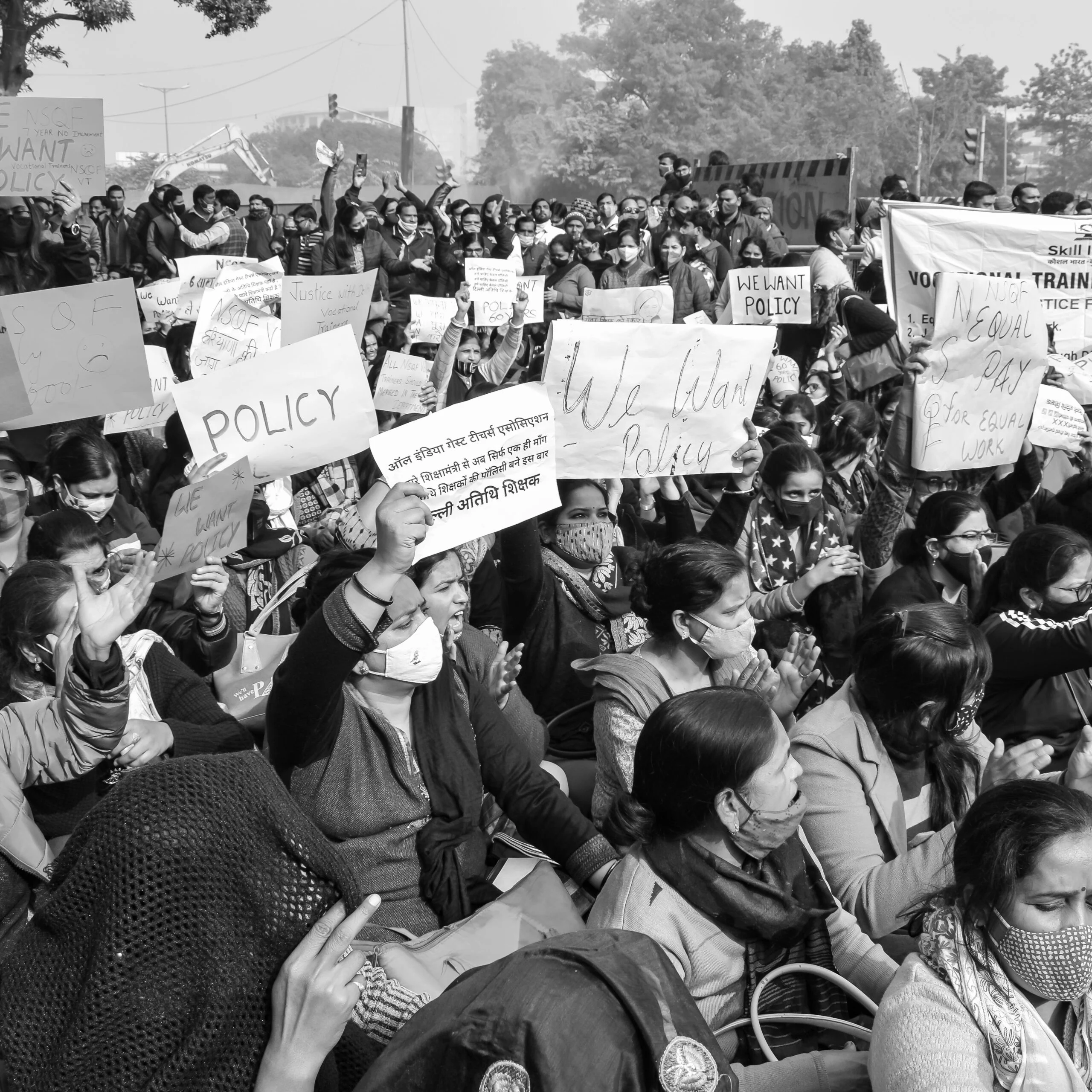
The youth movement that ran through June and July 2026 was covered mostly as spectacle: the crowds, the satirical name, the tear gas on 20 July, the resignation on 25 July. Between those images sat a list of demands that almost nobody printed in full.
They are worth reading, because they are unusually concrete for a mass movement, and because four of the five could be delivered by administrative decision rather than new law.
What triggered it
The immediate cause was the cancellation of the national medical entrance exam on 12 May 2026, after investigators found that a guess paper in circulation before the exam overlapped with the real question paper. About 22.7 lakh candidates had sat it. We covered what that cancellation cost those families separately.
The movement itself started as satire. A senior judge had described young Indians in dismissive terms, and a group of students adopted the insult as a name. Within weeks it had turned from a joke into a sit-in with a demand charter, which is a fairly common trajectory for youth movements and a rare one to complete.
Demand one: a stronger examinations law
India already has a Public Examinations Act, passed in 2024, which criminalised organised cheating and paper leaking and promised fast track courts. The movement’s position was that criminal penalties address the aftermath and not the design.
What they asked for is transparency obligations attached to the conduct of the exam itself: how papers are printed, where they are stored, who holds custody, and what is published afterwards. Penalty law punishes the person caught at the end of a long chain. Transparency law shortens the chain.
Demand two: reform the examination bodies
This is the demand with the least public glamour and probably the most substance. The agencies conducting national exams are asked to test millions of candidates on a single day with staffing and systems that were designed for a much smaller operation.
Reform here means specific, unexciting things: permanent professional staff instead of deputation, independent technical audit of question paper security, published standard operating procedures, and a governing board that includes people who are not from the ministry that also owns the outcome.
An agency that conducts the exam, investigates its own failure, and reports to the ministry judged by the result is not a structure that produces uncomfortable findings.
Demand three: a students’ rights charter
At present a candidate has almost no enforceable entitlements. Fees are often non refundable even when the exam is cancelled by the conducting body. There is no stated timeline within which a result must be declared. There is no obligation to explain a cancellation, and no defined remedy afterwards.
A charter would fix what a candidate is owed: refund of fees on cancellation, a published result timeline, a stated reason for any cancellation, an appeal route on the answer key, and compensation for travel where a centre fails. None of that requires legislation. All of it requires a conducting body to accept obligations it currently does not have.
Demand four: a welfare fund for affected candidates
This is the demand that received the least attention and speaks most directly to who bears the cost of a failed exam.
When an exam is cancelled, the candidate loses a year. Families who borrowed to fund coaching lose the money and gain a further year of expense. Some students do not return, and the ones who drop out are disproportionately from families that could only afford one attempt. The cancellation therefore filters by income rather than by merit, quietly.
A welfare fund is an unusual ask and a reasonable one. If the state’s failure imposes a cost on a private family, the state carrying part of that cost is ordinary practice in most other domains.
Demand five: standing external oversight
The final demand is for continuing external scrutiny of examination authorities rather than an inquiry after each scandal.
The pattern in India is familiar: a failure, an inquiry committee, a report, a set of recommendations, and then attention moves on before implementation is checked. Standing oversight with a published annual report changes the incentive, because the next report arrives whether or not anything has gone wrong.
What a resignation does and does not settle
The movement ended when the union education minister resigned on 25 July and the protesters agreed to leave the site. That is a real outcome, and it is worth being clear about its limits.
- The printing and custody chain that produced the leak is unchanged.
- The conducting bodies have the same staffing and the same governance.
- No candidate affected by the cancellation has been compensated or granted an age relaxation.
- The next exam cycle will run on the existing system.
Accountability at the top is a legitimate demand and a poor substitute for structural change. The risk now is the familiar one: the resignation is treated as the resolution, the demand charter is filed, and the next cancellation produces the same cycle with different names.
The demands nobody made
What a movement leaves out is as revealing as what it asks for, and this charter has two notable absences.
The first is seats. Nothing in the five demands asks for more medical or engineering places, which is the actual scarcity driving the entire system. That is probably tactical, because seat expansion is expensive, slow, and constrained by faculty and teaching hospitals rather than by willingness. It is also the reason a paper is worth buying, so a charter that ignores it is treating the symptom.
The second is the coaching industry. Not one demand touches the parallel education economy that most aspirants pay for, despite it being the largest single cost a family bears and the clearest driver of inequality in outcomes. A student who can afford two years of residential coaching and one who cannot are not sitting the same exam in any meaningful sense.
Both omissions are understandable in a movement that needed a short, winnable list. Both mean that even full implementation of all five demands would leave the underlying competition exactly as brutal as it is now, just administered more honestly.
Why this movement got further than most
Two things distinguished it. The first is that its demands were administrative rather than ideological, which made them hard to dismiss and hard to absorb into an existing political argument. The second is that the constituency was enormous and geographically spread. Exam aspirants exist in every district in India, and their families vote.
It is also a movement about process rather than identity, which is unusual in Indian public life and worth noticing. The grievance was that a system did not work as advertised. That is a claim any citizen can make about any public service, and the same argument applies to recruitment exams, discussed in the years job aspirants lose waiting.
What you can do about it
- Read the charter, not the coverage. The demands are specific and checkable. Coverage of crowds is not.
- Track implementation. Ask, in six months, which of the five has moved. Four need no new law, so there is no procedural excuse.
- If you know an affected candidate: the welfare demand exists because of people in exactly that position. Their account is worth recording and sending to whoever conducts the next review.
- Locally: exam centres are staffed by local institutions. Custody discipline at centre level is a district matter and responds to written questions.
A movement that begins as a joke about an insult and ends with a costed demand charter has done something most protests do not. Whether any of it survives the news cycle is now an administrative question rather than a political one.
Featured photo by Rahul Sapra on Pexels.
Sources: movement background and demand list via Britannica and TIME; the 20 July march and its aftermath via NPR; the resignation via Al Jazeera.
What you can do
- Share the evidenceSend this to one person who should know about education.Share on WhatsApp
- Give an afternoonTeach, mentor, clean up, or lend your professional skills.Ways to volunteer
- Tell us what's missingKnow a story, a fact we got wrong, or a solution worth spotlighting?Suggest a story
Politically neutral. Every claim sourced. Report a correction.
No comments yet