When the Teacher Fails the Test: India's Quietest Education Finding
India's 2026 school audit found that only 10 to 15 per cent of government school teachers score above 60 per cent in the subject they are paid to teach. That finding is about the system that trained them, not about them.

In this story
Buried inside India’s 2026 school education audit is a finding that got far less attention than the infrastructure numbers, and is harder to fix than any of them. On subject knowledge tests, only about 10 to 15 per cent of government school teachers score above 60 per cent in the subject they are employed to teach. Mathematics is the weakest area.
The temptation is to read that as an indictment of teachers. It is not. It is an indictment of every stage that put them in the classroom, and of the fact that nothing happens to a teacher’s knowledge for the thirty years after they are hired.
Where a teacher’s subject knowledge comes from
A government school teacher in India is typically a graduate who then completed a teacher education course, usually a two year Bachelor of Education or a diploma in elementary education. That qualification is supposed to do two things: confirm the person knows their subject, and teach them how to teach it.
Teacher education in India is overwhelmingly delivered by private colleges. Regulators have repeatedly found large numbers of these institutions to be substandard, with several rounds of action against colleges that existed mainly on paper, ran no real classes, or issued degrees without attendance. A qualification obtained from such a college certifies nothing about what the holder knows.
The person holding that degree is usually not the villain of the story either. They paid a fee for a course they believed was real, in a district where it was the only route into a secure job, and nobody told them their college was hollow until a newspaper investigation years later.
A teacher who was never taught the mathematics she is asked to teach has not failed. She was certified by a system that did not check, and then handed a classroom.
The eligibility test was supposed to catch this
India introduced teacher eligibility tests precisely to screen for subject and pedagogy knowledge before appointment. In principle this is the right instrument, and the pass rates tell their own story: in most states, the large majority of candidates who sit these tests do not clear them.
That looks like a filter working. Two things blunt it.
- The test is a one time gate. It screens at entry and never again. A teacher who cleared it at 24 is never assessed again in a career lasting until 60.
- Vacancy pressure erodes it. When a state carries lakhs of vacancies, pressure builds to relax criteria, extend validity, or fill posts with guest and contract teachers who never faced the same gate.
That second point connects this finding to the staffing crisis directly. The same states carrying the largest vacancy numbers, documented in the audit that counted one lakh single teacher schools, are the states with the strongest incentive to lower the bar to get bodies into rooms.
Nothing happens after appointment
The part of this that is genuinely fixable, and genuinely neglected, is what happens in the thirty years after hiring.
In service training exists on paper in every state. In practice it usually means a few days a year, delivered in a lecture hall, often on general themes rather than the specific content the teacher struggles with. Teachers describe it as a formality to be attended and signed. Nobody assesses whether it changed anything, because there is no follow up measurement.
Compare that with how any other skilled profession maintains competence. Doctors, pilots, accountants, and electricians all face recurring certification tied to practice. A teacher faces none. The assumption embedded in the system is that subject knowledge is acquired once, at 24, and never decays or needs deepening.
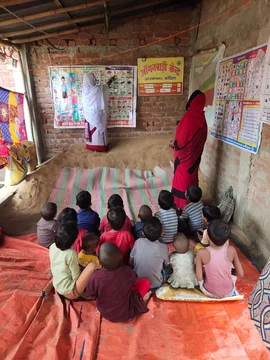
Worse, the training that is delivered is often disconnected from the actual daily problem. A teacher running five grades in one room does not primarily need a lecture on pedagogy theory. She needs concrete material for multigrade teaching, which almost no training programme provides.
What this does to the child
Weak subject knowledge shows up in a specific way in a classroom, and it is not that the teacher says something factually wrong. It is that she teaches the procedure and cannot explain the reason.
A child is shown the steps for long division and can reproduce them on identical problems. Change the format slightly and the method collapses, because the child learned a ritual rather than an idea. That is exactly the pattern the audit found in learning outcomes: large shares of Class 5 children able to recognise numbers but unable to solve a basic division problem presented unfamiliarly.
It also means questions cannot be answered. A teacher who is unsure of the underlying concept will discourage the child who asks why, because the question is a risk. Over a few years, children learn not to ask, and the classroom becomes a place for copying rather than thinking. That habit follows students into the employability gap that employers complain about a decade later.
The states that treat teaching as a profession
The national average hides a wide spread, and the states at the top of it did something specific rather than something lucky. They recruited through a genuine competitive process, paid a salary that made the job worth competing for, posted teachers close enough to home that they stayed, and then left them in the same school long enough to build a relationship with a community.
Stability turns out to matter as much as qualification. A teacher in her ninth year at the same school knows which children in Class 4 cannot read and why, knows their parents, and has taught the same syllabus enough times to have found the explanations that work. A teacher rotated every eighteen months never reaches that point regardless of what her degree says.
Kerala and Tamil Nadu are the usual examples, and both are instructive because their advantage was built over decades of continuous investment rather than a single reform. We traced one of those arcs in the state that decided in 1817 that education was government’s job. The relevant lesson is not that other states should copy a scheme. It is that competence is produced by continuity, and continuity is a budget decision repeated for thirty years.
What would actually change this
Fix the teacher education colleges first
No downstream fix survives a pipeline that issues qualifications without teaching. Closing hollow colleges is unpopular and slow, and it is the only step that changes the input rather than patching the output.
Make in service training subject specific and diagnostic
Test what a teacher actually finds difficult, then train that. A mathematics teacher weak on fractions needs work on fractions, not a general session on child psychology. This requires diagnosis before training, which almost no state does.
Separate assessment from punishment
Teachers resist knowledge testing for an understandable reason: they expect the result to be used against them in transfers and increments. An assessment whose only output is a training plan, with a legal bar on its use in service decisions, would get honest participation. One that feeds into personnel files will produce copying, and the country will learn nothing.
Give them time to be taught
A teacher managing the midday meal, the registers, the annual return, and survey duty has no hours left for professional learning. Removing non teaching work is a precondition for any training reform, not a separate issue.
What you can do about it
- Personally: if you are a subject graduate, a few hours a month of volunteer content support at a local school is worth more than money. Ask the head teacher which subject is uncovered.
- As a parent: ask your child to explain why a method works, not whether they got the answer. It tells you what kind of teaching they are receiving.
- Locally: retired teachers, engineers, and accountants in most neighbourhoods can support mathematics teaching directly. Almost nobody asks them.
- At state level: teacher education college recognition lists are public. Which colleges in your district are recognised, and how many students they claim, is a question worth asking in writing.
- Nationally: support recurring, non punitive competence support for teachers, and say so plainly, because teacher unions will reasonably oppose anything that looks like a disciplinary tool.
The finding sounds like a story about bad teachers. It is a story about a country that built a pipeline with no quality check at either end, and then asked the people inside it to produce a literate generation anyway.
Featured photo by Kirubakaran Uthira Kumar on Pexels.
Sources: NITI Aayog, School Education System in India, May 2026; learning outcome and teacher knowledge findings reported via ThePrint.
What you can do
- Share the evidenceSend this to one person who should know about education.Share on WhatsApp
- Give an afternoonTeach, mentor, clean up, or lend your professional skills.Ways to volunteer
- Tell us what's missingKnow a story, a fact we got wrong, or a solution worth spotlighting?Suggest a story
Politically neutral. Every claim sourced. Report a correction.

No comments yet