Unpaid Care Work in India: Women Give Nearly 5 Hours a Day
Indian women who do housework spend 289 minutes a day on it, men 88 (MoSPI 2024). What the ILO counts, where crèches work, and what to ask for.
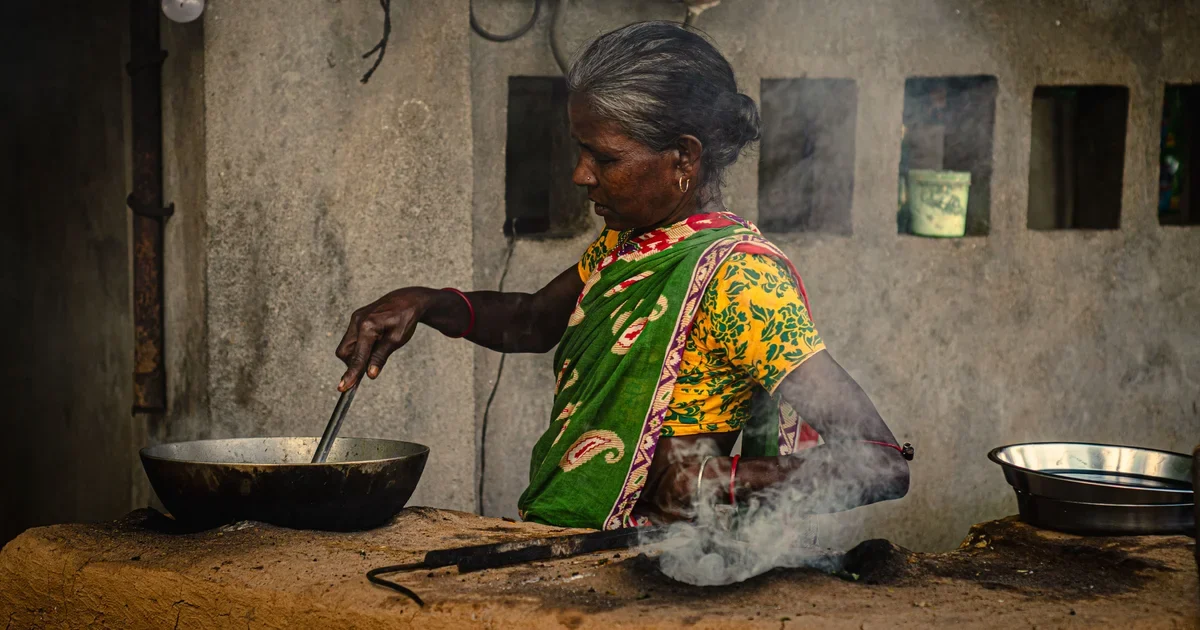
Photo by STORY FINDER on Pexels
In this story
How many hours of unpaid care work in India do women do each day?
Unpaid care work in India falls mostly on women. On an average day, a woman who does unpaid housework spends 289 minutes on it, which is just under five hours. A man who does any spends 88 minutes. These are the 2024 figures from the Time Use Survey of the Ministry of Statistics and Programme Implementation (MoSPI), released in February 2025. The survey covered 1,39,487 households and 4,54,192 people aged six and above across rural and urban India, and each person described a full 24 hours in 30-minute slots, as set out in the MoSPI press note.
The gap is not only in hours. It is also in who does the work at all. In 2024, 81.5 per cent of women aged six and above did some unpaid domestic work on the survey day, against 27.1 per cent of men. For unpaid caregiving of household members (children, the sick, the old), 34 per cent of women took part, against 17.9 per cent of men, and women who cared spent 137 minutes a day, against 75 for men.
Put the two together and spread the time over everyone, not just those who did the work. Unpaid domestic services take 16.4 per cent of a woman’s day and 1.7 per cent of a man’s. Unpaid caregiving takes another 3.3 per cent of a woman’s day and 0.9 per cent of a man’s. Paid employment and related work takes 4.9 per cent of a woman’s day and 19.9 per cent of a man’s. Added up, unpaid housework and care use about one fifth of a woman’s day and under three per cent of a man’s.
Activity (persons aged 6 and above, TUS 2024) | Women | Men |
|---|---|---|
Did unpaid domestic work on the survey day | 81.5% | 27.1% |
Minutes a day on it, among those who did it | 289 | 88 |
Did unpaid caregiving on the survey day | 34.0% | 17.9% |
Minutes a day on it, among those who did it | 137 | 75 |
Did paid work or related activity on the survey day | 20.7% | 60.8% |
Share of the whole day spent on unpaid domestic work | 16.4% | 1.7% |
Source: MoSPI, Time Use Survey (January to December 2024), press note of 25 February 2025.
Is this the same as “housework”?
Mostly, but the survey splits it in two. “Unpaid domestic services” means cooking, cleaning, washing clothes, fetching water or fuel for the home, shopping for the household and similar tasks. “Unpaid caregiving” means looking after children, helping a sick or elderly family member, and teaching or accompanying a child. Both are unpaid and both are done for people in your own household. Neither is counted in GDP, which is why economists call this the hidden half of the economy.
Has the burden fallen since 2019?
A little, and the direction matters more than the size. India ran its first national time use survey in 2019, covering 1,38,799 households. It found women spending 299 minutes a day on unpaid domestic services and men 97, as reported by The Wire. In 2024 the figures were 289 and 88. Both sexes cut their time by roughly ten minutes, so the ratio barely moved. A woman still spends about 3.3 times as long as a man on unpaid housework.
The age group that matters most for work and family, 15 to 59, shows the same pattern. Women in that group who did unpaid domestic work spent about 315 minutes in 2019 and about 305 in 2024. MoSPI links this to a shift from unpaid to paid activity, because the share of women in that age group taking part in paid work and related activities on the survey day rose from 21.8 per cent to 25 per cent. For men it rose from 70.9 per cent to 75 per cent.
The caregiving figures moved in an interesting direction. In 2019, 27.6 per cent of women and 14 per cent of men took part in unpaid caregiving, according to the same report coverage. In 2024 the shares were 34 per cent and 17.9 per cent. More people of both sexes now report caregiving. Part of this may be better recording, since MoSPI’s own note says there is “more acknowledgement of caregiving activities”, and part may be real change. The survey cannot tell us which.
What does the survey not tell us?
Three limits are worth knowing before anyone quotes these numbers. First, the averages are for people who did the activity, so they hide how many did none. Second, a woman who cooks while watching a toddler is recorded for up to three activities in a slot, so the time is not simply additive. Third, the tables in the press note do not show how the load differs by income, caste or household size. Researchers who work on care will want the unit-level data for that.
Why does unpaid care keep women out of paid work?
The International Labour Organization (ILO) has put numbers on this. In an October 2024 statistical brief it estimated that 748 million people aged 15 and above were outside the labour force worldwide in 2023 because of care responsibilities, and 708 million of them were women. The brief, titled The impact of care responsibilities on women’s labour force participation, lists India among the countries where more than half of women outside the labour force give care as the reason. Its country table, built from India’s Periodic Labour Force Survey of 2023, shows 53.0 per cent of such women citing care, against 1.1 per cent of men.
Read that carefully. It does not say 53 per cent of all Indian women are out of the labour force because of care. It says that among women who are outside the labour force, a little over half give care and housework as the reason. The ILO’s own conclusion is that countries which invest more in early childhood care and education tend to have a lower share of women kept out of work by care. It names India among the countries that “may need further investment in the care economy, particularly in ECCE” (early childhood care and education).
This connects to a puzzle we covered in our piece on why India’s labour force participation for women is lower than Pakistan’s. The time use data add a piece to that puzzle. A woman who works in the field or the family shop and then does five hours of housework has a very long day, and the care part of it never shows up in a pay slip.
Is it a choice?
Partly, and partly not. Households do decide who stays home, and norms push the decision towards the woman. But the decision is also shaped by what is available. If the nearest crèche is two villages away, shut by noon, or costs a third of what she could earn, staying home is the rational answer. If a daughter-in-law is the only person available to look after an ill parent, no one is exercising a free choice. The ILO brief and the Economic Survey 2024 both make the same basic point, as cited by The India Forum: affordable and reliable childcare gives women time for paid work, and it improves children’s learning and nutrition.
Who bears the heaviest load?
The all-India tables show women of every kind carrying more than men, but some women carry more than others. Care researchers generally point to four groups who carry the heaviest loads:
- Mothers of children under six, who have no affordable day care and often no choice but to leave a child with an older sibling, usually a girl.
- Women in poor and rural households, where fetching water and fuel, cooking over a chulha and washing by hand take longer, and where there is no paid help.
- Daughters and daughters-in-law in homes with an elder who needs care, a gap we explored in Ageing India: 150 million elders and no plan to care for them.
- Paid domestic and care workers, who do the same work for other families for low pay and no national law to protect them, as we reported in India’s domestic workers.
The last point is easy to miss. The unpaid care work of one family is the paid job of another woman. When a household outsources care, it usually hires another woman, often from a poorer family. So support for care workers is also part of the solution, not a separate topic.
What works to ease the load of unpaid care work in India?
The international literature uses a simple frame, often called the three Rs: recognise unpaid care work (count it), reduce it (with services and infrastructure), and redistribute it (between women and men, and between families and the state). India has pieces of each. The strongest evidence is for the second, and the weakest implementation is also there.
How do crèches and Anganwadi-cum-crèches help?
A good crèche does three things at once. It frees a mother’s hours, it gives the child food, play and early learning, and it creates a job for a local woman as a crèche worker. India has tried this several times and has a patchy record.
The history, as reconstructed by The India Forum from ministry data, goes like this. The Rajiv Gandhi National Crèche Scheme began in 2006 and was discontinued in 2016, with the government citing irregularities in how crèches were run. A National Crèche Scheme followed. In 2022 the Centre folded crèches into the Palna scheme, which sits under the Samarthya vertical of Mission Shakti. Palna’s design is sensible. It creates Anganwadi-cum-crèches (AWCCs), which add day care for children aged six months to six years to an existing anganwadi, and it is open to mothers whether or not they are employed. The target was 17,000 AWCCs by 2025-26.
The gap between plan and ground is large. A Rajya Sabha reply by Minister of State Savitri Thakur, reported by Sakshi Post, said that 14,599 AWCCs had been approved. A Lok Sabha reply on 12 December 2025 (Unstarred Question 2296) said 2,820 were functional. That is about one in five of the approved centres and about one in six of the target. Earlier, The India Forum counted 2,163 operational government crèches on 30 June 2024, down from 3,158 in 2023, and reported that spending on crèches stayed below Rs 50 crore a year in 2017 to 2021 and under one per cent of the women and child development ministry’s budget. Maharashtra, Uttar Pradesh and Chhattisgarh each had more than 300 crèches in 2014-15 and, in the latest data the authors saw, reported none. Eight states had no crèche of either kind.
The reasons are mundane and fixable. Central guidelines set an honorarium of Rs 4,500 a month for an anganwadi worker and Rs 2,250 for a helper (Delhi’s minimum wage for an unskilled worker in 2023 was Rs 17,494), and workers on that pay are hard to ask for a longer day running a crèche. Funds arrive late. States that lack a delivery system cannot spend the money. None of this means the model fails. It means the Centre’s own numbers show a model that has not yet been properly built.
Which states have done better?
The India Forum notes that Kerala, Karnataka and Haryana run their own state crèche schemes, mostly begun in 2021 or later, and appear to have kept a steady number of active crèches through the changes in central schemes. It also says the evidence on their effect on women’s work is thin and more data is needed. We have not found an evaluation that measures the effect on employment, so we do not claim one.
Kerala is also looking at crèches where women work. People Matters reported that the state was considering making childcare mandatory for firms with more than 50 employees, with the details of timelines and compliance not yet announced. We treat it as a proposal, not a result.
The southern states are also reported to run worksite crèches under the rural job guarantee better than the northern ones. The India Forum cites studies that found crèche provision under MGNREGA to be very poor or absent in Uttar Pradesh, Jharkhand, Rajasthan and Madhya Pradesh. The law requires a crèche when five or more children under six are at a worksite. Few women see one.
Does the law already require workplace crèches?
Yes, for large employers. Section 11A, added to the Maternity Benefit Act by the 2017 amendment, requires every establishment with 50 or more employees to provide a crèche within a prescribed distance, and to let a mother visit it four times a day, including her rest interval. The provision took effect on 1 July 2017, as set out in the text of the amendment. These rules have since been folded into the Code on Social Security, 2020, so check the current wording before relying on a section number.
The weak spot is the size of the workforce this reaches. Most women in India work in informal and small enterprises, on farms, as domestic workers, as home-based workers. A rule for establishments of 50 or more does not touch them. Crèche duties also appear in the Factories Act, 1948 and the Building and Other Construction Workers Act, 1996, but garment workers and construction workers report that the facilities are often missing, as The India Forum records. A law without inspection is a promise.
What can civil society show?
Voluntary groups have run crèches where the state has not. Mobile Creches, a Delhi-based organisation, runs childcare centres at construction sites and in urban slums and says on its charity listing that it has served about 7.5 lakh children since 1969. That figure is self-reported, but it shows that a worksite crèche for migrant families is feasible at scale. A study backed by the group looked at crèche models in Odisha and Kerala and found that barriers remain in availability, trust and affordability. Trust is the quiet issue. A mother will not leave an infant in a place she does not know, and parents need to see the workers and the food.
Do water, fuel and cooking matter as much as crèches?
They matter, though we do not have a survey number to attach. Time use researchers have long argued that “time-saving infrastructure” such as piped water to the home, a clean cooking fuel, and a nearby grain mill or health centre cuts the hours that fall on women. The logic is simple. A woman who does not walk to a hand pump twice a day has those hours to spend on something else. The TUS shows that in 2024, 24.6 per cent of rural people aged 15 to 59 spent time producing goods for their own final use (fetching, processing, farming for the home), averaging 121 minutes a day. A national measure of how much of that falls on women, and how it has changed with household taps, would settle the question. It is a good thing to ask the statistics office to publish.
What about sharing the work at home?
This is the slowest change and the one in which citizens have the most power. The TUS 2024 shows men’s participation in unpaid domestic work at 27.1 per cent. The signs of change are modest: a rise in the share of men reporting any caregiving, from 14 per cent in 2019 to 17.9 per cent in 2024. Employers can help set the norm by offering paid leave to fathers, and homes can do it by handing men a fixed share of the daily chores.
What should policy do next?
If the aim is to give women back hours and let them choose paid work, the evidence points to a short list.
- Make the Palna numbers real. Publish, state by state and every quarter, how many AWCCs are approved, built, staffed and open for at least six hours. The 14,599 versus 2,820 gap is the issue to close.
- Pay crèche workers a living wage. An honorarium of Rs 4,500 a month cannot sustain a daily service.
- Fund crèches out of an ongoing budget line. Spending of under one per cent of a ministry’s budget on crèches signals low priority. A fixed line, protected from the mid-year cuts, would let states plan.
- Put crèches where women work. Worksite crèches under MGNREGA, in markets, near garment clusters and at construction sites, with the facility inspected and results public.
- Count care in official data every year. The TUS has come twice, in 2019 and 2024. A shorter, annual module in the labour force survey would show whether the burden is moving.
- Extend care support to elders. With a growing elderly population, the next care gap is not only about children.
- Protect paid care workers. A national framework for domestic workers, with minimum pay and social security, treats care as work.
What can you do?
- Count the hours in your own home. For one week, write down who does the cooking, cleaning, school runs and care of elders. Share the list at dinner. The numbers usually surprise people.
- Rotate the chores that are never rotated. The daily cooking and the laundry are the heavy ones. Men and boys can take them on, and children learn from what they see.
- Ask for the crèche. If you are a worker, a union member or an employer in an establishment with 50 or more people, ask whether the crèche required by law exists and whether mothers can use it four times a day.
- Visit your local anganwadi. Ask whether it is an Anganwadi-cum-crèche, what its hours are, and who supervises it. Raise gaps with the Child Development Project Officer and the gram sabha or ward committee.
- Use the right to information. A simple RTI request to the district programme officer can ask how many AWCCs were sanctioned and are open in your district.
- Pay domestic workers fairly. Agree the pay, the hours and a weekly day off in writing, and add a paid leave allowance. It is the care that makes your own paid work possible.
- Support a local crèche. Volunteer, donate or help a women’s self-help group set one up. Even a part-day centre near a market changes a mother’s week.
- If you manage a team, offer flexible hours and paid leave to fathers as well as mothers. Policies that apply to only one sex tell everyone whose job care is.
Frequently asked questions
How much unpaid work do Indian women do every day?
Women who did unpaid domestic work in the 2024 Time Use Survey spent 289 minutes on it on the survey day, and women who did unpaid caregiving spent 137 minutes. Men spent 88 and 75 minutes. Only 27.1 per cent of men did any unpaid domestic work, against 81.5 per cent of women.
Did the 2024 survey show an improvement over 2019?
A small one. Women’s time on unpaid domestic work fell from 299 to 289 minutes, and men’s fell from 97 to 88. The share of women aged 15 to 59 in paid or related work rose from 21.8 to 25 per cent.
What does the ILO say about India?
In its 2024 brief, the ILO’s table for India (PLFS 2023) shows 53.0 per cent of women outside the labour force citing care responsibilities, against 1.1 per cent of men. It lists India among countries that may need more investment in early childhood care and education.
What is an Anganwadi-cum-crèche?
It is an anganwadi centre that offers day care for children from six months to six years, under the Palna scheme begun in 2022. It is open to mothers whether or not they are employed.
How many Anganwadi-cum-crèches are running?
The Centre said 14,599 had been approved against a target of 17,000, and a Lok Sabha reply of 12 December 2025 said 2,820 were functional.
Does the law require employers to run a crèche?
Under the Maternity Benefit Act as amended in 2017, establishments with 50 or more employees must provide a crèche and allow four visits a day. The provision now sits within the Code on Social Security, 2020.
Is unpaid care work counted in GDP?
No. Household production for own use is outside the standard national accounts, which is why time use surveys exist. India’s surveys give the hours, but no official rupee value has been set, and we do not quote an unverified one.
The bottom line
An Indian woman who does housework gives it close to five hours a day, and a man who does it gives under an hour and a half. The gap is narrowing in a few places, but only by minutes. The ILO’s count suggests that care is the reason a little over half of women outside the labour force are not in paid work. The state knows what to build: a full-day crèche in every anganwadi that wants one, a crèche at the worksites where women work, and care for elders. The data show the distance between the plan and the ground. 14,599 approved, 2,820 open. Closing that gap, paying the people who run the centres, and counting the hours every year would do more than any slogan. In the home, the change is smaller and cheaper: share the list, rotate the chores, and ask the local anganwadi what it needs.
Sources: Ministry of Statistics and Programme Implementation, Time Use Survey press note, 25 February 2025 (survey January to December 2024); National Statistical Office, Time Use in India 2019 (as reported by The Wire); International Labour Organization, “The impact of care responsibilities on women’s labour force participation” (October 2024); Lok Sabha Unstarred Question 2296 (12 December 2025); The India Forum, analysis of state crèche schemes; Maternity Benefit (Amendment) Act, 2017.
What you can do
- Share the evidenceSend this to one person who should know about gender equality.Share on WhatsApp
- Give an afternoonTeach, mentor, clean up, or lend your professional skills.Ways to volunteer
- Tell us what's missingKnow a story, a fact we got wrong, or a solution worth spotlighting?Suggest a story
Politically neutral. Every claim sourced. Report a correction.
No comments yet