Constitution Day, 26 November: Why India Marks It, What the Preamble Promises and the Rights You Can Use
Why India marks Constitution Day on 26 November, the Preamble in plain words, and the five fundamental rights people use most, with the cases behind them.
In this story
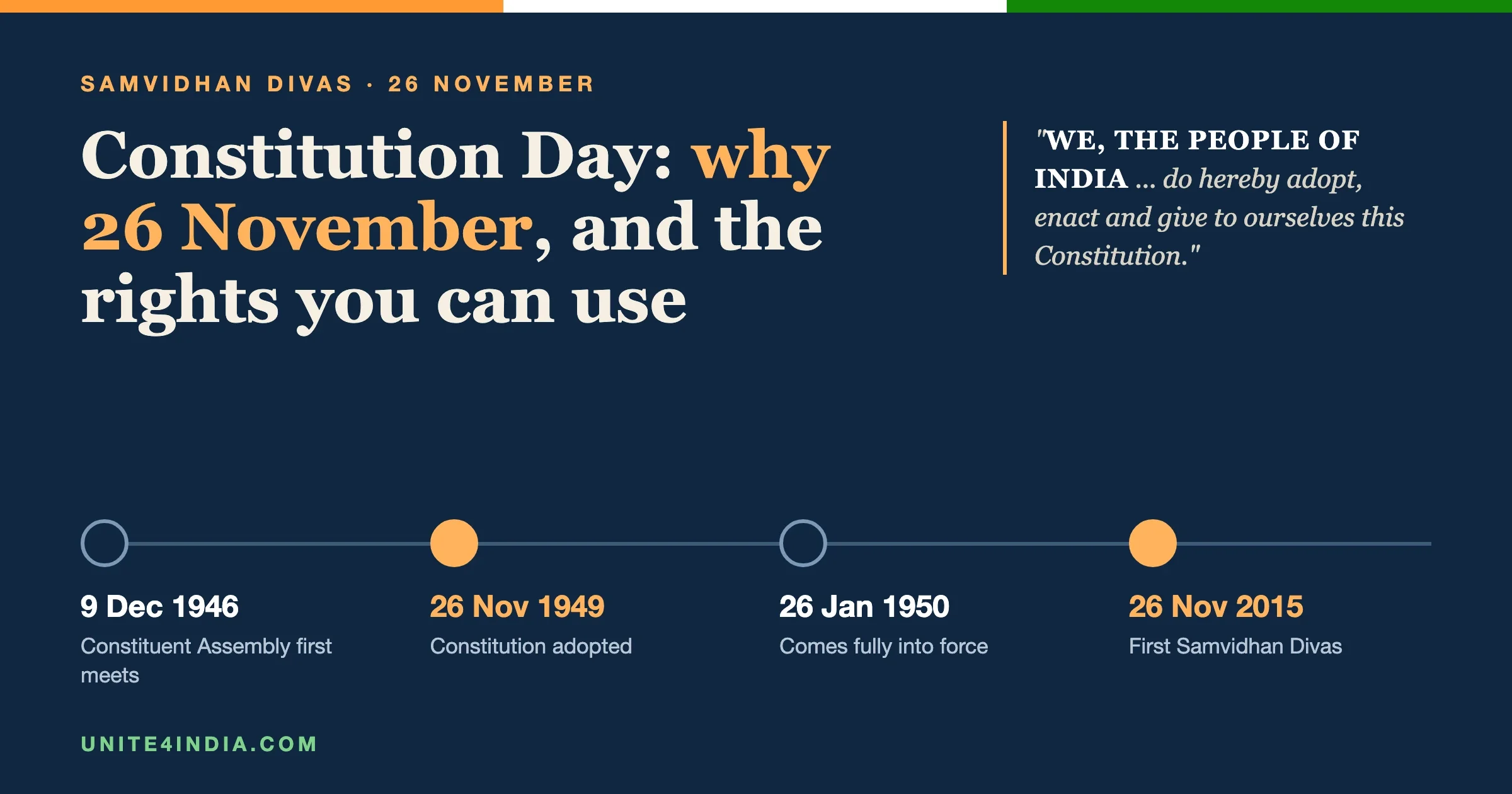
Short answer: India marks Constitution Day, or Samvidhan Divas, on 26 November because that is the day in 1949 when the Constituent Assembly adopted the Constitution. Most of it came into force two months later, on 26 January 1950, which is why Republic Day falls in January. The government began observing 26 November as Constitution Day in 2015. This guide explains the date, reads the Preamble line by line in plain words, and shows the five rights an ordinary citizen uses most, with real court cases behind each one.
We have kept to the official text throughout. Article numbers, dates and the amendment count were checked against the Legislative Department’s 1 May 2026 edition of the Constitution and against Parliament and PIB records. Checked on 21 November 2026.
Why does India celebrate Constitution Day on 26 November?
On 26 November 1949 the Constituent Assembly passed the motion that the Constitution “as settled by the Assembly be passed”. That is the adoption date, and the Preamble itself records it: “IN OUR CONSTITUENT ASSEMBLY this twenty-sixth day of November, 1949, do HEREBY ADOPT, ENACT AND GIVE TO OURSELVES THIS CONSTITUTION.”
The Constitution did not switch on all at once. Article 394 says that a short list of provisions came into force straight away, on 26 November 1949, and “the remaining provisions” on 26 January 1950. The early provisions were the ones needed to set up the new state: citizenship (Articles 5 to 9), elections (Article 324), the President’s oath arrangements in Article 60, and a set of transitional and interpretation clauses. Everything else, including the Fundamental Rights, began on 26 January 1950.
Why January? 26 January 1930 was the day the Indian National Congress had declared Purna Swaraj, complete independence. The Assembly chose that date for the Constitution to take effect so that the old pledge and the new republic would share a day.
So the two days do different jobs:
Date | What happened | How it is marked today |
|---|---|---|
26 November 1949 | Constituent Assembly adopted the Constitution; citizenship, election and transitional provisions came into force | Constitution Day (Samvidhan Divas), since 2015 |
24 January 1950 | Members signed the handwritten copies | Not a public observance |
26 January 1950 | The rest of the Constitution came into force; India became a republic | Republic Day, a national holiday |
When was 26 November first observed as Samvidhan Divas?
The Government of India notified in November 2015 that 26 November would be celebrated every year as Constitution Day. The decision came in the year of the 125th birth anniversary of Dr B.R. Ambedkar, who chaired the Drafting Committee, and the first observance was on 26 November 2015, with a special discussion on the Constitution in both Houses of Parliament.
The Ministry of Social Justice and Empowerment announced the decision on 19 November 2015 and was the nodal ministry that year. In recent years the Ministry of Parliamentary Affairs has led the observance; PIB named it as the nodal ministry for the 2025 celebrations.
Constitution Day is an observance, not a public holiday. Offices, schools and colleges stay open, and the usual practice is a reading of the Preamble, followed by talks, quizzes and exhibitions.
Who wrote the Constitution, and how long did it take?
The Constituent Assembly first met on 9 December 1946 in the Constitution Hall, now the Central Hall of the old Parliament House. It took two years, eleven months and eighteen days to finish the work, across eleven sessions and about 165 days of sittings (PIB gives 165; some histories count 166).
The Assembly was elected indirectly by the provincial legislatures under the Cabinet Mission plan of 1946, with seats also for the princely states. It began with 389 seats. After Partition, members from areas that went to Pakistan left, and the number fell to 299.
Fifteen women were members. Their names are worth knowing, because school textbooks often leave them out: Ammu Swaminathan, Annie Mascarene, Begum Aizaz Rasul, Dakshayani Velayudhan, Durgabai Deshmukh, Hansa Mehta, Kamla Chaudhri, Leela Roy, Malati Choudhury, Purnima Banerji, Rajkumari Amrit Kaur, Renuka Ray, Sarojini Naidu, Sucheta Kripalani and Vijaya Lakshmi Pandit.
The Drafting Committee was set up on 29 August 1947 with Dr B.R. Ambedkar as chairman. The final draft was introduced on 4 November 1948. According to PIB, members proposed 7,653 amendments to it and 2,473 were actually discussed before the text was passed. The full debates are public, and they are the best place to see why a clause reads the way it does.
The original was written by hand, in Hindi and English. Prem Behari Narain Raizada wrote the English calligraphy, and artists from Santiniketan under Nandalal Bose decorated the pages. On 24 January 1950, at the Assembly’s last meeting, 284 members signed the copies. The originals are kept in nitrogen-filled cases in the Library of Parliament.
What does the Preamble say, line by line?
The Preamble is one sentence. Here it is as it reads today, followed by what each part means in plain words.
WE, THE PEOPLE OF INDIA, having solemnly resolved to constitute India into a SOVEREIGN SOCIALIST SECULAR DEMOCRATIC REPUBLIC and to secure to all its citizens: JUSTICE, social, economic and political; LIBERTY of thought, expression, belief, faith and worship; EQUALITY of status and of opportunity; and to promote among them all FRATERNITY assuring the dignity of the individual and the unity and integrity of the Nation; IN OUR CONSTITUENT ASSEMBLY this twenty-sixth day of November, 1949, do HEREBY ADOPT, ENACT AND GIVE TO OURSELVES THIS CONSTITUTION.
“We, the people of India”
Power comes from the people, not from a king, a colonial parliament or a religious authority. The Constitution is something citizens give to themselves.
“Sovereign”
India makes its own laws and decisions, inside and outside the country. No outside power can overrule them.
“Socialist”
The state aims to reduce inequality of income, status and opportunity. In Indian usage this has never meant abolishing private property. It points the state towards welfare, which is spelt out in the Directive Principles in Part IV.
“Secular”
The state has no religion of its own and treats all faiths equally. Citizens are free to practise, profess and propagate religion under Articles 25 to 28, subject to public order, morality and health.
“Democratic Republic”
Governments are elected, and the head of state, the President, is elected too, not born into the post. That is what “republic” adds to “democratic”.
“Justice, social, economic and political”
Fairness is meant to reach daily life: in how people are treated socially, in their access to a living, and in their equal say in politics.
“Liberty of thought, expression, belief, faith and worship”
You may think, speak and believe as you choose. The detailed rights, and their limits, are in Articles 19 and 25.
“Equality of status and of opportunity”
No one is above or below another in the eyes of the law, and the state should open doors fairly. Articles 14 to 18 carry this, including the abolition of untouchability in Article 17.
“Fraternity, assuring the dignity of the individual and the unity and integrity of the Nation”
Fraternity means a sense of common brotherhood among all Indians. Ambedkar argued in the Assembly that liberty and equality cannot last without it. The dignity of each person comes first in this phrase, and the unity of the country follows from it.
Which words were added later?
Three words were not in the 1949 text. The Constitution (Forty-second Amendment) Act, 1976, in force from 3 January 1977, added “socialist” and “secular”, and changed “unity of the Nation” to “unity and integrity of the Nation”. On 25 November 2024 a two-judge bench of the Supreme Court led by Chief Justice Sanjiv Khanna dismissed petitions challenging the inclusion of “socialist” and “secular”, holding that Parliament’s power to amend extends to the Preamble and that the constitutional position was unambiguous. The Court had earlier held, in the Kesavananda Bharati case of 1973, that the Preamble is part of the Constitution.
Which fundamental rights do citizens actually use?
Part III of the Constitution lists the Fundamental Rights. Most people never read them, yet they rely on a handful almost every week. Here are the five that come up most in ordinary life, with a real case that shows each one at work.
Article | What it guarantees, in short | A case that shows it |
|---|---|---|
14 | Equality before the law and equal protection of the laws | Navtej Singh Johar (2018): consensual same-sex relations decriminalised |
19 | Six freedoms, including speech, assembly, movement and trade | Shreya Singhal (2015): Section 66A of the IT Act struck down |
21 | Protection of life and personal liberty | Maneka Gandhi (1978) and Puttaswamy (2017): fair procedure and privacy |
21A | Free and compulsory education for children aged 6 to 14 | Society for Unaided Private Schools (2012): the 25 percent RTE quota upheld |
32 | The right to go directly to the Supreme Court to enforce these rights | Habeas corpus and other writs, used every working week |
Article 14: equality before the law
Article 14 says the State shall not deny to any person equality before the law or the equal protection of the laws within the territory of India. Note the word “person”: it covers everyone in India, not just citizens.
Courts read it in two ways. First, the State can classify people only on a reasonable basis that is linked to the purpose of the law. Second, since the 1970s, an action that is arbitrary is treated as a breach of equality in itself. In Navtej Singh Johar v. Union of India, decided on 6 September 2018, a five-judge bench read down Section 377 of the Indian Penal Code so that it no longer criminalised consensual sex between adults of the same sex. The Court relied on Articles 14, 15, 19 and 21 together.
In daily life, Article 14 is what you are invoking when you say a government rule treats you differently from someone in the same position without a good reason, for example in a recruitment notice, a fee or an allotment.
Article 19: the six freedoms
Article 19(1) gives every citizen the right to:
- freedom of speech and expression;
- assemble peaceably and without arms;
- form associations or unions or co-operative societies;
- move freely throughout the territory of India;
- reside and settle in any part of India;
- practise any profession, or carry on any occupation, trade or business.
Each freedom can be limited, but only by a law that imposes “reasonable restrictions” on grounds listed in clauses (2) to (6), such as public order, decency, the security of the State or the interests of the general public.
The clearest recent example is Shreya Singhal v. Union of India, decided on 24 March 2015. Section 66A of the Information Technology Act let police arrest people for online posts that were “grossly offensive” or caused “annoyance”. The Supreme Court struck it down because those words were vague and went far beyond the reasonable restrictions Article 19(2) allows. If you post an opinion online, this judgment is part of why you cannot be arrested for causing “annoyance”.
Article 21: life and personal liberty
Article 21 is one sentence: “No person shall be deprived of his life or personal liberty except according to procedure established by law.” It has grown into the widest right in the Constitution.
In Maneka Gandhi v. Union of India (1978), the government had impounded a passport without giving reasons. The Supreme Court held that the “procedure” in Article 21 must be fair, just and reasonable, not merely written down in some law. That single holding opened the door to most of what followed.
In Justice K.S. Puttaswamy (Retd.) v. Union of India, a nine-judge bench held unanimously on 24 August 2017 that privacy is a fundamental right protected under Article 21 and Part III as a whole. Debates about Aadhaar, phone surveillance and data protection since then all start from this case.
Courts have also read rights to clean air, clean water, livelihood, shelter, a speedy trial and legal aid into Article 21. Many of the pollution cases that gave us today’s rules on Delhi’s air, which we cover in our guide to air pollution in India, were argued under this article.
Article 21A: the right to education
Article 21A says the State shall provide free and compulsory education to all children of the age of six to fourteen years in such manner as the State may by law determine. It was added by the Constitution (Eighty-sixth Amendment) Act, 2002, and the law that gives it effect, the Right of Children to Free and Compulsory Education Act, 2009, came into force on 1 April 2010.
The most-used part of that law for families is Section 12(1)(c): private unaided schools must admit at least 25 percent of their entry-class children from weaker sections and disadvantaged groups, with the government paying the fees. In Society for Unaided Private Schools of Rajasthan v. Union of India (2012), the Supreme Court upheld this quota for private unaided schools. Admissions are run by state education departments, usually through an online lottery each year, so if your child is eligible, the state portal is where to apply.
Article 32: the right to go to the Supreme Court
The rights above would be words on paper without a way to enforce them. Article 32 lets any person move the Supreme Court directly when a fundamental right is violated, and lets the Court issue writs: habeas corpus (produce the person), mandamus (do your legal duty), prohibition, certiorari and quo warranto. High Courts have a similar and in some ways wider power under Article 226.
Speaking in the Assembly on 9 December 1948, on the draft article that became Article 32, Ambedkar said that if he were asked to name the most important article, “an article without which this Constitution would be a nullity”, he could name no other: “It is the very soul of the Constitution and the very heart of it.” In practice, most people start in the High Court under Article 226, which is closer and often faster, and the Supreme Court has itself encouraged that route in many cases.
Other rights you should know
Article 15 bars discrimination on grounds of religion, race, caste, sex or place of birth, and allows special provisions for women, children and socially and educationally backward classes. Article 16 covers equal opportunity in public jobs and is the basis for reservation, which we look at in detail in what the evidence on reservation shows. Article 17 abolishes untouchability. Articles 23 and 24 ban forced labour and the employment of children under fourteen in factories, mines and hazardous work. Articles 25 to 28 protect religious freedom, and Articles 29 and 30 protect minorities’ language, culture and educational institutions.
What are the fundamental duties under Article 51A?
The original Constitution had no list of duties. The Forty-second Amendment of 1976 added Part IVA (in force from 3 January 1977), with Article 51A and ten duties. The Eighty-sixth Amendment of 2002 added an eleventh, on education. In short, every citizen should:
- abide by the Constitution and respect its ideals and institutions, the National Flag and the National Anthem;
- cherish and follow the noble ideals that inspired the freedom struggle;
- uphold and protect the sovereignty, unity and integrity of India;
- defend the country and render national service when called upon;
- promote harmony and the spirit of common brotherhood, and renounce practices derogatory to the dignity of women;
- value and preserve the rich heritage of our composite culture;
- protect and improve the natural environment, including forests, lakes, rivers and wildlife, and have compassion for living creatures;
- develop the scientific temper, humanism and the spirit of inquiry and reform;
- safeguard public property and abjure violence;
- strive towards excellence in all spheres of individual and collective activity;
- as a parent or guardian, provide opportunities for education to a child between six and fourteen.
Duties are not enforceable in court the way rights are. No one can be prosecuted for breaching Article 51A as such. But courts use the duties to read other laws, and Parliament has passed laws that give some of them teeth, such as the Prevention of Insults to National Honour Act, 1971 and environmental laws. The environment duty in clause (g) is the one that most directly concerns daily choices, from burning waste to wasting water.
How is the Constitution amended, and how many amendments have there been?
Article 368 sets out the procedure. A Constitution Amendment Bill can start in either House of Parliament. Most amendments need a special majority in each House: a majority of the total membership of that House and at least two-thirds of the members present and voting. Amendments that touch the federal structure, such as the election of the President, the powers of the Union and the states, the High Courts or the representation of states in Parliament, also need ratification by the legislatures of at least half the states. Then the President gives assent.
Some changes, such as creating a new state or altering a state’s boundaries, can be made by an ordinary majority under other articles and are not counted as amendments under Article 368.
There is one limit Parliament cannot cross. In Kesavananda Bharati v. State of Kerala (1973), a thirteen-judge bench held that Parliament can amend any part of the Constitution but cannot destroy its basic structure. The Court has since named features such as the supremacy of the Constitution, the rule of law, judicial review, free and fair elections, federalism and secularism as part of that structure.
On the count: the most recent amendment act is the Constitution (One Hundred and Sixth Amendment) Act, 2023, which reserves one-third of seats in the Lok Sabha, state assemblies and the Delhi assembly for women. The Legislative Department’s edition of the Constitution as on 1 May 2026 incorporates all amendments up to this one, which makes 106 amendment acts since 1950. That edition shows the new women’s reservation articles as in force from 16 April 2026; the Act itself ties the actual reserved seats to the delimitation that follows the next census.
Bill numbers run higher than the act count, because many bills are introduced and never passed. Two examples from the news: the Constitution (One Hundred and Thirtieth Amendment) Bill, 2025, on removing ministers held in custody, has been with a Joint Parliamentary Committee since August 2025, and the Constitution (One Hundred and Thirty-first Amendment) Bill, 2026, on delimitation, was introduced on 16 April 2026 and defeated in the Lok Sabha the next day, when it fell short of the two-thirds majority Article 368 requires. So a “131st Amendment Bill” in a headline does not mean there have been 131 amendments.
Amendment | Year | What it did |
|---|---|---|
1st | 1951 | Added the Ninth Schedule and new grounds for restricting speech |
42nd | 1976 | Added “socialist”, “secular” and “integrity” to the Preamble and created the Fundamental Duties |
44th | 1978 | Removed property from the Fundamental Rights and added safeguards against misuse of Emergency |
73rd and 74th | 1992 | Gave panchayats and municipalities constitutional status |
86th | 2002 | Made education a fundamental right (Article 21A) and added the eleventh duty |
101st | 2016 | Introduced the Goods and Services Tax |
103rd | 2019 | Allowed reservation for economically weaker sections |
106th | 2023 | Reserved one-third of Lok Sabha and assembly seats for women |
The 73rd Amendment is a good example of a promise only half kept. Panchayats got constitutional status, but as we found in our look at panchayat finances, they still raise only a tiny share of their own money.
How is the Constitution organised today?
The Constitution began with 395 articles in 22 parts and 8 schedules, about 90,000 words. Amendments have added articles with letter suffixes, such as 21A, 51A and 330A, rather than renumbering, so the last article is still numbered 395 even though there are many more. New parts got letters too: IVA (duties), IXA (municipalities), IXB (co-operative societies) and XIVA (tribunals), while Part VII was omitted. It now has 12 schedules. The Eighth Schedule lists the 22 languages recognised by the Constitution.
If you want to read it yourself, the Legislative Department publishes the current text, updated after each amendment, free of charge. The Legislative Department also publishes it in Hindi and has been releasing editions in other scheduled languages; nine of them (Malayalam, Marathi, Nepali, Punjabi, Bodo, Kashmiri, Telugu, Odia and Assamese) were released on Constitution Day 2025.
How can a school, college or RWA mark Constitution Day?
Most observances are short and cheap to run. Here is a plan that works in a school assembly, a college hall or a housing society, and takes under an hour.
- Read the Preamble together. Print it in English and in the local language. One person reads a line, everyone repeats it. The government’s Constitution Day campaigns have also invited people to read the Preamble online on MyGov and Constitution75.com.
- Explain one word. Pick one word, such as “fraternity” or “secular”, and ask a student or resident to explain it in two minutes using an example from their own street or school.
- Hold a rights quiz. Use the table of five rights above. Ask which article covers a real situation: a child refused admission, a post deleted by police, a family evicted without notice.
- Tell the story of one Assembly member. The fifteen women members are a good start. Dakshayani Velayudhan and Hansa Mehta are rarely in textbooks.
- Link duties to something local. For a housing society, Article 51A(g) on the environment fits naturally with a pledge on waste segregation or on not burning leaves and garbage, which matters in November when the air is at its worst.
- Show where to get help. Put up the number of the District Legal Services Authority. Free legal aid under the Legal Services Authorities Act, 1987 is the most practical way for a poor family to use the rights in Part III, and many residents have never heard of it.
Keep it non-partisan. The Constitution belongs to everyone, and a Preamble reading works best when no political speeches are attached to it.
Common mistakes people make about the Constitution
These are the errors we see most often in school projects, social media posts and quiz answers around 26 November.
- “Constitution Day and Republic Day are the same.” They are not. 26 November marks adoption in 1949; 26 January marks the Constitution coming fully into force in 1950.
- “The Constitution came into force on 26 November 1949.” Only some provisions did, as Article 394 lists. The Fundamental Rights started on 26 January 1950.
- “Ambedkar wrote the Constitution alone.” He chaired the Drafting Committee and was its leading voice, and he deserves the credit he gets. But the text was debated and amended by the whole Assembly over almost three years, and the Committee had other members, including Alladi Krishnaswami Ayyar, N. Gopalaswami Ayyangar and K.M. Munshi.
- “The Preamble was always ‘socialist secular’.” Those words came in 1976 through the Forty-second Amendment.
- “There have been 130 amendments.” Bill numbers are not amendment numbers. The count of amendment acts in force is 106.
- “Fundamental duties can be enforced like rights.” They cannot be enforced directly in court, though courts use them to interpret laws.
Common questions
Why is Constitution Day celebrated on 26 November?
Because the Constituent Assembly adopted the Constitution on 26 November 1949. The rest of it came into force on 26 January 1950.
Is Constitution Day a public holiday?
No. It is an observance. Offices and schools stay open and usually hold a Preamble reading.
When was Constitution Day first celebrated?
On 26 November 2015, after the Ministry of Social Justice and Empowerment announced on 19 November 2015 that the date would be observed every year.
Which article is called the heart and soul of the Constitution?
Article 32, the right to move the Supreme Court to enforce fundamental rights. On 9 December 1948 Ambedkar called it “the very soul of the Constitution and the very heart of it”.
How many amendments have been made to the Indian Constitution?
106 amendment acts as of 21 November 2026. The latest is the One Hundred and Sixth Amendment Act, 2023, on women’s reservation.
Is the Preamble enforceable in court?
Not on its own. It is part of the Constitution and courts use it to interpret other provisions, but you cannot file a case only for breach of the Preamble.
What we could not confirm
We did not open the 2015 gazette notification itself; the date and ministry come from PIB releases. We could not read the Legislative Department’s online list of amendment acts, so the count of 106 rests on its 1 May 2026 edition of the Constitution and PIB’s January 2026 year-end review. We did not count the current number of articles, including lettered ones, so we give no total. The vote on the 131st Amendment Bill comes from PRS Legislative Research, not a Lok Sabha record. The government’s Preamble reading site was down when we checked, so we do not link it.
Sources
- The Constitution of India, as on 1 May 2026, Legislative Department: Preamble and Articles 14, 19, 21, 21A, 32, 51A, 368 and 394, with amendment footnotes.
- PIB, 23 November 2015: decision to observe 26 November as Constitution Day.
- PIB factsheet on the Constitution: women members, signing on 24 January 1950, calligraphy and illustration.
- PIB backgrounder, November 2021: first sitting, sessions, Drafting Committee, amendments proposed.
- Rajya Sabha Secretariat, speeches of women members of the Constituent Assembly.
- Constituent Assembly Debates, 9 December 1948.
- PIB, 26 November 2025: Constitution Day 2025 and editions in nine languages.
- Supreme Court, Dr Balram Singh v. Union of India, 25 November 2024.
- Supreme Court judgments via Indian Kanoon: Maneka Gandhi (1978), Society for Unaided Private Schools of Rajasthan (2012), Shreya Singhal (2015), K.S. Puttaswamy (2017), Navtej Singh Johar (2018).
- PRS Legislative Research, Constitution (131st Amendment) Bill, 2026.
Checked on 21 November 2026.
What you can do
- Share the evidenceSend this to one person who should know about governance.Share on WhatsApp
- Give an afternoonTeach, mentor, clean up, or lend your professional skills.Ways to volunteer
- Tell us what's missingKnow a story, a fact we got wrong, or a solution worth spotlighting?Suggest a story
Politically neutral. Every claim sourced. Report a correction.


No comments yet