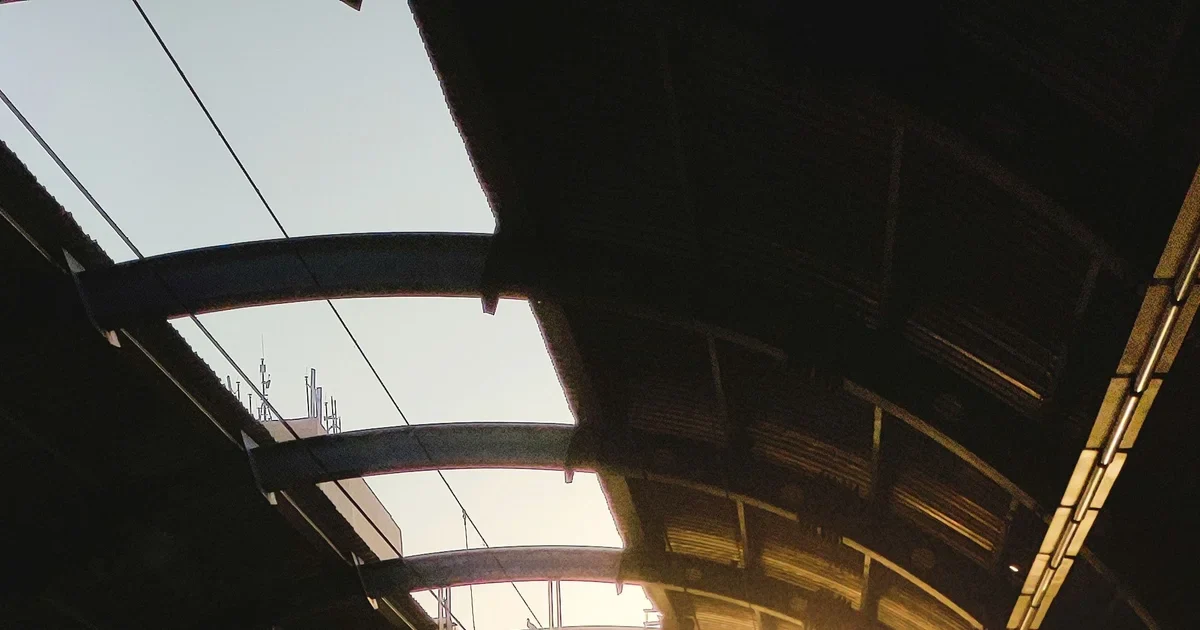
A metro train arrives at a New Delhi platform. Photo by Ankit Gupta on Pexels.
Builders of India: E. SreedharanThe Engineer Who Built the Konkan Railway and Delhi Metro, and What Public Projects Can Learn
E. Sreedharan rebuilt a cyclone-hit bridge in 46 days, then led the Konkan Railway and the Delhi Metro. What he delivered, where the record is less tidy, and what public projects can copy.
A life in chapters
Who is E. Sreedharan and why do his projects matter?
Elattuvalapil Sreedharan was born on 12 June 1932 in Palakkad district, Kerala, and trained as a civil engineer at the Government Engineering College in Kakinada. He spent his career in public service and public enterprises. He is best known for two projects: the Konkan Railway, a line through the Western Ghats built in the 1990s, and the first phases of the Delhi Metro, which opened in 2002 and finished ahead of its schedule.
Indian public works have a poor reputation for delay. Roads, bridges and rail lines routinely take years longer than planned and cost far more than promised. Sreedharan’s record matters because it shows that a government-owned body can build hard things quickly, and that the reasons are mostly about organisation, not luck or special talent. This article follows his main projects, uses the best available sources for the numbers, and looks honestly at where the record is less tidy than the legend. His name was later also linked to politics, but this piece is about engineering and management only.
What did he do at Pamban in 1964?
The story that made his name inside the railways began in December 1964. A cyclone destroyed much of Dhanushkodi, and parts of the Pamban rail bridge, which connects Rameswaram island to the mainland, were washed away. The railway estimated six months for repairs, and Sreedharan’s superior reduced that to three months. Sreedharan, then a young engineer in his early thirties, restored the bridge in 46 days. The News Minute and his Wikipedia biography both give this account.
It is a single anecdote, and anecdotes grow in the retelling. What matters is the pattern it shows: a hard, visible deadline, a small team given authority, and an engineer who treated delay as a cost. He later applied the same thinking on larger scales.
How did the Konkan Railway come about?
People had asked for a rail line along the Konkan coast for decades. Surveys began in the early 1970s, and a first section from Apta to Roha opened in March 1986. The hard part was the stretch between Roha in Maharashtra and Mangalore in Karnataka, through a coast cut by rivers and backed by the Western Ghats. Konkan Railway’s own history page says no survey data existed for the Maharashtra half of the line and that earlier alignments had sharp curves and steep gradients, so the route was surveyed again.
Railway Minister George Fernandes pushed the project in 1989, and the scheme entered the 1990-91 works programme. The Konkan Railway Corporation Limited (KRCL) was incorporated on 19 July 1990, and the foundation stone was laid at Roha on 15 September 1990. Sreedharan, a Member of the Railway Board, was appointed Chairman and Managing Director.
Why was a corporation used instead of the railway ministry?
Money was the obstacle. According to the Konkan Railway history page, the economist Bimal Jalan suggested a corporation model in which the Centre and the states that would benefit would raise the funds together. Maharashtra, Goa, Karnataka and Kerala became partners in an autonomous company. Business Today reports that Sreedharan proposed a special purpose vehicle on a build-operate-transfer basis, with the states contributing roughly one-third of the cost and the market funding the rest. Under the normal budget route, the same article says, construction could have taken 20 to 25 years. The Konkan history page notes that 100 km of easier terrain had once taken 20 years.
The corporate form was the first big decision. It moved the project out of the annual railway budget cycle and gave it a single manager with a single deadline.
How was the Konkan line built?
Sreedharan designed a small organisation. The line was split into seven sectors of about 100 km each, each led by a chief engineer, with a corporate office of specialist officers above them. At the peak of construction, according to KRCL, there were about 2,400 people on the payroll, including around 400 young field engineers. Computer networks linked the sectors so that decisions did not wait for files to travel. This was an unusual set-up for a railway project in the early 1990s.
The engineering was hard. Sources differ on exact counts, which is a common problem with large projects described decades later. Reports give the line as roughly 740 km, though some sources say 738.9 km, 741 km or 760 km. They give about 90 tunnels covering around 82 to 84 km, and many hundreds to some 2,000 bridges depending on how a bridge is counted. This article therefore uses round numbers only. The Karbude tunnel, near 6 km long, is often cited as the longest.
Sreedharan’s approach to setbacks is reported by the News Minute. When one tunnel team hit solid rock and had to start another bore, he is quoted as telling them not to worry about the budget, saying that the more the work is delayed, the more it costs, so start now. The principle is stated simply: money lost to delay usually exceeds the money spent on speed.
Was the Konkan Railway on time and on budget?
Partly, and the details matter. The line was commissioned on 26 January 1998. That is about seven years and four months after the foundation stone. KRCL was originally given five years, later shortened to four and a half. So it was late against its own target, and early against the 20 to 25 years it would likely have taken by normal methods.
On cost, Business Today reports an estimate of about Rs 1,600 crore at the start. A reply in the Rajya Sabha in July 2019 gave the final completion cost as Rs 3,555 crore. The two numbers are not strictly comparable. The original estimate was made in 1990 for a longer alignment of about 840 km, and prices rose through the 1990s. Still, a project cost that more than doubled in nominal terms is not a clean claim of staying on budget. A fair summary is that the Konkan Railway was built quickly and at a cost that was high relative to the first estimate, but far below the cost of delay.
What did the Konkan Railway change?
For the western coast, the line replaced a long detour through the interior. Business Today, quoting Sreedharan, says it cut travel time by about 12 hours and distance by 650 km on the Mumbai to Mangalore run. It brought rail to towns and fishing ports that had never had it, and it linked Maharashtra, Goa, Karnataka and Kerala by a single route. The ownership of the company is shared among the Centre and those states.
It also gave Indian engineers practical experience in long tunnels and soft-ground tunnelling, which the country had done little of before.
Why had nobody built the Konkan line before?
The demand was old and the maps were drawn. Konkan Railway’s history page records a cursory survey to Mangalore in 1971 to 1973 and an in-depth survey of the Dasgaon to Ratnagiri section in 1975 to 1977. In 1977 Railway Minister Madhu Dandavate sanctioned the first stage from Apta to Roha, and it opened in March 1986, nine years later. A final location survey for the Roha to Mangalore line was authorised in October 1984, and the Southern Railway submitted its report in July 1988.
That is the usual life of a big Indian project: a survey, a report, a sanction, a funding gap and a wait. The Konkan Railway broke the pattern only when the funding problem was solved by a new structure and the construction was given to a single body with a single deadline. The engineering was not new. The organisation was.
How did Sreedharan come to the Delhi Metro?
The Delhi Metro Rail Corporation (DMRC) was set up in 1995. Sreedharan became its managing director in November 1997 and stayed until the end of 2011.
One episode is well documented. The News Minute reports that he insisted on Japanese consultants over a German firm that the then Railway Minister preferred, and held his position. Whatever the merits of each side, the point is that the managing director had the standing to decide on technical grounds.
What did the first phase deliver?
The first stretch of the Delhi Metro, from Shahdara to Tis Hazari, was opened by Prime Minister Atal Bihari Vajpayee on 24 December 2002 and opened to the public the next day. It was 8.4 km long. Phase 1 as a whole, about 65 km, was completed in 2005 and 2006. ThePrint reports that it finished two years and nine months ahead of schedule and without exceeding the budget. Railway Gazette reported the first phase cost at Rs 105.6 billion. Estimates of the figure differ between sources, from roughly Rs 89 billion to Rs 98 billion after revisions, so the exact cost should be checked in DMRC’s official documents.
Phase 2 followed, and Sreedharan stayed on until the end of 2011 after about 16 years with the corporation. The News Minute describes him as meeting every deadline within budget, and puts the network he handed over at around 168 km. Today the Delhi Metro has a constructed network of around 393 km with 288 stations, as of September 2023, and set a single-day record of 72.38 lakh journeys on 13 August 2024, reported by the Deccan Herald.
Those later phases were not all his, and the network has grown under other managers. But the system that millions use every day grew from the practices of the early years.
How do the two projects compare?
Point | Konkan Railway | Delhi Metro, Phase 1 |
|---|---|---|
Body | Konkan Railway Corporation Ltd, owned by the Centre and four states | Delhi Metro Rail Corporation, a joint company of the Centre and Delhi |
Start | Foundation stone, 15 September 1990 | Company set up 1995; first section opened 24 December 2002 |
Delivery | Commissioned 26 January 1998, about seven years four months after the foundation stone | Completed 2005 to 2006, reported two years nine months ahead of schedule |
Cost | Estimate Rs 1,600 crore (1990); reported final cost Rs 3,555 crore | Reported at about Rs 105.6 billion; described as within budget |
Setting | Rural, hills and rivers, a long single line | Dense city, land, utilities and traffic |
The table shows why one set of lessons does not fit everything. The Konkan project fought geography; the Delhi project fought the city. In both, the common element was a body that could plan the whole job from the first day, and a head who could be held to the date.
What did the Delhi Metro mean for the city’s riders and its air?
The Delhi Metro was certified by the United Nations in 2011 as the first rail-based system in the world to earn carbon credits, ThePrint reports, with emissions cut by about 6.3 lakh tonnes a year. That is a measured environmental gain, and a reminder that a transit system can serve climate goals as well as convenience.
The social record is more mixed. The system is clean, punctual and safe by Indian standards, which is why many people choose it over a car or a scooter. Yet two fare rises in 2017 and the Centre for Science and Environment finding on affordability show how fast a well-run system can become hard to afford for the poorest commuters. A public project’s success includes its price at the gate, not only its date.
What management habits stand out?
The sources do not give a rule-book. But the facts in this story point to a few repeating habits:
- Autonomy by structure. Both KRCL and DMRC were separate companies owned by government, not departments. They had their own boards, their own funds and a managing director who could decide.
- A small, young team. Konkan ran on about 2,400 people, including 400 young field engineers, instead of a large department.
- Fast communication. Networks linked the sectors in the early 1990s. Decisions did not wait for files.
- Deadlines treated as cost. The tunnel remark shows an engineer who counted delay as a cost line.
- Technical decisions on technical grounds. The Japanese consultants episode shows a manager refusing to yield on a choice he thought was right.
- Planning for disputes. In 2009, a dispute over land on the Delhi-Gurgaon line threatened delay. The News Minute reports his team used prefabricated steel to build a station frame while the case was settled over six months, so work did not stop.
None of this is secret. What is rare is doing all of it together, for years, and keeping politicians and contractors from interfering. His own biography credits him with shielding projects from political pressure, though that claim comes from one profile and cannot be tested from outside.
Where does the legend need care?
A fair profile should say where the record is less perfect.
- Konkan cost and time. As above, the line was late against its own target and the cost is not a simple success story.
- Fares and access. Delhi Metro raised fares twice in 2017. A Centre for Science and Environment study, reported by ThePrint, ranked it the second most unaffordable transit system in the world in terms of the share of commuter income spent on a journey. Ridership reportedly fell by about 4.2 lakh passengers after the hike. A system that finishes on time but prices out low-income riders only partly serves its purpose.
- Public statements. After retirement he spoke strongly on policy, including calling the Mumbai-Ahmedabad bullet train highly expensive and aimed at the elite, and arguing that Indian Railways should raise fares rather than borrow for operations. Reasonable engineers disagree with some of these views, and readers should treat them as opinions, not findings.
- Source quality. Many sources for the Konkan numbers are tribute pieces written after Fernandes’s death or profile articles that repeat each other. For a project this famous, the primary documents (KRCL, DMRC, parliamentary replies, audit reports) matter more than profiles.
None of this removes the achievement. It means the lesson is about method, not about one man.
What can public projects learn from Sreedharan?
- Give the project its own legal body. A project company with a clear owner and a clear deadline avoids the delays of annual budgets and department files.
- Pick a manager and let that person decide. A single accountable head, with technical authority, is the biggest difference between his projects and the typical one.
- Keep the team small and skilled. More staff does not mean faster work.
- Count delay as money. Interest, price rises and lost benefits mount up daily. A deadline is a budget line.
- Plan for the dispute before it arrives. The 2009 prefabricated-station solution shows planning around a legal or land delay.
- Publish the numbers. The confusion over Konkan’s length, tunnels and cost shows what happens when a project does not keep a public, simple record.
- Measure who can use it. Fares, access and last-mile links decide who benefits, and need the same discipline as construction.
Other Indian cities are now building metros and bus systems. Our look at Curitiba’s bus rapid transit argues that smaller cities may be better served by buses at lower cost, and Helsinki’s single-ticket system shows how to make different modes work as one. The state of Indian trains themselves is covered in our piece on the rail network and its punctuality. Two other builders in this series, Verghese Kurien and M.S. Swaminathan, also built institutions rather than just structures.
What you can do
- Check a local project’s status. Many state and city projects publish expected completion dates. Look up the plan for your nearest metro, flyover or road, and compare it with what you see.
- Use the right to information. An RTI application can ask for the sanctioned cost, the revised cost and the reasons for any delay on a public project.
- Attend public hearings. Metro and highway projects hold consultations on route and land. Go, ask questions and note the answers.
- Ask about fares and access. Ask your city’s transport body how fares were set and who the project is meant to serve.
- Support project bodies with a single owner. When your city proposes a new rail or bus project, ask who the single accountable head is and what the deadline is.
- Use public transport and report problems. Complaints on cleanliness, safety or access, filed with dates, help managers fix them.
- Read the audit. The Comptroller and Auditor General’s reports on infrastructure are public and plain-language summaries are available.
Frequently asked questions
Who is E. Sreedharan?
He is an Indian civil engineer, born in 1932, who led the Konkan Railway Corporation from 1990 and the Delhi Metro Rail Corporation for about 16 years until the end of 2011. He received the Padma Shri in 2001 and the Padma Vibhushan in 2008.
How long did the Konkan Railway take to build?
The foundation stone was laid in September 1990 and the line was commissioned on 26 January 1998, about seven years and four months later.
Was the Konkan Railway finished within budget?
Not in nominal terms. A 1990 estimate of Rs 1,600 crore compares with a reported final cost of Rs 3,555 crore, though the early figure covered a different alignment and prices rose.
Was the Delhi Metro delivered on time?
ThePrint reports that Phase 1 was completed two years and nine months ahead of schedule without exceeding the budget. Different sources give different cost figures.
What happened at Pamban in 1964?
After a December 1964 cyclone damaged the Pamban bridge, Sreedharan led repairs that restored it in 46 days against a target of three months.
What is the main lesson from his work?
Organisation matters more than heroics: an autonomous project body, a small skilled team, one accountable head and deadlines treated as cost.
Who owns the Konkan Railway?
Konkan Railway Corporation Limited is a public company owned by the Government of India and the governments of Maharashtra, Karnataka, Goa and Kerala, the four states the line serves.
Why do experts still study these projects?
Because they were built by public bodies, with public money, in difficult conditions, and the main reasons for their speed are organisational choices that other agencies can copy: a separate company, a small team, one accountable head and a fixed date.
The bottom line
Sreedharan’s record shows that India can build hard things fast with public money. The Konkan Railway took a little over seven years against the two or three decades it might have taken, and the Delhi Metro’s first phase finished well ahead of its schedule. The record also contains late dates, cost growth and questions of fare and access. The lasting lesson is not a man but a method: give a project its own body, one head and a clear deadline, count delay as money, and publish the numbers so the next project can do better.
What you can do
- Share the evidenceSend this to one person who should know about governance.Share on WhatsApp
- Give an afternoonTeach, mentor, clean up, or lend your professional skills.Ways to volunteer
- Tell us what's missingKnow a story, a fact we got wrong, or a solution worth spotlighting?Suggest a story
Politically neutral. Every claim sourced. Report a correction.
No comments yet