India's Street Food Economy: How 10 Million Vendors Feed the Nation
India's street food economy employs 10 million vendors and feeds hundreds of millions daily. Covers FSSAI licensing, hygiene standards, economic contribution, regional specialties, and the Street Food Hubs initiative.
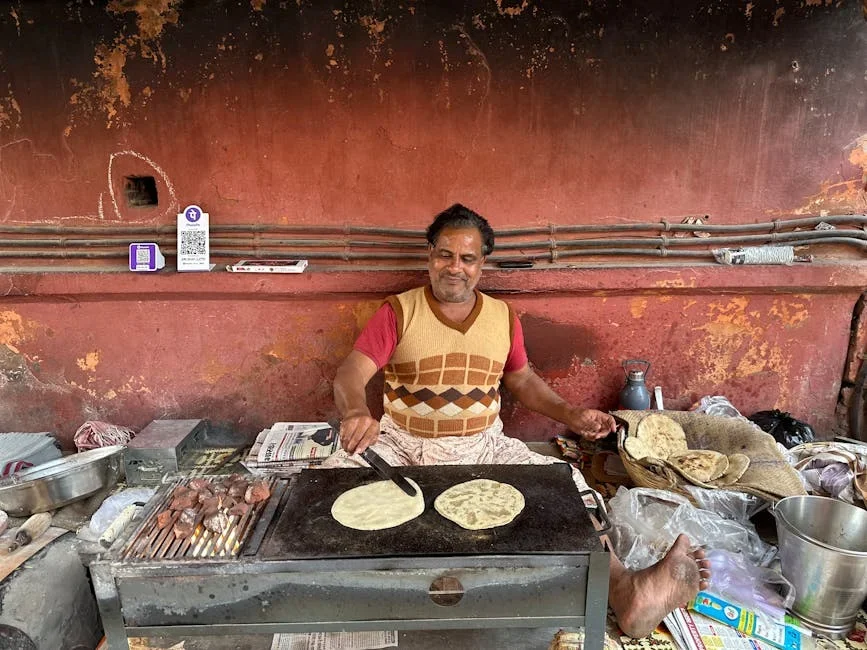
Every morning, before the rest of the city stirs, Ramesh Kumar unfolds a cart on a narrow lane in Varanasi, lights a kerosene stove, and begins kneading dough for the day’s first batch of kachoris. By seven o’clock he has served sixty customers and earned more than most salaried workers make before noon. Ramesh is one of an estimated 10 million street food vendors across India, a workforce larger than the entire population of Switzerland, and together they feed hundreds of millions of people every single day.
A 3,000-Year-Old Industry Hidden in Plain Sight
Street food in India is not a modern phenomenon born of urban congestion. Archaeological evidence from the Indus Valley Civilisation suggests that food stalls existed in ancient Mohenjo-daro, and the traveller Ibn Battuta noted in the 14th century that hot-food sellers lined the roads entering Delhi. What has changed is scale. India’s rapid urbanisation since the 1990s has swelled the informal food sector into something economists describe as a critical parallel economy, one that absorbs rural migrants, enables low-income households to eat affordably, and generates enormous tax-invisible wealth.
The National Association of Street Vendors of India (NASVI) estimates that street food vendors collectively turn over between ₹40,000 crore and ₹60,000 crore annually, figures that, if formalised, would comfortably outrank many mid-cap listed companies. Yet the sector operates largely in the shadows, misunderstood by policymakers, periodically harassed by municipal authorities, and almost entirely absent from formal GDP accounting.
The Economic Backbone of Urban India
To understand why street vendors matter economically, consider what they provide. A plate of pav bhaji in Mumbai costs between ₹50 and ₹80. The same dish in a mid-range restaurant costs ₹180 to ₹250. For the factory worker earning ₹12,000 a month and feeding a family of four, that gap is the difference between lunch being a sustainable daily habit and an occasional treat. Street food is, at its most essential, an affordable calorie delivery system for urban India’s working class.
But vendors do far more than feed people cheaply. Each vendor is a micro-enterprise that supports multiple supply chains: the vegetable wholesaler who sells them onions and tomatoes, the flour mill whose produce ends up in the dough, the utensil-maker, the kerosene or LPG supplier, the cleaning-cloth vendor who passes by each morning, and the waste collector who manages their scraps. A 2019 study by the International Labour Organization found that for every direct street vendor job, an average of 2.3 additional jobs exist in the upstream and downstream supply chain. Scale that across 10 million vendors and the economic multiplier effect becomes staggering.
“Street food vendors are the last-mile logistics of nutrition for Indian cities. Remove them and you create a hunger crisis overnight.”
Prof. Chirashree Das Gupta, Jawaharlal Nehru University
Income Profiles Across India
Vendor incomes vary enormously by city, location, and speciality. Street food entrepreneurs in high-footfall urban corridors, a metro station exit, a college gate, a hospital entrance, can net ₹800 to ₹2,000 daily after raw material costs. In smaller towns and rural district headquarters, that figure drops to ₹300 to ₹600. The average, according to a 2022 survey by the Institute for Human Development, sits around ₹550 per day, or roughly ₹16,500 a month. That places the median street vendor within the same income band as a skilled blue-collar worker or a Tier-3 town schoolteacher.
City Tier | Average Daily Net Income | Dominant Products |
|---|---|---|
Metro (Mumbai, Delhi, Bengaluru) | ₹900 - ₹2,000 | Chaat, vada pav, rolls, dosa |
Tier 1 (Pune, Jaipur, Ahmedabad) | ₹600 - ₹1,200 | Biryani, kachori, bhel puri |
Tier 2 (Indore, Lucknow, Coimbatore) | ₹400 - ₹800 | Poha, samosa, paratha |
Tier 3 and Rural | ₹200 - ₹500 | Tea, pakoras, fruit chaat |
FSSAI Licensing: The Formalisation Battle
In 2006, the Food Safety and Standards Authority of India (FSSAI) was established to bring coherence to the country’s fragmented food safety laws. For street vendors, the most directly relevant provision is the Basic Registration requirement under FSSAI, a streamlined, low-cost process intended to bring small food businesses into the regulatory fold without the burden of a full licence. Vendors with an annual turnover below ₹12 lakh qualify for basic registration, which costs just ₹100 per year.
Despite this accessibility, registration rates remain low. FSSAI’s own 2023 annual report estimated that only 18 to 22 percent of eligible street vendors in India have completed even basic registration. The reasons are partly bureaucratic, the online portal was historically difficult to navigate for vendors with limited digital literacy, and partly a matter of incentive: an unregistered vendor faces prosecution risk, but that risk is unevenly enforced and often resolved informally with a small bribe to a local inspector.
This is changing, however slowly. In 2023 FSSAI launched the Food Safety on Wheels initiative, deploying mobile registration vans to street markets in 22 states. The initiative also introduced vernacular-language registration assistants and waived the fee for the first year for vendors registered under PM SVANidhi, the government’s street vendor credit scheme. By March 2024, the programme had registered over 1.2 million new vendors, a significant jump, though still covering only a fraction of the total population.
What Registration Actually Changes
The practical value of FSSAI registration goes beyond compliance. Registered vendors gain access to formal credit through banks and NBFCs, can participate in government procurement schemes such as supplying meals to school midday meal programmes, and face dramatically less harassment from municipal officials. Perhaps most importantly, registration creates a formal identity that vendors can use to access other welfare schemes, health insurance under Ayushman Bharat, housing subsidies, and now direct benefit transfers linked to the PM SVANidhi microloan scheme.
Hygiene Standards: The Gap Between Aspiration and Reality
Ask any street food aficionado in India about hygiene and you will get two very different answers depending on who you ask. The loyal daily customer of a particular chaat stall will insist, correctly, that their vendor maintains scrupulous personal hygiene and sources fresh ingredients every morning. The public health researcher will present equally valid data showing that contaminated water, inadequate handwashing facilities, and inconsistent cold chain management create genuine food safety risks.
Both are right. Street food safety in India exists on a wide spectrum. A 2021 study published in the Indian Journal of Community Medicine tested food samples from 200 street vendors in four major cities and found that 34 percent of samples showed microbial contamination above acceptable FSSAI limits, most commonly due to coliform bacteria associated with contaminated water or unwashed hands. Yet the study also noted that vendors who had received any form of food safety training showed contamination rates 60 percent lower than untrained counterparts.
This is the essential insight driving government hygiene programmes: the problem is not the existence of street food but the absence of basic training and infrastructure. Most street vendors cannot access potable running water at their vending spot. Most do not have cold storage facilities. Most work 10 to 14 hours daily and have neither the time nor the resources to complete formal food safety courses offered in urban centres during weekday hours.
Clean Street Food Hub Initiative
The response from the Ministry of Housing and Urban Affairs and FSSAI is the Clean Street Food Hub initiative, which designates specific street food zones in cities and invests in shared infrastructure: clean water connections, washbasins, solid waste bins, and, crucially, regular free food safety training for all vendors in the zone. By end of 2023, over 100 Clean Street Food Hubs had been certified across 31 cities, with cities like Indore, Ahmedabad, and Mysuru leading the programme with multiple certified hubs each.
The results in certified hubs have been measurable. FSSAI’s monitoring data shows that food sample pass rates, the percentage of tested samples meeting safety standards, in certified hubs average 89 percent, compared to 66 percent in uncertified street food clusters in the same cities. Consumer footfall in the hubs has also increased significantly, suggesting that when hygiene is visibly improved and officially certified, Indian consumers respond with increased patronage rather than indifference.
Regional Specialties: A Country of a Thousand Street Foods
No discussion of India’s street food economy is complete without confronting its extraordinary regional diversity. India does not have one street food culture, it has dozens, each rooted in local agriculture, religious tradition, and culinary history. Understanding this diversity is not merely gastronomic pleasure; it is economically significant because regional specialties carry embedded cultural capital that can be monetised through food tourism, GI tagging, and export of packaged versions.
- Mumbai’s Vada Pav: Often called the Indian burger, vada pav feeds an estimated 1.2 million Mumbaikars daily. The vada pav ecosystem alone, from potato farmers in Nashik to the pav bakeries of Dharavi, supports tens of thousands of livelihoods. The dish is so culturally embedded that the Maharashtra government declared it the state’s official street food in 2021.
- Kolkata’s Kathi Rolls: Born at Nizam’s restaurant in 1932, the kathi roll has evolved into a sprawling informal economy along Park Street and New Market. Kolkata’s roll vendors, estimatedly 80,000 across the city, turn over an estimated ₹500 crore annually.
- Hyderabad’s Irani Chai and Osmania Biscuits: The Irani cafe culture centred on double-ka-meetha and the thick, milky Irani chai sustains hundreds of small establishments in the old city. These spaces serve as community hubs for Hyderabad’s working-class neighbourhoods, and their economic role extends well beyond food into social infrastructure.
- Amritsar’s Langar Economy: The Golden Temple serves free langar to over 100,000 pilgrims daily, creating a massive demand-side pull for wheat, dal, ghee, and vegetables from Punjab’s surrounding farmlands. Outside the temple, the streets around Amritsar host one of India’s densest concentrations of food stalls, including the famous kulcha-chole vendors of Katra Ahluwalia.
- Chennai’s Idli-Dosa Belt: South Indian tiffin culture, idli, dosa, medu vada, pongal, supports what food economists estimate is a ₹8,000 crore annual market in Tamil Nadu alone. The standardisation and quality of South Indian street breakfast is remarkable: a ₹30 idli from a Chennai tiffin stall routinely matches the hygiene and taste of expensive restaurant versions.
- Indore’s 56 Dukan: The Chappan Dukan (56 Shops) area in Indore’s Vijay Nagar is considered by many food historians as India’s most concentrated street food microclimate. This small stretch has launched national brands including Shree Vijay Chaat House and has become a pilgrimage site for food journalists. Indore was also the first Indian city to achieve a fully certified street food hub under the national initiative.
Geographic Indication Tags and Brand Value
Several iconic street foods are now pursuing Geographical Indication (GI) tags, a legal protection that restricts commercial use of a name to products originating from a specific region. Kolkata’s rosogolla obtained a GI tag in 2017 after a high-profile dispute with Odisha. Hyderabad’s Haleem was GI tagged in 2010, becoming the first meat product in India to receive the designation. Discussions are ongoing for GI tags on Lucknow’s Tunday Kababi-style galawati kebabs and Mumbai’s vada pav.
The economic significance of GI tags for street food is complex. They protect the identity and premium pricing of authentic regional foods, but they also create tension with the mobile, informal nature of street food production. A vendor in Bengaluru selling “Lucknowi biryani” is not violating a GI tag because biryani is not yet GI-protected, but if awareness grows, the informal economy’s freedom to adopt any regional style anywhere in India could be constrained.
PM SVANidhi: Microcredit as a Formalisation Tool
Launched in June 2020, deliberately during the COVID-19 economic crisis to rehabilitate street vendors whose livelihoods had been annihilated by lockdowns, PM SVANidhi (PM Street Vendor’s AtmaNirbhar Nidhi) is arguably the most significant policy intervention in the street food sector in a generation. The scheme provides collateral-free working capital loans in three tranches: ₹10,000 in the first tranche, ₹20,000 in the second (on timely repayment of the first), and ₹50,000 in the third.
By February 2024, over 6.8 million loans had been disbursed under PM SVANidhi, totalling more than ₹11,000 crore. The scheme’s repayment rates have surprised sceptics: the national average loan repayment rate exceeds 90 percent, significantly higher than many formal retail lending products. The scheme also digitised vendor profiles through a dedicated app, creating a database that FSSAI has used to target registration drives.
Critically, the scheme requires that vendors have a vending certificate from their local Urban Local Body, which has created administrative momentum for cities to actually issue these certificates to previously undocumented vendors. Before SVANidhi, only 14 of India’s 100 largest cities had completed comprehensive street vendor surveys as required under the Street Vendors (Protection of Livelihood and Regulation of Street Vending) Act, 2014. Post-SVANidhi, that number had risen to over 70 by 2023.
The Street Vendors Act, 2014: Legal Recognition at Last
For most of India’s post-Independence history, street vendors existed in a legal grey zone. Municipal laws in most states gave wide discretionary power to police and civic officials to remove vendors from public spaces, with little recourse for vendors who had operated in the same spot for decades. The result was a system of informal rent-seeking: vendors paid regular “fees” to police constables, ward officials, and local political operators to maintain their pitches. These payments were ubiquitous, extortionate, and entirely unaccounted for.
The Street Vendors (Protection of Livelihood and Regulation of Street Vending) Act, 2014, fundamentally changed the legal framework. The Act mandates that every Urban Local Body constitute a Town Vending Committee with one-third representation from vendors themselves, conduct a survey of all vendors within their jurisdiction, issue vending certificates to eligible vendors, and designate vending zones in the city plan. It also prohibits relocation of vendors without providing an alternative site and caps fees for vending certificates.
Implementation has been uneven. States like Odisha, Tamil Nadu, and Madhya Pradesh have moved relatively quickly to constitute Town Vending Committees and conduct surveys. Others, notably several large northern states, have been slow to operationalise the Act, and vendors there continue to face harassment despite the legal protections on paper. NGO networks like NASVI and the Self-Employed Women’s Association (SEWA) have filed Public Interest Litigations in multiple High Courts to force compliance, with mixed results.
Street Food Hubs of India Initiative: Creating Destinations
While the Clean Street Food Hub initiative focuses on hygiene certification, the separate Street Food Hubs of India initiative, a joint programme between the Ministry of Tourism, the Ministry of Housing and Urban Affairs, and FSSAI, aims to transform India’s best street food clusters into recognised tourism destinations. The programme identifies historically significant food streets, invests in physical infrastructure (uniform stall design, lighting, signage, seating areas), provides vendor training in hospitality and food safety, and promotes the locations through national and international tourism campaigns.
The programme has designated 25 Street Food Hubs of India to date, including Paranthe Wali Gali in Delhi’s Chandni Chowk, the Zaveri Bazaar food lanes in Mumbai, Anna Nagar in Chennai, and the Bamboo Shoot area in Guwahati, one of the few hubs to specifically spotlight North-East Indian cuisine. The tourism angle is deliberate: food tourism is one of the fastest-growing segments of domestic travel in India, and street food is consistently cited in consumer surveys as a primary motivator for visiting specific cities.
The economic impact of hub designation is visible. Vendors on Delhi’s Paranthe Wali Gali report income increases of 40 to 60 percent since the lane’s formal recognition and promotion, driven largely by domestic and international food tourists who would not previously have ventured into the congested lanes of old Delhi. Food tourism generates what economists call a place premium, visitors are willing to pay two to three times normal street food prices in a recognised “famous food street” context, even for identical products.
Women in Street Food: An Undercount and an Opportunity
Roughly 28 to 32 percent of India’s street vendors are women, according to NASVI surveys, but this number significantly undercounts female participation because it misses women who operate food stalls from home doorways, women who process ingredients for their husbands’ stalls without operating independently, and women in SEWA-affiliated cooperatives who sell through collective structures rather than individual pitches.
Female street food vendors in India face compounded challenges: the same regulatory and harassment pressures as male vendors, plus the additional barriers of cultural restrictions on women occupying public commercial space independently, safety concerns at early-morning or late-evening operating hours, and lower access to credit because many schemes require property documentation that women in informal households rarely hold in their own names.
SEWA has addressed some of these barriers through collective organising. In Ahmedabad, SEWA’s street vendor cooperative provides shared storage facilities, collective bargaining with municipal authorities for vending zone allocations, group FSSAI registrations, and peer networks for safety and solidarity. The SEWA model has been replicated in over 12 cities and is increasingly cited by international development organisations as a template for inclusive formalisation of informal food economies.
Digital Payments and the New Street Food Economy
The UPI revolution has reached the street food cart. As of 2023, approximately 45 percent of urban street food vendors in metro cities accept digital payments via UPI QR codes, up from under 5 percent before the COVID-19 pandemic. The shift was accelerated by the disruption to cash handling during the pandemic and by the government’s aggressive push to link PM SVANidhi loan disbursements and repayments to digital accounts.
Digital payments have done more than replace cash. They have created transaction records that vendors can use to demonstrate income and build credit histories. A vendor with 18 months of consistent UPI transaction records has data that can support a bank loan application, a more accurate tax assessment, or an MSME registration that unlocks new government schemes. The National Payments Corporation of India has partnered with FSSAI and the Urban Livelihoods Mission to specifically promote this credit history building among registered vendors.
Platform aggregators have also entered the space. Zomato and Swiggy have both launched dedicated programmes to onboard street food vendors onto their delivery platforms, recognising that the informal sector’s price points and product variety offer something their existing restaurant partners cannot match. Zomato’s “Street” category, launched in 2022, had onboarded over 40,000 vendors across 15 cities by end of 2023, generating average incremental revenues of ₹4,000 to ₹8,000 per month per participating vendor.
The Environmental Dimension: Single-Use Plastic and the Street
India’s ban on certain single-use plastics, implemented from July 2022, created a significant disruption for street food vendors who had relied on plastic bags, straws, and disposable cutlery as cost-efficient serving options. The transition cost fell disproportionately on small vendors who lacked the capital to switch quickly to alternatives or the knowledge to navigate the complex list of banned versus permitted items.
Creative adaptation has followed. Leaf plate makers in Odisha and Chhattisgarh, a traditional industry that had been in decline, have seen a dramatic revival, with leaf plate production increasing by an estimated 40 percent in 2022-23. Areca palm sheath plates from Tamil Nadu and Karnataka have found new markets. In Mumbai, a network of women’s self-help groups has pivoted to making newspaper cones for chaat vendors, creating new income streams while solving the vendor’s packaging problem.
The environmental transition is not complete, enforcement of the plastic ban at street food level remains patchy, but the directional shift is visible and, in many cities, self-reinforcing as consumers begin to associate the absence of plastic packaging with hygiene and quality rather than mere regulatory compliance.
What Would Full Formalisation Look Like?
India’s street food sector stands at a crossroads. The policy infrastructure for formalisation, the Street Vendors Act, PM SVANidhi, FSSAI registration, the Clean Street Food Hub initiative, the Street Food Hubs of India tourism programme, now exists in a way it did not a decade ago. The question is whether implementation can catch up with ambition.
Full formalisation, if achieved, would add an estimated ₹35,000 to ₹50,000 crore to India’s formal tax base annually, extend health insurance and pension coverage to 10 million households currently outside the formal safety net, dramatically reduce the extortion economy that currently siphons vendor earnings into unofficial payments, and create a platform for street food to become a genuine cultural export, through food tourism, packaged product lines, and the soft power of India’s culinary diversity reaching international audiences.
The risk is that formalisation becomes an excuse for displacement, using hygiene standards and vending zone regulations as administrative tools to clear vendors from premium urban spaces to satisfy real estate interests rather than public health goals. This has happened in cities from Beijing to Lagos, and Indian urban planners have not been immune to the temptation. The Street Vendors Act was written precisely to prevent this, but laws are only as strong as the institutions that enforce them and the communities that hold those institutions accountable.
The Way Forward
Ramesh Kumar, the kachori vendor in Varanasi, obtained his FSSAI basic registration in 2022 through a camp organised at the Kashi Vishwanath Corridor, itself a government infrastructure project that swept away many informal vendors in the name of renovation, but also created a new designated food zone where Ramesh now has a certified spot with a water connection and a waste bin. His income has increased by 35 percent since the move, and he has applied for a ₹20,000 SVANidhi second-tranche loan to buy a better stove.
His story is neither a straightforward success nor a simple failure. It is what India’s street food transition actually looks like, messy, uneven, often unjust in its disruptions, but incrementally moving toward a world where 10 million vendors have legal security, safe working conditions, access to capital, and the formal recognition that their extraordinary contribution to India’s food system has always deserved.
India feeds itself through these ten million hands. The least the nation can do is feed them in return, with policy, protection, and the acknowledgment that the ₹30 plate of poha served on a crowded street corner at 7 a.m. is not an informal afterthought. It is the foundation.
Support India’s Street Food Vendors
The formalisation of India’s street food economy is a cause that every Indian, whether a daily customer, a policymaker, or a food journalist, can actively support. Choose registered vendors. Pay digitally when possible. Advocate for your city to complete its vendor survey under the Street Vendors Act. And the next time you eat a plate of chaat or a dosa on the street, consider what it cost in labour, skill, and resilience to get that plate in front of you.
Join the conversation on Unite4India and share your favourite street food story. Every vendor has one, and every story adds to the record of an economy that deserves to be seen.
What you can do
- Share the evidenceSend this to one person who should know about this issue.Share on WhatsApp
- Give an afternoonTeach, mentor, clean up, or lend your professional skills.Ways to volunteer
- Tell us what's missingKnow a story, a fact we got wrong, or a solution worth spotlighting?Suggest a story
Politically neutral. Every claim sourced. Report a correction.
No comments yet