Types of Millets in India: Names in Hindi, Tamil and Telugu, and Where Each Is Grown
Names of the types of millets in India in Hindi, Tamil and Telugu, with the states that grow each one, from ICAR-IIMR research data.
In this story
Short answer: there are two big millets, sorghum (jowar) and pearl millet (bajra), and a group of seven small millets: finger millet (ragi), little millet, kodo millet, foxtail millet, barnyard millet, proso millet and browntop millet. Foxtail millet is kangni in Hindi, thinai (spelled tenai in one scientific table) in Tamil and korra in Telugu. This guide gives the names of the types of millets in India in Hindi, Tamil and Telugu, and shows which states grow each one. The names and farm data come from the ICAR-Indian Institute of Millets Research (IIMR) in Hyderabad.
Types of millets in India
IIMR is the national research institute for millets. A paper by an IIMR scientist in Indian Farming (January 2023) sets out the family clearly. In India, sorghum, pearl millet and a group of seven small millets together make up the millets family. The seven small millets are:
- Finger millet (Eleusine coracana)
- Little millet (Panicum)
- Kodo millet (Paspalum scrobiculatum)
- Foxtail millet (Setaria italica)
- Barnyard millet (Echinochloa frumentacea)
- Proso millet
- Browntop millet (Brachiaria ramosa)
IIMR’s own website lists 12 millet types in all. It adds browntop, sekia, teff and fonio to the list. Teff and fonio are crops of Africa, and they are not widely grown in India.
The group of small millets is sometimes called “minor millets”. The word “minor” describes grain size and the area under the crop, not nutrition. In government and research writing you will also see the name Shree Anna and the term “nutri-cereals” for millets.
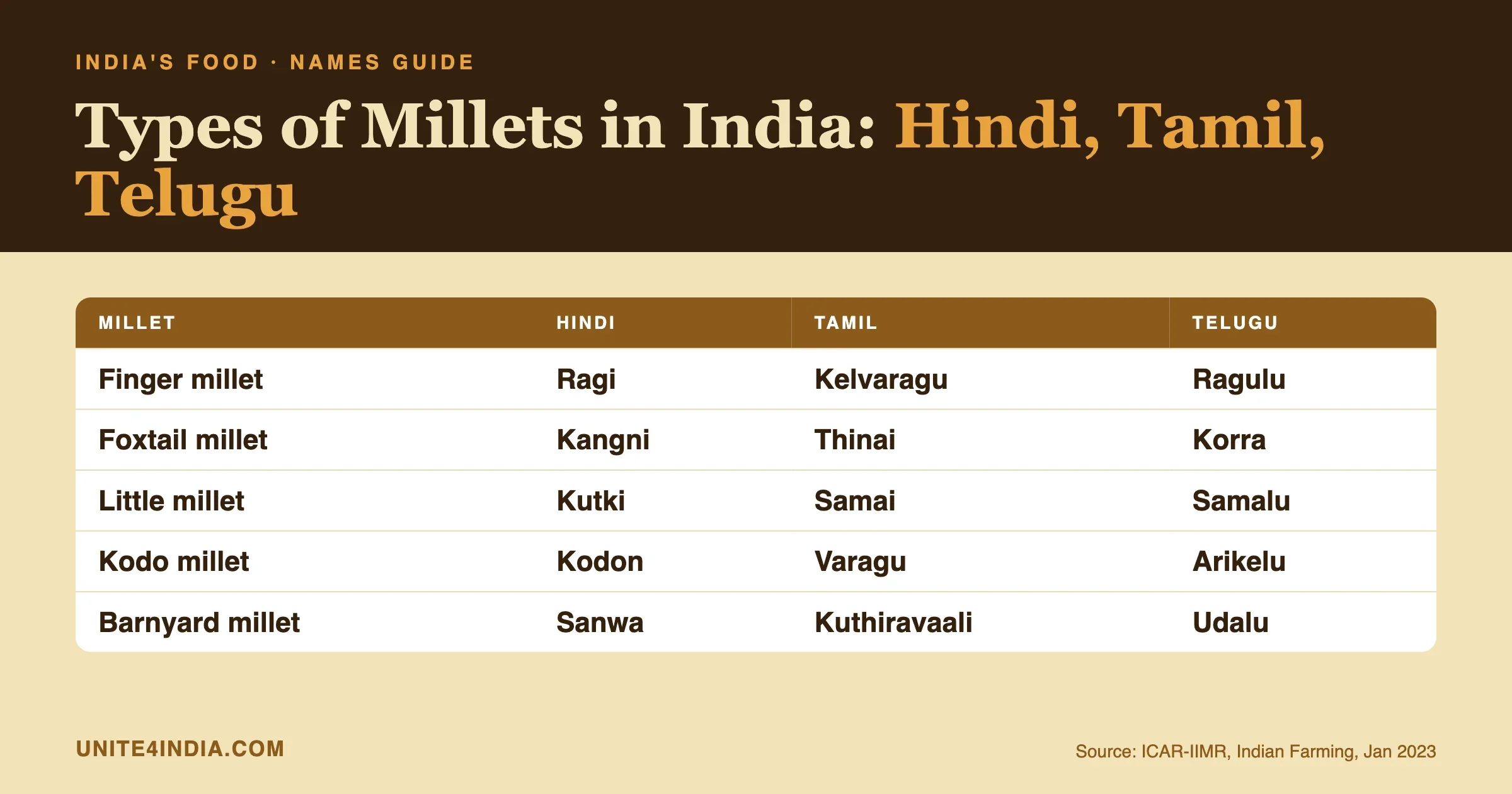
Millet names in Hindi, Tamil and Telugu
This is the table most people come looking for. The six small-millet rows follow the vernacular names table published by IIMR in Indian Farming. Spellings vary from state to state, so you may see slightly different forms in shops and on packets.
Millet | Hindi | Tamil | Telugu |
|---|---|---|---|
Finger millet | Ragi, Mundua | Kelvaragu | Ragulu |
Little millet | Kutki, Savan | Samai | Samalu |
Kodo millet | Kodon | Varagu | Arikelu, Arika |
Barnyard millet | Sanwa | Kuthiravaali | Udalu, Kodisama |
Foxtail millet | Kangni, Kakun | Tenai (commonly written Thinai) | Korra |
Proso millet | Cheena, Bari | Panivaragu | Variga |
Sorghum and pearl millet are not in that table. The names below are the ones commonly used in the three languages. They are not taken from the IIMR table, and spellings vary.
Millet | Hindi | Tamil | Telugu |
|---|---|---|---|
Sorghum | Jowar | Cholam | Jonna |
Pearl millet | Bajra | Kambu | Sajja |
Browntop millet is the rare one. The IIMR paper says it is known as Korale in Kannada and Andakorra in Telugu, and it covers only a few thousand hectares in the dryland tracts along the Karnataka and Andhra Pradesh border.
Millets in other languages
The same IIMR table covers more languages. A few examples, for the types people ask about most:
- Kannada: finger millet is ragi, foxtail is navane, little millet is same, and barnyard is oodalu.
- Malayalam: finger millet is moothari, and foxtail is thina.
- Marathi: finger millet is nachni, little millet is sava, and foxtail is kang or rala.
- Bengali: finger millet is mandua or marwa, and foxtail is kaon.
- Odia: finger millet is mandia, and little millet is suan.
- Gujarati: finger millet is nagli or bavto, and little millet is gajro or kuri.
Foxtail millet: names and where it grows
Foxtail millet is the type people search for most. It is kangni or kakun in Hindi, tenai or thinai in Tamil, korra in Telugu, navane in Kannada and thina in Malayalam. Its scientific name is Setaria italica.
The IIMR paper says foxtail millet is important in Andhra Pradesh and Karnataka. Its table of important states for foxtail millet reads: Andhra Pradesh, Karnataka, Tamil Nadu, Telangana and Rajasthan. For 2015-16, the paper gives India’s foxtail millet area as 0.87 lakh hectares, with production of 0.66 lakh tonnes and a yield of 762 kilograms per hectare. That makes it a small crop by area, even though it is a popular one with shoppers.
Where each millet is grown in India
The IIMR paper lists the important states for each small millet, based on 2015-16 data. We have also added the area, in lakh hectares, to show how big each crop is. One lakh is 100,000.
Millet | Area (lakh ha) | Production (lakh tonnes) | Yield (kg/ha) | Important states |
|---|---|---|---|---|
Finger millet | 11.38 | 18.21 | 1,601 | Karnataka, Uttarakhand, Maharashtra, Tamil Nadu, Odisha, Andhra Pradesh, Gujarat, Jharkhand, Telangana |
Little millet | 2.34 | 1.27 | 544 | Odisha, Madhya Pradesh, Chhattisgarh, Gujarat, Maharashtra, Karnataka, Tamil Nadu, Andhra Pradesh, Jharkhand |
Kodo millet | 1.96 | 0.84 | 429 | Madhya Pradesh, Chhattisgarh, Tamil Nadu, Gujarat, Maharashtra, Karnataka, Uttar Pradesh, Andhra Pradesh |
Barnyard millet | 0.96 | 0.73 | 758 | Uttarakhand, Tamil Nadu, Maharashtra, Madhya Pradesh, Karnataka, North Eastern states |
Foxtail millet | 0.87 | 0.66 | 762 | Andhra Pradesh, Karnataka, Tamil Nadu, Telangana, Rajasthan |
Proso millet | 0.41 | 0.22 | 531 | Tamil Nadu, Bihar, Karnataka, Andhra Pradesh, Madhya Pradesh, North Eastern states |
Browntop millet | - | - | - | Karnataka (Tumkur, Chitradurga, Chikkaballapura), Andhra Pradesh (Ananthpur) |
Source: ICAR-IIMR, Indian Farming, January 2023, Table 3. Data for sorghum and pearl millet are not in this table.
Finger millet: the biggest small millet
Finger millet (ragi) is the most important of the small millets. The IIMR paper says it grows from near sea level in coastal Andhra Pradesh up to 8,000 feet in the Himalayas. Karnataka is the major state, with about 65 percent of both area and production in 2019-20, followed by Uttarakhand and Tamil Nadu. Tamil Nadu has the highest finger millet yield, 3,246 kilograms per hectare. Karnataka’s yield was 1,726 and the national average was 1,697. The area under finger millet has stayed near 10 lakh hectares in recent years, while the area under the other small millets has fallen much faster.
Little millet and kodo millet: the central India crops
In Madhya Pradesh, kodo and little millet are the main small millets, according to the IIMR paper. Odisha, Chhattisgarh and Gujarat are also on the list for little millet. Yields for these two crops are low, 544 kilograms per hectare for little millet and 429 for kodo, so Madhya Pradesh has a large area under them but a smaller share of production.
Barnyard and proso millet: hills, north Bihar and the north-east
Barnyard millet and proso millet are grown mainly in the hills of Uttarakhand, the North-Eastern region, the plains of north Bihar and western Uttar Pradesh, and Maharashtra, as the paper puts it. Barnyard millet is called sanwa in Hindi, kuthiravaali in Tamil and udalu in Telugu.
State by state in 2019-20
The paper’s table for 2019-20 shows how concentrated the crop is. For finger millet, Karnataka grew about 673,700 hectares out of 1,043,000 in India. For the other small millets taken together, India’s area was 462,000 hectares, and Madhya Pradesh had the largest share at 17.3 percent of area, followed by Maharashtra at 16.5 percent and Chhattisgarh at 13.7 percent. Karnataka was the biggest small-millet producer overall, with 56 percent of production, followed by Tamil Nadu at 14 percent and Uttarakhand at 9.3 percent.
Which millet belongs to which landscape
For a quick map in words, the IIMR paper ties each crop to a type of land and region. This is a good way to remember the names, because the place often gives the clue.
- Coast to mountain: finger millet, from coastal Andhra Pradesh at sea level up to 8,000 feet in the Himalayas.
- Peninsular dry land: foxtail millet in Andhra Pradesh, Karnataka, Tamil Nadu and Telangana, and browntop millet along the Karnataka and Andhra Pradesh border.
- Central Indian plateau: kodo and little millet in Madhya Pradesh and Chhattisgarh, with little millet also important in Odisha.
- Hills and north-east: barnyard and proso millet in the hills of Uttarakhand and the North-Eastern region.
- Northern plains: barnyard and proso millet in north Bihar and western Uttar Pradesh.
The table of vernacular names also lists Punjabi and Kashmiri forms. Finger millet is mandhuka or mandhal in Punjabi, and foxtail millet is kangni in Punjabi and shol in Kashmiri. Little millet is swank in Punjabi and ganuhaar in Kashmiri. The IIMR table has gaps for some languages, shown as dashes, so a missing name does not mean the crop is unknown there.
Why the area under small millets has fallen
This is a short summary. For the history and the nutrition data, our earlier piece on India’s food map and millets goes deeper. We keep this section to the farm numbers in the IIMR paper.
- The share of small millets in India’s gross cropped area fell from 4.9 percent in 1956-61 to 0.88 percent in 2014-19.
- Their share in total foodgrain production fell from 5.2 percent in 1956-61 to 0.71 percent in 2016-21.
- Between 1951 and 2021, area under small millets other than finger millet fell by 89.7 percent, and area under finger millet fell by 52 percent.
- Total production fell by about 44 percent, which is less than the fall in area, because yields have improved. Finger millet yield rose from 649 kilograms per hectare in 1950-51 to 1,747 in 2019-20.
The paper gives several reasons: high-yielding varieties of other crops, a shift to more profitable kharif crops such as soybean, maize, cotton and sunflower, changing food habits as people moved to cities and incomes rose, difficulty in processing small millets, poor grain quality and a lack of market support. The same paper says the highest fall in area was in undivided Andhra Pradesh, followed by Tamil Nadu, Madhya Pradesh including Chhattisgarh, and Gujarat.
How to tell the millets apart
If you are standing in a shop, the names are only half the problem. These simple clues help. They are general descriptions, so use the packet label as the final check.
- Finger millet (ragi): tiny, round, reddish-brown grains. Usually sold as flour.
- Foxtail millet (kangni, thinai, korra): small, round, pale yellow grains.
- Little millet (kutki, samai, samalu): small, pale grains that look like a smaller version of foxtail.
- Kodo millet (varagu, arikelu): small, brownish grains that are often sold hulled.
- Barnyard millet (sanwa, kuthiravaali, udalu): small, off-white grains that look like broken rice.
- Proso millet (cheena, panivaragu, variga): round, creamy or light grains.
- Pearl millet (bajra, kambu, sajja): larger, grey-green round grains.
- Sorghum (jowar, cholam, jonna): the largest of the group, round and pale.
The common names in one language can point to different millets in another region. Check the English name on the packet and, where you can, the scientific name.
What about nutrition?
People often ask which millet has the most protein, iron or fibre. We do not quote nutrient numbers here. Values differ by variety, soil, season and how the grain is milled, and the IIMR paper we used is about area, production and names. For nutrient data, look at the composition tables published by Indian government institutes, and read the label on the packet. Our food map piece on millets discusses the nutrition data and what the 2023 International Year of Millets changed.
If you live with diabetes or are changing your diet for a health reason, talk to a doctor or a dietitian before you swap staples. Our guide to diabetes and obesity in India explains what screening and home care achieve.
The long fall and the yield gain: decade by decade
The IIMR paper gives five-year averages from 1951 to 2022. The table below picks a few of those periods for finger millet and for the six other small millets taken together. Area is in thousand hectares, production in thousand tonnes and yield in kilograms per hectare.
Period | Finger millet area | Finger millet production | Finger millet yield | Other small millets area | Other small millets production | Other small millets yield |
|---|---|---|---|---|---|---|
1951-55 | 2,274 | 1,605 | 704 | 5,290 | 2,177 | 410 |
1971-75 | 2,442 | 2,227 | 909 | 4,489 | 1,745 | 388 |
1991-95 | 1,891 | 2,511 | 1,331 | 1,950 | 851 | 439 |
2011-15 | 1,179 | 1,915 | 1,625 | 683 | 412 | 606 |
2016-20 | 1,033 | 1,674 | 1,612 | 523 | 386 | 739 |
2021-22 (advance estimate) | 1,079 | 1,700 | 1,576 | 479 | 370 | 772 |
Three things stand out. First, the area under the other small millets dropped from about 5.3 million hectares to under half a million. Second, finger millet production in 2016-20 was close to its 1951-55 level even though the area was less than half, because yield more than doubled. Third, the yield of the other small millets has almost doubled since 1951-55, from 410 to 772 kilograms per hectare, but it is still low when set against many other crops. The paper also notes that finger millet production peaked at 3.20 million tonnes in 1978-79.
Why millets suit dry land, according to the research paper
The IIMR paper describes small millets as a vital part of dry farming and hill farming, supporting millions of poor and food-insecure people. Its closing summary points to their nutritional value, drought tolerance and adaptability to marginal conditions. It also lists what scientists want to improve:
- Better use of nitrogen. Small millets are generally sown on poor soils, so the paper says nutrient-use efficiency, especially for nitrogen, needs to improve.
- Better use of water. The crops tolerate drought, but the paper says water-use efficiency still needs to improve.
- Dwarf varieties. Lodging, where the plant falls over, is a major problem, so breeders want shorter plants.
- Non-shattering varieties. The grain should stay on the plant until harvest, so less is lost in the field.
- Easier processing. The paper says grain should thresh freely and be easy to dehull, to cut the drudgery of processing. It lists difficulty in processing as one reason people moved away from small millets.
These points help explain why a packet of millet in a shop can cost more than rice. Processing is harder, the crop is grown in small volumes, and the supply chain is thin. We could not find a source with a price comparison, so we leave the actual prices out.
How to use the names when you read labels, recipes and notices
The same grain can carry several names, and the same name can mean different grains in different places. A few habits make this easier.
- Use the English name as the anchor. The packet should list the English name. Match it to the table above, and then pick up the local name.
- Watch for shared names. “Sama” in Malayalam and Bengali and “samai” in Tamil refer to little millet in the IIMR table. “Sama” in Gujarati refers to barnyard millet. Context decides.
- Remember that ragi has more than one Hindi name. The IIMR table gives ragi and mundua for finger millet in Hindi.
- Check the scientific name for rare millets. Browntop millet has different local names in Kannada and Telugu, so use Brachiaria ramosa if you need to be exact.
- Treat “minor millet” as a size label. It does not tell you anything about quality.
Where research and support come from
IIMR is the nodal research institute for millets in India. Its website says the All India Coordinated Research Project on Sorghum and Small Millets has 31 centres across 15 states, and the project on pearl millet has 13 centres in 10 states. The IIMR paper says attention on small millets was limited until a separate coordinated project on small millets was set up in 1986. That project develops varieties with higher yield, different maturity periods and tolerance to diseases and pests, and it works through State Agricultural Universities and other centres.
The paper lists the steps its author believes would help farmers: better varieties, mechanisation to cut costs, research on grain processing and value addition, area expansion to new regions, farmer producer organisations, assured procurement and a place for millets in public food programmes such as the public distribution system and mid-day meals. These are the author’s recommendations, not decisions that have been taken. We list them because they show what farmers in these regions say is missing.
The weather side matters too. Millets are grown mostly in dry, rain-fed areas, and the rainy season decides the year. Our guide to farmers and erratic rainfall in Vidarbha shows what a poor monsoon does to a farm.
Questions people ask
What is foxtail millet called in Hindi, Tamil and Telugu?
Kangni (or kakun) in Hindi, thinai or tenai in Tamil, and korra in Telugu.
What are the millets in Telugu?
Finger millet is ragulu, little millet is samalu, kodo millet is arikelu, barnyard millet is udalu, foxtail millet is korra and proso millet is variga. Jowar is jonna and bajra is sajja.
What are the millets in Tamil?
Finger millet is kelvaragu (also called ragi), little millet is samai, kodo millet is varagu, barnyard millet is kuthiravaali, foxtail millet is thinai (tenai) and proso millet is panivaragu. Sorghum is cholam and pearl millet is kambu.
How many types of millets are there in India?
Two large millets (sorghum and pearl millet) and seven small millets, which makes nine. IIMR’s website lists 12 types if teff, fonio, sekia and browntop are counted in a wider list.
Which state grows the most millets?
Karnataka leads for finger millet and for total small millets production, with 56 percent of production in 2019-20. We did not find a production table for sorghum and pearl millet in the sources we used, so we do not rank states for those two crops.
Is ragi a millet?
Yes. Ragi is finger millet, the most widely grown of the small millets.
What we could not confirm
The names and farm data come from one IIMR paper, which uses 2015-16 data for the crop table and 2019-20 data for the state tables. Newer figures exist in government statistics, but we did not find a single current table for all millets, so we used the paper and said which year each number is from. The IIMR table writes foxtail millet in Tamil as “Tenai”, and most shops write it “Thinai”. We did not find an IIMR table for sorghum and pearl millet names, so those names are common usage. We did not quote nutrient values, and we did not check cooking times or recipes.
Sources
- K. Hariprasanna, ICAR-IIMR, Small millets in India: Current scenario and way forward, Indian Farming, January 2023.
- ICAR-Indian Institute of Millets Research, Hyderabad (home page, list of millet types and research network).
Checked on 11 November 2026.
What you can do
- Share the evidenceSend this to one person who should know about this issue.Share on WhatsApp
- Give an afternoonTeach, mentor, clean up, or lend your professional skills.Ways to volunteer
- Tell us what's missingKnow a story, a fact we got wrong, or a solution worth spotlighting?Suggest a story
Politically neutral. Every claim sourced. Report a correction.
No comments yet