The Ganga: Holy Water, Toxic River — India's Most Sacred Crisis
The Ganga is India's holiest river and its most polluted. This article explains the sewage, industrial waste and decades of policy failure behind the crisis.
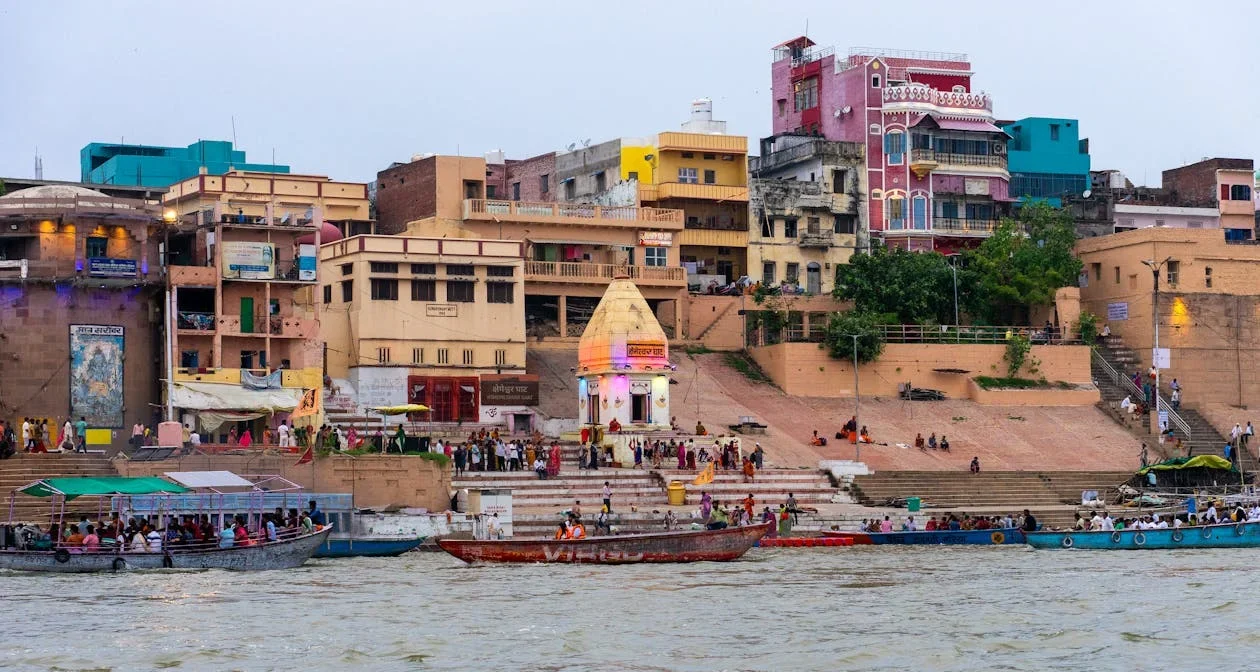
500 Million Prayers, 100 Cities’ Sewage
Every morning before sunrise, millions of Indians face east and pour water from the Ganga over their heads. They believe it washes away sins. Priests chant mantras over its waters at ghats that have been in use for three thousand years. The dying are brought to its banks in Varanasi because Hindus believe that death beside the Ganga guarantees moksha, liberation from the cycle of rebirth. Newborns are bathed in it. Marriages are solemnised beside it. The ashes of the dead are immersed in it.
And every morning, those same waters carry 1.5 billion litres of untreated sewage, industrial effluent from 764 factories, heavy metals from tanneries, pesticide runoff from one of the world’s most intensively farmed floodplains, and the remains of partially cremated bodies.
The Ganga is India’s holiest river and India’s most polluted. It is worshipped as a goddess and treated as a drain. This contradiction isn’t a paradox, it’s a policy failure that has lasted four decades and counting. Four prime ministers have promised to clean the Ganga. Over ₹20,000 crore has been spent. The river is still dying.
To understand why, you need to understand the Ganga, not just as a river, but as a civilisation, an ecosystem, an economy, and a political symbol that no government dares to fail at and none has succeeded.
The River by Numbers
Metric | Figure |
|---|---|
Length | 2,525 km (Gangotri glacier to Bay of Bengal) |
Basin area | 1.08 million km² (26% of India’s landmass) |
States crossed | 5 (Uttarakhand, UP, Bihar, Jharkhand, West Bengal) |
Population dependent | ~500 million (40% of India) |
Cities dumping sewage | 97 cities and towns |
Daily sewage inflow | ~3,800 million litres per day (MLD) |
Treatment capacity | ~2,100 MLD (only 55% of inflow) |
Fecal coliform (Varanasi) | 100-10,000× WHO safe limits |
Industrial polluters | 764 grossly polluting industries (CPCB) |
Major tributaries | Yamuna, Son, Gomti, Ghaghara, Gandak, Kosi |
Glacial source | Gangotri glacier (retreating 22 metres/year) |
The gap between what flows in and what gets treated is the story of the Ganga. Forty-five percent of the sewage that enters the river receives no treatment at all. It flows in raw, human waste, detergent, cooking oil, hospital waste, everything that 500 million people produce in their daily lives, and it flows straight into a river that 500 million people also use for drinking, bathing, cooking, and irrigation.
The basin area alone tells the scale of the challenge. The Ganga basin covers 26% of India’s landmass and is home to 43% of India’s population. It is the most densely populated river basin on Earth. Everything that happens in the basin, farming, manufacturing, construction, urbanisation, deforestation, eventually ends up in the river.
The River as Civilisation
Before discussing pollution, it’s essential to understand what the Ganga means. No river on Earth carries the cultural weight of the Ganga. It is not comparable to the Thames, the Rhine, or even the Nile. It is closer in significance to what Jerusalem is to the Abrahamic religions, except that the Ganga is not a fixed point but a flowing one, touching millions of lives every day across 2,525 kilometres.
The Rig Veda, composed over 3,500 years ago, mentions the Ganga. The Mahabharata and Ramayana feature it prominently. In Hindu cosmology, the Ganga descends from heaven, flowing through Lord Shiva’s hair to prevent the force of its descent from destroying the Earth. The river is worshipped as Ganga Ma, Mother Ganga, a living goddess.
This is not merely religious sentiment. It shapes policy, law, economics, and daily behaviour. In 2017, the Uttarakhand High Court declared the Ganga and Yamuna rivers “living entities” with the legal rights of a person, a ruling later stayed by the Supreme Court but indicative of how Indians think about their rivers. The Ganga is not infrastructure. It is family.
This cultural reality creates a unique challenge for cleanup. You cannot treat the Ganga as a simple engineering problem, build treatment plants, enforce discharge standards, done, because the river’s cultural function (ritual bathing, cremation, idol immersion, flower offerings) is itself a source of pollution. Any cleanup plan that doesn’t account for religious practice will fail. Any cleanup plan that restricts religious practice will be politically impossible.
The River as Economy
The Ganga basin produces roughly 40% of India’s GDP. The Indo-Gangetic Plain is one of the most productive agricultural regions on Earth, growing rice, wheat, sugarcane, and vegetables that feed not just India but global markets. The river provides irrigation water for millions of hectares of farmland. Fisheries along the river support millions of livelihoods. Sand mining (legal and illegal) extracts millions of tonnes annually for construction.
The cities along the Ganga are economic engines: Kanpur (leather and textiles), Varanasi (silk and tourism), Allahabad/Prayagraj (administration), Patna (administration and trade), Kolkata (manufacturing, trade, and services). These cities depend on the river for water supply, waste disposal, and transportation.
This economic dependence creates a vicious cycle: the river supports economic activity, which produces waste, which pollutes the river, which degrades the economic activity it supports. Kanpur’s tanneries depend on the Ganga for water and dump their waste back into it, poisoning the water that downstream farmers use for irrigation, which contaminates the food supply, which creates health costs that exceed the economic value of the tanneries.
Four Decades of Failed Cleanups
Ganga Action Plan I (1986-2000)
Rajiv Gandhi launched India’s first river cleanup programme with a budget of ₹462 crore. It was ambitious for its time: 261 schemes across 25 towns in three states (Uttar Pradesh, Bihar, West Bengal), focused primarily on building sewage treatment plants (STPs), diverting drains, and installing electric crematoriums.
The results were mixed. STPs were built, 35 of them, but most were never properly maintained. Many ran at a fraction of their capacity because state governments couldn’t afford the electricity to run them. In some cases, the STPs were built but the sewage lines connecting them to the drains were never completed, so the plants sat idle while raw sewage continued to flow into the river.
The Comptroller and Auditor General’s (CAG) report on GAP I was damning: most of the money was spent on infrastructure that didn’t work. By the time the programme ended, pollution levels in the Ganga had actually increased, because the cities were growing faster than the treatment infrastructure.
Ganga Action Plan II (1993-2014)
Extended to more cities, more states, and more tributaries, with an expanded budget. The National River Conservation Plan (NRCP) was created to bring other polluted rivers under the same framework. Additional STPs were built. Crematoria were upgraded. Afforestation along riverbanks was attempted.
Same result. The fundamental problem, that Indian cities generate more sewage every year as populations grow and urbanisation accelerates, while treatment capacity remains static or grows slowly, was never addressed. Building an STP is a one-time capital expenditure. Running it costs money every day, for electricity, chemicals, maintenance, and trained operators. State governments, perpetually short of funds, built the plants to claim credit and then let them decay.
A study by the Centre for Science and Environment (CSE) found that the combined expenditure on GAP I and II was approximately ₹4,000 crore (in 2014 rupees) with minimal improvement in water quality. The GAP became a case study in Indian governance: good intentions, ambitious plans, poor execution, zero accountability.
Namami Gange (2014-present)
The current government’s flagship programme, announced with a budget of ₹20,000 crore (later expanded), represents the most ambitious and best-funded attempt yet. Namami Gange differs from its predecessors in several ways: it treats the Ganga as a single integrated system rather than a city-by-city problem, it includes afforestation and biodiversity conservation alongside sewage treatment, and it attempts to address industrial pollution and agricultural runoff in addition to domestic sewage.
As of 2026, 182 sewage treatment projects have been completed, adding significant treatment capacity. The programme has invested in real-time water quality monitoring, biodiversity conservation (particularly for the Gangetic dolphin and gharial), riverfront development, and public awareness campaigns. Some stretches, particularly in Uttarakhand, from Gangotri to Haridwar, have shown measurable improvement.
But the core challenge remains. India’s urban population keeps growing, and rural-to-urban migration means more people, more sewage, every year. The STPs built under Namami Gange address today’s sewage loads, but by the time they’re fully operational, the cities have grown and the loads have increased. It’s a race the infrastructure keeps losing.
The programme also faces an institutional challenge: sewage treatment is a state government responsibility, while Namami Gange is a central government programme. The centre builds the plants; the states have to run them. The incentives are misaligned. A state government gets credit for inaugurating a plant but no credit for running it efficiently. The result is the same as GAP I and II: plants built, plants neglected, pollution continues.
What’s Actually Killing the River
Sewage (80% of pollution)
The single biggest polluter isn’t industry, it’s human waste. Indian cities along the Ganga produce roughly 3,800 MLD (million litres per day) of sewage. Treatment plants can handle about 2,100 MLD. The rest, 1,700 MLD, every single day, flows directly into the river, untreated. To put that in perspective: 1,700 million litres is roughly equivalent to 680 Olympic swimming pools of raw sewage, every day, for decades.
The problem isn’t just capacity. It’s that existing STPs frequently don’t work. Power cuts shut them down, and Indian cities experience power cuts daily. Sludge clogs them because maintenance schedules are not followed. Trained operators are scarce because operating an STP requires technical expertise that most small-city governments can’t attract or retain. A 2020 audit found that 50% of STPs along the Ganga were not meeting discharge standards. They were “treating” sewage, but the treated output was itself polluted beyond acceptable levels.
And even the 55% treatment figure is misleading. Most Indian STPs use outdated technology (activated sludge process or oxidation ponds) that removes solid waste and some biological contaminants but does not remove pharmaceuticals, heavy metals, microplastics, or antibiotic-resistant bacteria, all of which are present in Indian urban sewage in alarming quantities.
Industrial Effluent (15% of pollution)
Kanpur’s tannery district is the most notorious example. Over 400 tanneries discharge chromium-laced waste into the river. The leather tanning process uses chromium sulphate, and the waste water contains chromium VI, a known carcinogen. Despite court orders, closure notices, and mandatory effluent treatment, enforcement is inconsistent. Tanneries operate at night, when inspectors don’t visit. They dilute their waste water to pass spot checks. They bribe local officials.
The health consequences are devastating. Communities downstream from Kanpur’s tannery cluster report elevated rates of skin diseases, respiratory ailments, gastrointestinal disorders, and cancer. Chromium contamination has spread from the river into groundwater, the water that people drink from hand pumps and wells is contaminated with carcinogens at levels 70 times above safe limits.
Kanpur is the worst but not the only industrial polluter. Sugar mills in Uttar Pradesh discharge molasses-laden waste water. Chemical plants along the river release heavy metals. Textile dyeing units dump coloured effluent. Paper mills release bleaching chemicals. The CPCB has identified 764 “grossly polluting industries” along the Ganga, industries that discharge effluent far above permitted levels. Closing them would affect hundreds of thousands of jobs. Not closing them affects the health of hundreds of millions.
Agricultural Runoff (growing problem)
The Indo-Gangetic Plain is one of the world’s most intensively farmed regions. Farmers use enormous quantities of fertilisers (urea, DAP, potash) and pesticides (many of which are banned in developed countries but still legal in India). When it rains, these chemicals wash into the drainage system and eventually into the Ganga and its tributaries.
Fertiliser runoff causes eutrophication: excess nitrogen and phosphorus feed algal blooms that spread across the water surface, block sunlight, and deplete dissolved oxygen. When the algae die, their decomposition consumes even more oxygen, creating “dead zones” where fish and other aquatic life cannot survive. Pesticide residues accumulate in sediment and bioaccumulate through the food chain, eventually reaching the fish that people eat.
Agricultural runoff is harder to address than point-source pollution (a factory pipe or a city drain) because it comes from millions of individual farms across a vast area. There is no pipe to plug, no factory to close. Solutions require changing farming practices across an entire basin, promoting organic farming, reducing fertiliser use, building constructed wetlands to filter runoff, all of which are slow, expensive, and politically difficult in a country where farmers are already struggling.
Religious Practices
This is the most sensitive issue. Millions of flowers, plastic wrappers, synthetic garlands, idols made of plaster of Paris (which contains heavy metals in the paint), and partially cremated remains enter the river during festivals and daily rituals. During major festivals like Durga Puja and Ganesh Chaturthi, thousands of painted idols are immersed in the river, releasing lead, mercury, and cadmium into the water.
Cremation at the ghats of Varanasi is a continuous process, roughly 80-100 bodies are cremated daily on the burning ghats. Each cremation requires 300-400 kg of wood and produces ash, partially burned remains, and smoke. Families that cannot afford enough wood for complete cremation sometimes release partially burned remains into the river. The very poor, and some communities whose customs prohibit cremation, sometimes place uncremated bodies directly in the Ganga.
Addressing religious pollution requires cultural sensitivity, you cannot ask 500 million people to stop practicing their faith. But you can provide alternatives: biodegradable idols made of natural clay, electric crematoriums (Namami Gange has funded several, though acceptance remains low), flower composting systems (which turn temple offerings into fertiliser), designated immersion pools that prevent offerings from reaching the main river channel.
The Ecosystem Collapse
The Ganga once supported one of the richest freshwater ecosystems in Asia. That ecosystem is now in crisis:
- Gangetic dolphin (Platanista gangetica), India’s national aquatic animal, now endangered. Population estimated at 2,000-3,000, down from tens of thousands a century ago. These blind, sonar-using dolphins are found mainly in Bihar, where pollution is slightly lower and the river is deeper. Barrages and dams have fragmented their habitat, preventing migration and isolating small populations that are vulnerable to inbreeding and local extinction.
- Gharial (Gavialis gangeticus), The fish-eating crocodilian that once thrived throughout the Ganga system. Fewer than 650 remain in the wild, making it one of the most critically endangered crocodilians on Earth. The gharial needs clean, deep, fast-flowing water with sandy banks for nesting, conditions that are increasingly rare in the Ganga.
- Hilsa fish (Tenualosa ilisha), Once migrated 1,000 km upstream from the Bay of Bengal to Allahabad. Hilsa was a major commercial fishery and a beloved food fish across Bengal and Bihar. Dams and barrages (particularly the Farakka Barrage) have blocked the migration. Pollution has degraded spawning habitat. Hilsa has virtually disappeared from the upper Ganga. The fishermen who depended on it have lost their livelihoods.
- Golden mahseer (Tor putitora), The “tiger of the river,” a large game fish prized by anglers and ecologists. Once common throughout the upper Ganga, it is now critically endangered. Overfishing, pollution, and dam construction have devastated populations.
- Turtles, Several species of freshwater turtles, including the Indian softshell turtle and the red-crowned roofed turtle, are declining as nesting habitats are destroyed by sand mining, pollution affects egg viability, and accidental drowning in fishing nets takes a steady toll.
- Microorganisms, Studies have found that the Ganga’s famous “self-purifying” properties, long attributed to bacteriophages (viruses that kill bacteria), are being overwhelmed by the sheer volume of pollutants. The river’s natural ability to break down organic waste, which sustained it for millennia, is failing under the load.
A river isn’t just water. It’s an ecosystem, a web of relationships between water, sediment, microorganisms, plants, invertebrates, fish, birds, and mammals. When the ecosystem dies, the river becomes a canal, a conduit for moving water and waste from one place to another. That’s what the Ganga is becoming in its most polluted stretches between Kanpur and Varanasi.
The Cities That Define the Crisis
- Haridwar, Where the Ganga exits the Himalayas and enters the plains. Relatively clean at this point, but the city’s 250,000 residents (swelling to millions during the Kumbh Mela) strain local treatment capacity. The Kumbh Mela, held every 12 years, sees 100+ million pilgrims bathe in the Ganga over a few weeks, the largest human gathering on Earth, and one of the largest point-source pollution events.
- Kanpur, Tannery capital of India. Chromium levels in groundwater near the river are 70 times above safe limits. Residents in downstream communities report skin diseases, respiratory issues, and elevated cancer rates. The Jajmau industrial area alone discharges enough toxic waste to poison the river for 100 kilometres downstream. Despite a Supreme Court order to close polluting tanneries, many continue to operate.
- Varanasi, The holiest city in Hinduism. Three thousand years of continuous habitation. Eighty-four ghats line the riverfront. 300 million litres of sewage daily from a city whose drainage system dates to the colonial era. Pilgrims bathe in water with fecal coliform counts thousands of times above safe limits. The health implications are severe but rarely discussed because of the religious sensitivity. The city is the constituency of the Prime Minister, which has brought investment but also political pressure to show results, sometimes leading to cosmetic improvements (ghat beautification, LED lighting) rather than systemic ones (sewage treatment).
- Patna, Bihar’s capital, where the Ganga is joined by two major tributaries (the Gandak and Son). The river is wide here but slow-moving, allowing pollutants to accumulate. Patna’s treatment capacity covers less than 40% of its sewage output. The riverfront, where middle-class families walk in the evenings, sits beside water that would be classified as unsafe for any human contact.
- Kolkata, Where the Hooghly (a Ganga distributary) meets tidal influence. Industrial pollution from both banks, plus the accumulated pollution of 2,000 km upstream. The East Kolkata Wetlands, a UNESCO-designated wetland system, has historically functioned as a natural sewage treatment system, wastewater is fed into fish ponds and vegetable gardens that use natural processes to purify it. This system, developed by local communities over centuries, is one of the most elegant ecological solutions on the planet. It is now threatened by real estate development.
The Glacial Threat
Beyond pollution, the Ganga faces an existential threat that no treatment plant can address: the Gangotri glacier, the river’s source, is retreating at approximately 22 metres per year. Climate change is melting the glaciers that feed the Ganga’s upper reaches. In the short term, this increases water flow (more meltwater). In the medium term, it will reduce flow as the glaciers shrink. In the long term, if the glaciers disappear entirely, the Ganga could become a seasonal river, flowing only during the monsoon and drying to a trickle in summer, when the demand for water is highest.
This isn’t a hypothetical scenario. The Himalayan glaciers are retreating faster than glaciers anywhere else on Earth. A 2019 study in Science Advances found that Himalayan glaciers are losing ice twice as fast as they were 25 years ago. The IPCC projects that the Himalayas could lose a third of their ice by 2100 even under optimistic climate scenarios.
A Ganga without glacial flow would be devastating for the 500 million people who depend on it. Agriculture in the Indo-Gangetic Plain would collapse. Cities would lose their water supply. The river’s capacity to dilute pollutants would decrease dramatically, making existing pollution even more concentrated and dangerous.
What’s Actually Working
Not everything is failure. Some approaches show genuine results:
- Sewage treatment in Uttarakhand, The upper Ganga, from Gangotri to Haridwar, has shown measurable improvement. Smaller cities, less industrial pollution, stronger political will, and targeted investment have made a difference. Dissolved oxygen levels (a key indicator of water health) have improved, and some aquatic species are returning.
- Real-time monitoring, CPCB now monitors water quality at 113 locations along the Ganga in real-time, with data available publicly. This transparency has pushed some cities and industries to act. When your pollution is visible to anyone with an internet connection, the pressure to reduce it increases.
- Biodegradable idol campaigns, Several cities now promote clay idols and flower recycling during festivals. Adoption is slow but growing. In Kolkata, the Calcutta High Court has mandated that all Durga Puja idols be immersed in designated artificial pools rather than the river, a significant step, though enforcement varies.
- Community-led initiatives, NGOs like the Sankat Mochan Foundation in Varanasi and rural communities upstream have implemented local solutions that work at village scale. The SwachhAbility (Clean Ability) movement has engaged volunteers in river cleanup. These efforts are small relative to the scale of the problem but demonstrate that change is possible when communities take ownership.
- Hybrid decentralised treatment, Rather than relying solely on large centralised STPs (which fail when power is cut or operators leave), some cities are experimenting with smaller, decentralised treatment systems that use natural processes (constructed wetlands, bioreactors, algae-based treatment) that require less energy and expertise to operate.
- Faecal sludge management, Recognising that many riverside communities use septic tanks rather than sewage networks, several cities have started faecal sludge treatment plants that can process waste from areas not connected to the sewage system.
What the Rest of the World Did
The argument that rivers can’t be cleaned doesn’t survive comparison with international examples:
- The Thames (UK), Was declared “biologically dead” in 1957. Today it supports 125 species of fish, including seahorses. The cleanup took 60 years and required sustained political will, massive investment in sewage infrastructure, strict industrial regulation, and public engagement.
- The Rhine (Europe), Was so polluted in the 1970s that it caught fire. Today it is one of Europe’s cleanest rivers, supporting salmon populations that had disappeared for decades. The International Commission for the Protection of the Rhine coordinated cleanup across six countries.
- The Han River (South Korea), Seoul’s river was effectively a sewer in the 1960s. South Korea’s economic boom funded massive infrastructure investment, and the Han is now clean enough for recreational use. The Cheonggyecheon stream restoration in central Seoul (2003-2005) became a global model for urban river restoration.
None of these cleanups was easy, cheap, or fast. All required decades of sustained effort. But they prove that cleaning a polluted river is possible, if the political will exists and is sustained across multiple government terms.
The Question India Won’t Answer
The Ganga is called “Maa Ganga”, Mother Ganga. India worships her as a goddess. India also dumps its waste into her. The cognitive dissonance is not lost on Indians. Devotees who bathe in the Ganga for spiritual purification know the water is toxic. Priests who perform rituals on the ghats know the water makes people sick. Fishermen who catch fish from the Ganga know the fish contain heavy metals. Farmers who irrigate with Ganga water know the crops absorb pollutants.
Everyone knows. And yet the river remains dirty, because cleaning it requires confronting interests, industrial, political, cultural, economic, that no government has been willing to fully confront.
The technology to clean the Ganga exists. Sewage treatment is not rocket science. Countries with far fewer resources have cleaned far more polluted rivers, the Thames, the Rhine, the Han in Seoul. The problem isn’t technical. It’s political, institutional, and cultural.
Can India treat its holiest river with the same reverence in policy that it shows in prayer? Can a country that built the world’s most advanced digital payment system build sewage plants that actually work? Can the nation that sent a spacecraft to Mars for less than the cost of a Hollywood film invest enough in plumbing to stop poisoning the water its children drink?
The Ganga has been dying for decades. It doesn’t need more prayers. It doesn’t need more promises. It doesn’t need another programme with a Sanskrit name and a ₹20,000-crore budget and a five-year timeline. It needs plumbing. It needs enforcement. It needs political courage sustained over 30 years, not 30 months.
And it needs India to decide, once and for all, whether Mother Ganga is worth saving, not in slogans, but in sewage treatment plants that run 24 hours a day, 365 days a year, for the rest of time.
This article is part of unite4india’s “India’s Rivers” series, exploring the life, crisis, and future of India’s waterways.
What you can do
- Share the evidenceSend this to one person who should know about this issue.Share on WhatsApp
- Give an afternoonTeach, mentor, clean up, or lend your professional skills.Ways to volunteer
- Tell us what's missingKnow a story, a fact we got wrong, or a solution worth spotlighting?Suggest a story
Politically neutral. Every claim sourced. Report a correction.

No comments yet