India's Cooperative Movement and the Dairy Network That Changed a Nation
India became the world's largest milk producer through farmer-owned cooperatives, from Kaira in 1946 to Operation Flood. This article explains how the network works and who it serves.
From Milk Shortage to Milk Surplus
In 1946, a group of dairy farmers in Kaira district, Gujarat, were tired of being exploited. The Polson Dairy company, which held a monopoly on milk collection, paid them a fraction of fair prices. Under the guidance of Tribhuvandas Patel and a young engineer named Verghese Kurien, these farmers formed the Kaira District Cooperative Milk Producers’ Union. That cooperative would later become Amul, and the model it pioneered would transform India from a milk-deficit nation into the world’s largest milk producer.
India today produces over 230 million tonnes of milk annually, more than any other country. Behind that number is not a corporate conglomerate or a government factory, but a network of roughly 190,000 dairy cooperatives involving over 17 million farming families. Most of these families own two to five animals. Most are small and marginal farmers. Many are women who manage the dairy animals while their husbands work the fields. The cooperative model gave these families direct access to markets, fair prices, and a collective voice that no individual farmer could have achieved alone.
Operation Flood: The World’s Largest Dairy Development Program
The turning point came in 1970 when the National Dairy Development Board (NDDB), led by Verghese Kurien, launched Operation Flood. The program ran in three phases over 26 years and is widely considered the most successful rural development program in post-independence India.
Phase | Period | Key Achievement |
|---|---|---|
Phase I | 1970-1980 | Linked 18 of India’s best milk sheds with consumers in four major metro cities through a national milk grid |
Phase II | 1981-1985 | Expanded the milk grid to 136 urban markets, increased milk shed coverage to 136 districts, and added 34,500 village cooperatives |
Phase III | 1985-1996 | Strengthened dairy cooperative infrastructure across 30,000 new villages, added 7.5 million farmer members |
The genius of Operation Flood was not technology or funding, though both mattered. It was the insistence on farmer ownership. The program funded the creation of village-level cooperatives that collected milk twice daily, district unions that processed and marketed the milk, and state federations that handled interstate sales and exports. At every level, farmers were the owners, not employees or suppliers to a corporate buyer.
By the time Operation Flood ended in 1996, India’s milk production had more than doubled. The country went from importing milk powder under food aid programs to becoming self-sufficient. More importantly, the program created a self-sustaining institutional structure that continued growing without government subsidies.
How the Three-Tier Cooperative Structure Works
The Amul model, replicated across India, operates on a three-tier structure that keeps power with the farmers:
- Village Dairy Cooperative Society (Tier 1). Every village with enough dairy farmers forms a cooperative. Members bring their milk to the collection centre twice daily. The cooperative tests milk quality, records quantity, and pays farmers every 10 days. Each society is managed by an elected committee of farmer-members. India has roughly 190,000 of these village societies.
- District Milk Union (Tier 2). Village cooperatives in each district federate into a union that handles milk processing, packaging, and marketing within the district. The union operates the dairy plant, manages the cold chain, and ensures quality control. The union’s board consists of elected representatives from the village societies.
- State Cooperative Milk Federation (Tier 3). District unions in each state form a federation that manages the brand, handles interstate and international marketing, and coordinates product development. Gujarat Cooperative Milk Marketing Federation (GCMMF), which markets Amul products, is the most prominent example.
This structure ensures that the farmer who wakes up at 4 AM to milk her buffalo has a voice that reaches the boardroom where marketing and pricing decisions are made. It is one of the purest examples of democratic economic organisation operating at national scale anywhere in the world.
India produces over 230 million tonnes of milk annually, more than any other country. Behind that number is not a corporate conglomerate but a network of roughly 190,000 dairy cooperatives involving over 17 million farming families, most owning just two to five animals.
The Numbers Behind the Movement
The scale of India’s dairy cooperative network is staggering:
- 17 million farmer families are members of dairy cooperatives across India.
- 190,000 village dairy cooperative societies collect milk daily from rural areas.
- Over 50 million litres of milk are collected daily through the cooperative network.
- GCMMF (Amul) alone reported annual turnover of over Rs 72,000 crore (approximately $8.7 billion) in 2024-25, making it India’s largest food brand.
- Women constitute over 30% of dairy cooperative members nationally, and in states like Gujarat and Rajasthan, women-only dairy cooperatives have become powerful vehicles for economic independence.
For context, India’s entire dairy sector is worth over $200 billion, making it larger than the combined value of the country’s wheat and rice production. The cooperative movement is responsible for organising the most fragmented part of this sector, the smallholder farmer with two buffaloes and no cold storage, into a supply chain that competes with the world’s largest dairy corporations.
Women and the Dairy Cooperative
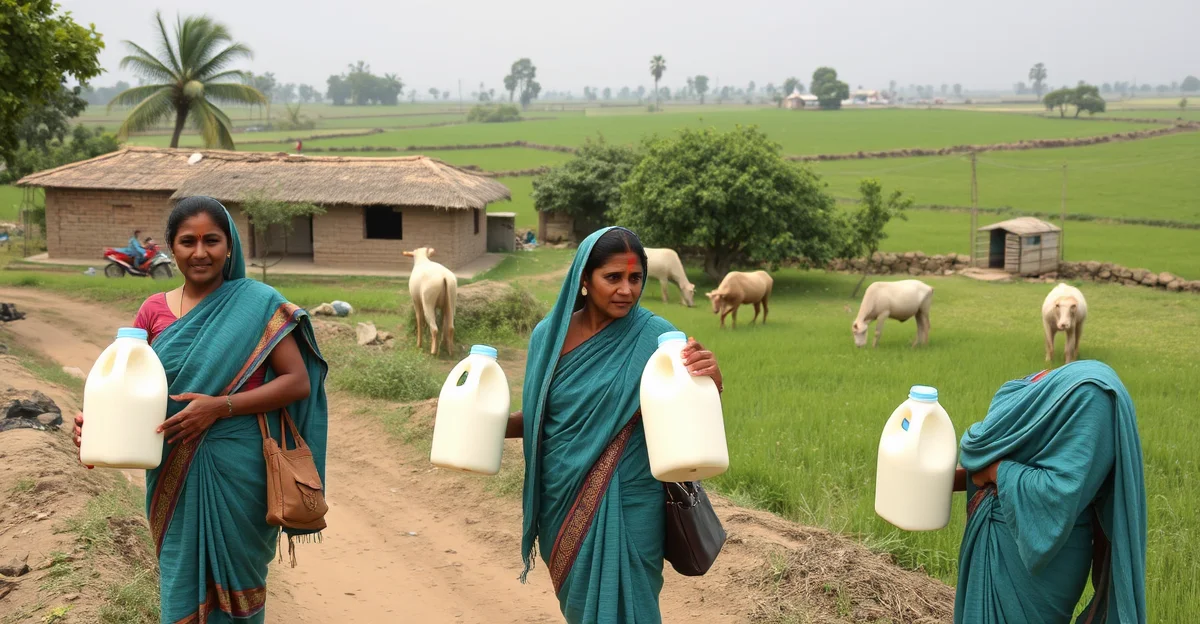
The dairy cooperative movement has been one of India’s most effective, if underrecognised, instruments for women’s economic empowerment. In most Indian farming households, women handle the daily care of dairy animals: feeding, cleaning, milking, and managing the calves. Yet before cooperatives, women rarely saw the income from milk sales. Middlemen dealt with the men, and payments went into accounts women had no access to.
Dairy cooperatives changed this in two ways. First, cooperatives pay the person who delivers the milk. Since women typically bring the milk to the village collection centre, the payment goes directly to them. Second, many states actively promoted women-only dairy cooperatives. In Gujarat, the Mahila (women’s) dairy cooperatives now number in the thousands, with women managing every level from collection to processing.
The economic impact is direct. A family with two dairy animals earning Rs 400-600 daily from milk sales through the cooperative has a predictable income stream that pays for children’s education, healthcare, and household needs. For landless and marginal farming families, dairy income through cooperatives often exceeds agricultural income. This echoes the pattern seen in India’s microfinance movement, where small, regular financial flows transform household economics.
Challenges Facing the Cooperative Model
The dairy cooperative movement is not without problems. Several structural challenges threaten its continued success:
Political Interference
Cooperative boards at the district and state level have become politically valuable. Elected positions on dairy union boards serve as stepping stones for political careers, and in some states, cooperative elections are as contested as municipal elections. This has led to instances where board decisions prioritise political patronage over farmer welfare, with unnecessary hiring, inflated contracts, and delayed payments to farmers.
Private Sector Competition
Private dairy companies like Lactalis (which acquired Tirumala and Anik), Mother Dairy (NDDB’s own brand), and regional players now compete aggressively for the same milk supply. They often offer slightly higher prices during lean seasons to pull farmers away from cooperatives. For individual farmers, the short-term price advantage is tempting. But private procurement lacks the institutional commitment to fair pricing during surplus seasons, when cooperatives continue buying at stable prices even when the market drops.
Climate and Feed Costs
Rising temperatures reduce milk yield. Erratic monsoons affect fodder availability. Feed costs have risen sharply while milk procurement prices have not kept pace. The squeeze on farmer margins is real, and cooperatives must find ways to help members reduce costs through shared feed procurement, fodder development programs, and veterinary services. These challenges mirror the broader agricultural crisis documented in regions like Vidarbha, where climate instability threatens farming livelihoods.
Technology Gaps
Many village cooperatives still use manual testing and paper records. Digital milk collection systems with automatic fat and SNF (solids-not-fat) testing, SMS-based payment notifications, and electronic record-keeping exist but adoption is uneven. The cooperatives that have digitised their operations show higher farmer satisfaction and lower leakage. Scaling this technology across 190,000 societies is the next frontier, one that connects to the broader smart village movement bringing digital infrastructure to rural India.
Beyond Dairy: The Cooperative Model’s Broader Lessons
The dairy cooperative model has been replicated, with varying success, across other sectors:
Sector | Example | Scale |
|---|---|---|
Sugar | Maharashtra sugar cooperatives | Over 200 cooperative sugar factories across the state |
Fisheries | Matsyafed (Kerala) | Over 600 primary fishermen cooperatives serving coastal communities |
Handlooms | Weaver cooperatives across India | Millions of weavers organised into thousands of cooperative societies |
Credit | District cooperative banks | Over 90,000 primary agricultural credit societies |
Housing | Urban cooperative housing societies | Millions of urban families live in cooperative housing, especially in Maharashtra |
The handloom cooperatives in particular have followed a similar trajectory to dairy, organising rural women artisans into collective enterprises that bypass exploitative middlemen and connect directly to consumers. The underlying principle is the same: when producers own the processing and marketing infrastructure, they capture a larger share of the final value.
What Kurien Built and What Comes Next
Verghese Kurien, who died in 2012, insisted on a principle that sounds simple but was revolutionary in practice: the institutions that process and market rural products should be owned by the producers themselves, not by the government and not by corporations. He rejected both the government-run model (where bureaucrats make decisions for farmers) and the corporate model (where shareholders extract value from farmers). The cooperative model puts farmers in charge of their own economic destiny.
The next chapter of India’s dairy cooperative story will be shaped by three forces:
- Value addition. Cooperatives are moving beyond liquid milk into cheese, yogurt, ice cream, chocolate, and nutraceuticals. Amul now sells over 50 product categories. This diversification increases farmer incomes by capturing more value from the same raw milk.
- Technology adoption. Digital payment systems, IoT-enabled milk testing, blockchain-based supply chain tracking, and AI-powered cattle health monitoring are being piloted across progressive cooperatives. The cooperatives that adopt these tools will outcompete those that do not.
- Export growth. India exports dairy products to over 50 countries, but the value remains small relative to production. As cooperatives improve quality standards and gain international certifications, the export share will grow, bringing more revenue back to village-level farmers.
The dairy cooperative movement is proof that India’s most powerful economic transformations do not always come from Bangalore’s tech parks or Mumbai’s trading floors. Sometimes they come from a village collection centre where a woman pours five litres of buffalo milk into a steel container at dawn, knowing that the institution she co-owns will give her a fair price by evening. That simple transaction, repeated 100 million times a day across the country, is the foundation of the world’s largest dairy industry and one of the most successful cooperative movements in human history.
What you can do
- Share the evidenceSend this to one person who should know about poverty.Share on WhatsApp
- Back what worksVolunteer time or skills with groups doing this work.Ways to volunteer
- Tell us what's missingKnow a story, a fact we got wrong, or a solution worth spotlighting?Suggest a story
Politically neutral. Every claim sourced. Report a correction.


No comments yet