Biosphere Reserves in India: All 18, State by State, and What Protection Means
India has 18 notified biosphere reserves and 13 are in UNESCO's network. The full list by state, area and year, what the zones are, and what protection really means.
In this story
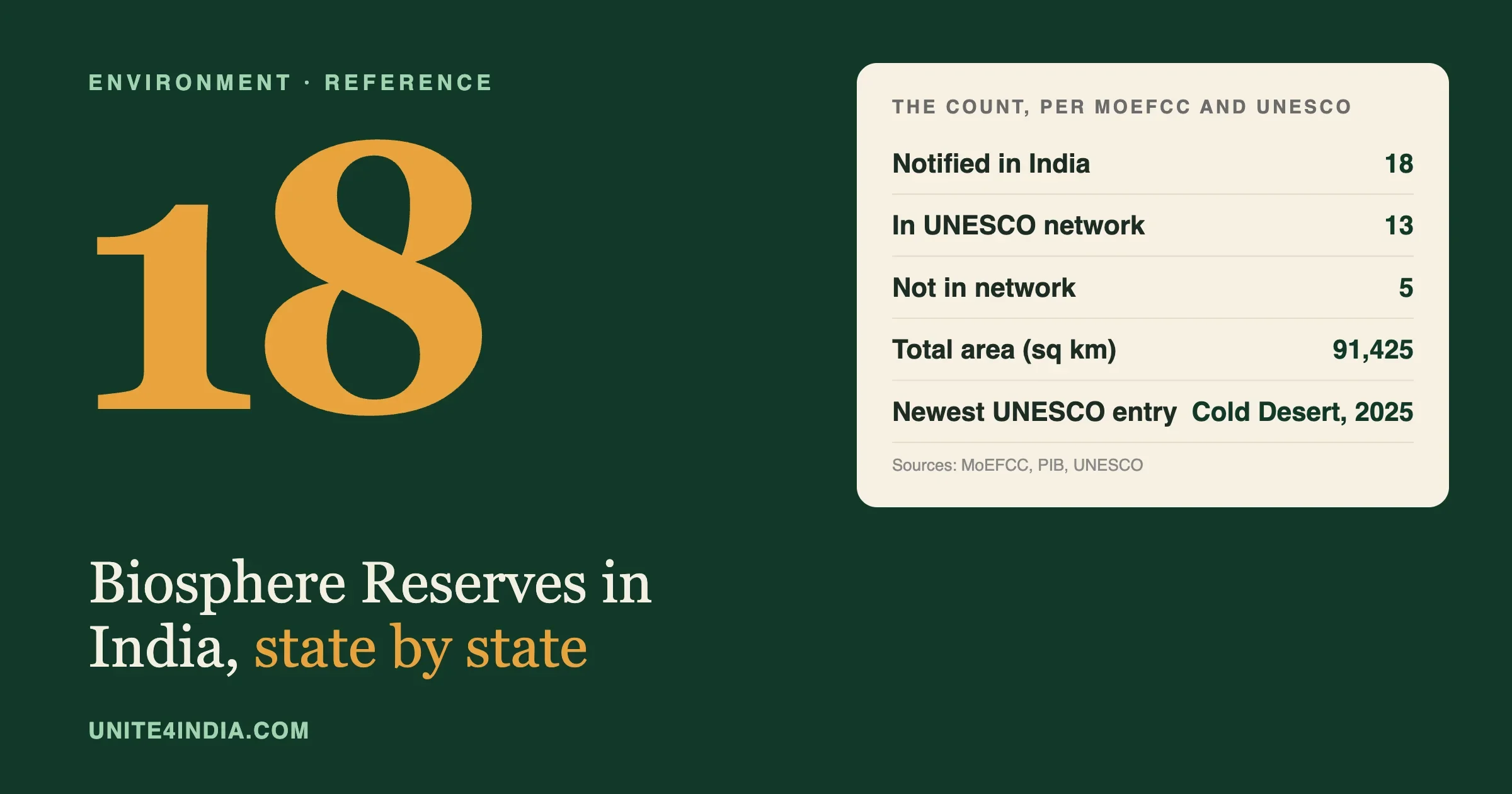
Short answer: there are 18 biosphere reserves in India, covering about 91,425 square kilometres, according to the Ministry of Environment, Forest and Climate Change (MoEFCC). Thirteen of these biosphere reserves in India are in UNESCO’s World Network of Biosphere Reserves. The newest to join is Cold Desert in Himachal Pradesh, added on 27 September 2025. The other five are nationally notified but are not in the UNESCO network: Manas, Dibru-Saikhowa, Dihang-Dibang, Great Rann of Kutch and Seshachalam Hills.
All 18 biosphere reserves in India, state by state
The table below follows the MoEFCC’s Biosphere Reserve Division list for the year of designation, states, area and UNESCO inclusion year. The Cold Desert UNESCO year comes from UNESCO’s own announcement. Areas are in square kilometres.
No. | Biosphere reserve | State or union territory | Designated in India | In UNESCO network since | Area (sq km) |
|---|---|---|---|---|---|
1 | Nilgiri | Tamil Nadu, Kerala, Karnataka | 1986 | 2000 | 5,520 |
2 | Nanda Devi | Uttarakhand | 1988 | 2004 | 6,407.03 |
3 | Nokrek | Meghalaya | 1988 | 2009 | 820 |
4 | Gulf of Mannar | Tamil Nadu | 1989 | 2001 | 10,500 |
5 | Sundarbans | West Bengal | 1989 | 2001 | 9,630 |
6 | Manas | Assam | 1989 | Not in network | 2,837 |
7 | Great Nicobar | Andaman and Nicobar Islands | 1989 | 2013 | 1,038.7 |
8 | Simlipal | Odisha | 1994 | 2009 | 5,569 |
9 | Dibru-Saikhowa | Assam | 1997 | Not in network | 765 |
10 | Dihang-Dibang | Arunachal Pradesh | 1998 | Not in network | 5,111.5 |
11 | Pachmarhi | Madhya Pradesh | 1999 | 2009 | 4,981.72 |
12 | Khangchendzonga | Sikkim | 2000 | 2018 | 2,931.12 |
13 | Agasthyamalai | Kerala, Tamil Nadu | 2001 | 2016 | 3,500 |
14 | Achanakmar-Amarkantak | Madhya Pradesh, Chhattisgarh | 2005 | 2012 | 3,835.46 |
15 | Great Rann of Kutch | Gujarat | 2008 | Not in network | 12,454 |
16 | Cold Desert | Himachal Pradesh | 2009 | 2025 | 7,770 |
17 | Seshachalam Hills | Andhra Pradesh | 2010 | Not in network | 4,755.58 |
18 | Panna | Madhya Pradesh | 2011 | 2020 | 2,998.98 |
The areas add up to the MoEFCC’s national total of 91,425.11 square kilometres. Published lists sometimes differ on individual areas, for example for Nanda Devi, Great Nicobar and Simlipal, because the boundaries have been revised over time. We used the ministry’s own table.
Quick facts that people search for
- How many biosphere reserves are in India? 18 are notified by the MoEFCC.
- How many are in UNESCO’s network? 13, after Cold Desert joined in September 2025. An older MoEFCC note, which used December 2023 data, showed 12.
- First to be designated: Nilgiri, in 1986. It was also the first Indian site to enter the UNESCO network, in 2000.
- Newest national designation: Panna, notified in 2011.
- Largest: Great Rann of Kutch in Gujarat, at 12,454 square kilometres.
- Smallest: Nokrek in Meghalaya, at 820 square kilometres.
- States with the most: Madhya Pradesh has three (Pachmarhi, Achanakmar-Amarkantak, Panna) and Tamil Nadu has three (Nilgiri, Gulf of Mannar, Agasthyamalai). Nilgiri and Agasthyamalai are shared with other states.
What are biosphere reserves in India?
A biosphere reserve is a large area of land, coast or sea that a national government nominates to conserve biodiversity and also support the people who live there. The idea comes from UNESCO’s Man and the Biosphere (MAB) Programme, which began in 1971. The MoEFCC describes biosphere reserves as sites for “experimenting with and learning about sustainable development”, and UNESCO calls them “learning places for sustainable development”.
UNESCO gives each reserve three jobs. It should conserve biodiversity and cultural diversity. It should support economic development that is socially and environmentally sustainable. And it should provide logistic support for research, monitoring, education and training. That third job is why many reserves have research stations and community programmes.
The three zones
Every biosphere reserve is organised into zones, from most protected to most used:
- Core area. UNESCO describes it as strictly protected ecosystems that conserve the biodiversity of habitats and species.
- Buffer zone. This surrounds or sits next to the core. Compatible activities such as research, education and sustainable use of resources are encouraged here.
- Transition area. This is the outer part, where communities live and work. The focus is sustainable economic and human development.
The Indian programme puts its money in the second and third zones. The ministry says the scheme gives supplementary and alternate livelihood support to people in the buffer and transition zones, so that pressure on the core zone falls.
What protection does a biosphere reserve actually give?
This is the question most readers want answered, and the honest answer is that the label is only part of the picture.
1. The designation is a framework, not a single law
Biosphere reserves are nominated by the national government and stay under the sovereign jurisdiction of the state where they lie, as the MoEFCC’s own backgrounder says. UNESCO recognition does not hand control to UNESCO. The international designation is decided by UNESCO’s International Co-ordinating Council on the request of the country concerned, and India’s list of reserves is kept by the MoEFCC.
2. Legal protection comes from the protected areas inside
Secondary sources that explain the Indian system say the designation by itself does not extend the protection of the Wildlife (Protection) Act, 1972 to the whole area, and that core zones are usually existing national parks or sanctuaries. The ministry’s own list shows how this works in practice. The Cold Desert reserve, for example, is described as Pin Valley National Park and its surroundings, Chandratal, and the Sarchu and Kibber Wildlife Sanctuary. Panna is described by its district boundaries and its place in the Ken River catchment. So the strongest legal protection sits in the parks and sanctuaries inside a reserve, and the buffer and transition zones are managed through planning, local rules and development schemes.
We could not find one MoEFCC document that sets out the legal status of every zone in every reserve. If you need the exact rules for a specific reserve, for a research permit or a land dispute, ask the State Forest Department, which runs the programme on the ground.
3. There is a dedicated central scheme and funding
The MoEFCC runs a centrally sponsored scheme for biosphere reserves, as a sub-scheme of its Conservation of Natural Resources and Ecosystems programme. Grants go to states on a 60:40 central to state basis, and on a 90:10 basis for North Eastern and Himalayan states. State Forest Departments implement the scheme, except in Madhya Pradesh, where the Environment Planning and Coordination Organisation does. A November 2025 government backgrounder says the budget for biodiversity conservation under this programme rose from 5 crore rupees in 2024-25 to 10 crore rupees in 2025-26. That is a small sum spread across 18 large landscapes, which is worth keeping in mind when judging what the label can deliver on its own.
4. A UNESCO listing comes with a review
Being in the UNESCO network means the site meets UNESCO’s criteria and joins an international group that shares data and practice. Five Indian reserves have not been nominated or accepted, and they are still protected under national and state law where they overlap with parks and sanctuaries. The MoEFCC note says efforts are on to create transboundary reserves with neighbouring countries and to increase resources for the MAB programme.
Biosphere reserve, national park, sanctuary: how they differ
Label | Main idea | People living inside |
|---|---|---|
Biosphere reserve | A large landscape with zones that mixes conservation, research and sustainable use | Expected, and a key part of the design (transition zone) |
National park | A protected area under the Wildlife (Protection) Act with strict limits on human activity | Generally restricted |
Wildlife sanctuary | A protected area under the same Act where some regulated activity can be allowed | Some regulated use can continue |
UNESCO World Heritage Site | A site of outstanding universal value under a separate UNESCO convention | Depends on the site |
One area can carry more than one label. Sundarbans, for example, is a biosphere reserve in the Ganges and Brahmaputra delta and also appears on UNESCO’s World Heritage list as a national park. Check each label on its own terms.
The biosphere reserves in India by region
Western Ghats and the south: Nilgiri and Agasthyamalai
Nilgiri is the oldest. It was designated in 1986 and spreads over Tamil Nadu, Kerala and Karnataka, with parts of Wayanad, Nagarhole, Bandipur, Mudumalai, Nilambur and Silent Valley listed by the ministry. It covers 5,520 square kilometres. Agasthyamalai, designated in 2001 and recognised by UNESCO in 2016, covers 3,500 square kilometres across Kerala and Tamil Nadu around the Neyyar, Peppara and Shenduruny Wildlife Sanctuaries. Both lie in the Western Ghats biogeographic zone.
Himalayas: Nanda Devi, Khangchendzonga and Cold Desert
Nanda Devi in Uttarakhand covers parts of Chamoli, Pithoragarh and Bageshwar districts. Khangchendzonga in Sikkim was designated in 2000 and joined UNESCO’s network in 2018. Cold Desert in Himachal Pradesh is the newest member of the UNESCO network. UNESCO says it covers 7,770 square kilometres at 3,300 to 6,600 metres, has 732 vascular plant species including 30 endemics, and is home to snow leopard, Himalayan ibex, blue sheep and Himalayan wolf. About 12,000 people live in scattered villages there, farming barley and peas, herding yaks and goats, and practising Tibetan herbal medicine, and UNESCO notes that Buddhist monastic traditions and community councils help regulate the use of fragile alpine resources.
North-East India: Nokrek, Manas, Dibru-Saikhowa and Dihang-Dibang
The north-east has four reserves in the Eastern Himalayas zone. Nokrek in the West Garo Hills of Meghalaya is the smallest in the country at 820 square kilometres and joined UNESCO’s network in 2009. Manas covers parts of Kokrajhar, Bongaigaon, Barpeta, Nalbari, Kamrup and Darrang districts in Assam, and Dibru-Saikhowa covers parts of Dibrugarh and Tinsukia districts. Dihang-Dibang covers part of the Siang and Dibang valleys in Arunachal Pradesh. Of these four, only Nokrek is in the UNESCO network.
Coasts, deltas and islands: Gulf of Mannar, Sundarbans and Great Nicobar
Gulf of Mannar is the Indian part of the gulf, running from Rameswaram island in the north to Kanyakumari in the south of Tamil Nadu, and it extends to Sri Lanka. At 10,500 square kilometres it is one of the largest. Sundarbans is part of the delta of the Ganges and Brahmaputra river system in West Bengal. Great Nicobar is the southernmost of the Andaman and Nicobar Islands. All three joined UNESCO’s network, in 2001, 2001 and 2013.
Central India: Simlipal, Pachmarhi, Achanakmar-Amarkantak and Panna
Simlipal in Mayurbhanj district of Odisha is in the Deccan Peninsula zone. Pachmarhi covers parts of Betul, Hoshangabad and Chhindwara districts in Madhya Pradesh and is classed as semi-arid. Achanakmar-Amarkantak is in the Maikala Hills and spans Madhya Pradesh and Chhattisgarh. Panna, in Panna and Chhatarpur districts of Madhya Pradesh, is the newest national designation and sits in the catchment of the Ken River. UNESCO accepted Panna in 2020.
Desert and the Eastern Ghats: Great Rann of Kutch and Seshachalam Hills
Great Rann of Kutch, notified in 2008, is the largest in the country, at 12,454 square kilometres across parts of Kutch, Morbi, Surendranagar and Patan districts in Gujarat. Seshachalam Hills, notified in 2010, covers parts of Chittoor and Kadapa districts of Andhra Pradesh in the Eastern Ghats. Neither is in the UNESCO network.
How biosphere reserves sit alongside other conservation tools
The government backgrounder places the biosphere programme next to several other national efforts, and it helps to know how they differ so you can read news about them correctly.
- Project Tiger began in 1973 and focuses on tiger conservation through dedicated reserves with strict protection. A tiger reserve and a biosphere reserve can overlap. Panna and Simlipal are examples of landscapes that carry more than one status, so a news story about one may not describe the other.
- Project Elephant works on habitat, human-elephant conflict and the welfare of captive elephants. India is home to over 60 percent of the world’s Asian elephants, according to the same backgrounder.
- Eco-sensitive zones are belts around national parks and sanctuaries. The government describes them as a “shock absorber” and a transition from high protection to lesser protection. They are drawn around protected areas, not around whole biosphere reserves.
- The National Biodiversity Authority, set up under the Biological Diversity Act, 2002, regulates access to biological resources and the traditional knowledge linked to them.
- The Green India Mission aims to protect, restore and enhance forest cover, including mangroves and wetlands.
The same document says India ranks 9th in the world for total forest area and 3rd for annual forest gain, citing the Food and Agriculture Organization’s Global Forest Resources Assessment 2025. These national numbers describe forests generally. They do not measure the performance of any one biosphere reserve, so treat them as context.
Common misunderstandings
“A biosphere reserve is a no-go area.”
Only the core zone is strictly protected. By design the buffer and transition zones include farms, villages and tourism. Cold Desert shows this clearly: about 12,000 people live in scattered villages inside it, according to UNESCO.
“UNESCO runs the reserve.”
It does not. The site stays under national and state jurisdiction. UNESCO recognises it and keeps the network together, and in India the MoEFCC and State Forest Departments manage it.
“All 18 are UNESCO sites.”
Thirteen are in the UNESCO network. People often confuse biosphere reserves with World Heritage Sites, which are a different UNESCO list under a different convention. A place can be on both lists, but being on one does not put it on the other.
“The numbers on lists are the same everywhere.”
They are not. The ministry’s table gives Nanda Devi as 6,407.03 square kilometres, Great Nicobar as 1,038.7 and Simlipal as 5,569, while other published lists show different values for the same reserves. Boundaries have been revised and some lists copy older figures. When you cite a number, name the source and the year.
Reading the list as a map
If you sort the 18 reserves by landscape type, a clear pattern shows. Seven are in the Himalayas and the north-east (Nanda Devi, Khangchendzonga, Cold Desert, Nokrek, Manas, Dibru-Saikhowa and Dihang-Dibang). Three lie on the coast or islands (Gulf of Mannar, Sundarbans, Great Nicobar). Two are in the Western Ghats (Nilgiri, Agasthyamalai). Four are in central India (Simlipal, Pachmarhi, Achanakmar-Amarkantak, Panna). One is in the desert of Kutch and one is in the Eastern Ghats. The ministry’s own classification groups them by biogeographic zone, and the spread is wide on purpose: the programme aims to cover characteristic ecosystems from diverse biogeographic regions of the country.
For a reader, the useful reading of that map is simple. If you live near one of these reserves, the zone you live in decides which rules apply to you. If you are researching one, the State Forest Department and the Indian MAB Committee are the offices that can answer questions about permits, boundaries and scheme funding.
How a site gets into UNESCO’s network
- The national government nominates the site. In India, the Indian MAB Committee in the MoEFCC handles this.
- The site must meet the minimum criteria set out in the statutory framework of UNESCO’s MAB Programme.
- UNESCO’s International Co-ordinating Council decides on the designation, at the request of the country.
Cold Desert was one of 26 new sites added at the 5th World Congress of Biosphere Reserves in Hangzhou, China, in September 2025. UNESCO’s article puts the network at 785 sites at that time, and UNESCO’s biosphere pages listed 797 sites in 145 countries when we checked on 11 November 2026. An older MoEFCC note gave 738 sites in 134 countries. The count grows each year, so quote the date with any number.
Why the label matters to people, and why it is not enough
The government backgrounder says more than 260 million people live in biosphere reserves worldwide, and these sites protect more than 7 million square kilometres. In India, the pitch is that conservation and livelihoods can go together. Whether that works in a given reserve depends on local conditions: how much of the area is under strict protection, how much is farmland or settlement, and how well the zones are managed.
Three practical points follow from the data above:
- Size and money are mismatched. The 18 reserves cover about 91,425 square kilometres, and the biodiversity conservation budget cited by the government for 2025-26 is 10 crore rupees. That budget funds a programme that works mainly through State Forest Departments.
- Half of the picture is people. The transition zone is where villages, farms and towns sit. Rules there tend to be about planning and sustainable practice, not exclusion.
- Not every reserve is in the global network. Five are national only, and each of those would need a nomination and acceptance to join.
Planning a visit
Many biosphere reserves include national parks and sanctuaries where entry needs a permit, a fixed route or a guide. Core zones are often closed to casual visitors. Before you plan a trip, check the State Forest Department or park authority for the reserve you want to see. Rules differ by state and can change with the season, so we have not listed fees or timings here.
- Check which part of the reserve you want to visit: a national park inside it, a buffer zone village or a transition-zone town.
- Look for permit requirements, especially in the north-east and Himalayan reserves, where border and inner line rules can apply.
- Choose local homestays and guides where they exist, since the scheme is built around local livelihoods.
Related reading on Unite4India
For how India counts and protects its most celebrated places, see our piece on India’s UNESCO heritage sites that need urgent attention. For the wider air, water and waste picture that sits behind conservation, see how India can win the war on waste and air pollution in India. For the tourism side, our tourism trends guide covers where visitors are heading.
Frequently asked questions
Which is the biggest biosphere reserve in India?
Great Rann of Kutch in Gujarat, at 12,454 square kilometres. It is not in UNESCO’s network.
Which Indian biosphere reserves are in UNESCO’s list?
Nilgiri, Nanda Devi, Nokrek, Gulf of Mannar, Sundarbans, Great Nicobar, Simlipal, Pachmarhi, Khangchendzonga, Agasthyamalai, Achanakmar-Amarkantak, Panna and Cold Desert.
Is a biosphere reserve the same as a national park?
No. A biosphere reserve is a landscape with three zones that includes people. A national park is a legally protected area under the Wildlife (Protection) Act. A reserve may contain one or more parks.
Can people live in a biosphere reserve?
Yes. The buffer and transition zones are designed for communities and sustainable use, and the core zone is the strictly protected part.
Who manages biosphere reserves in India?
The MoEFCC’s Biosphere Reserve Division runs the national scheme, and State Forest Departments do the on-ground work. In Madhya Pradesh the Environment Planning and Coordination Organisation implements it.
What we could not confirm
The MoEFCC list we used is dated around December 2023 and shows 12 reserves in the UNESCO network. We added Cold Desert as the 13th from UNESCO’s announcement and the government’s 2025 backgrounder. We did not find one official document that states the legal status of every zone of every reserve, so the section on legal protection relies on the ministry’s own descriptions and on secondary explainers. Individual areas vary between published lists. UNESCO’s network totals change with each annual round of designations.
Sources
- MoEFCC, Biosphere Reserve Division note with the list of 18 reserves, years, states and areas.
- Press Information Bureau, Sustaining Life, Celebrating Nature: India’s Biosphere Reserves (3 November 2025).
- UNESCO, Cold Desert designated as India’s 13th UNESCO biosphere reserve (September 2025).
- UNESCO, World Network of Biosphere Reserves, for zones and network totals.
Checked against these pages on 11 November 2026.
What you can do
- Share the evidenceSend this to one person who should know about environment.Share on WhatsApp
- Give an afternoonTeach, mentor, clean up, or lend your professional skills.Ways to volunteer
- Tell us what's missingKnow a story, a fact we got wrong, or a solution worth spotlighting?Suggest a story
Politically neutral. Every claim sourced. Report a correction.
No comments yet