India's Rivers: The Yamuna - Why a 22-Kilometre Stretch Through Delhi Carries 80 Percent of the Pollution
Delhi is two percent of the Yamuna's length and about 80 percent of its pollution. What the latest DPCC data show, where thousands of crores went, and what has and has not worked.
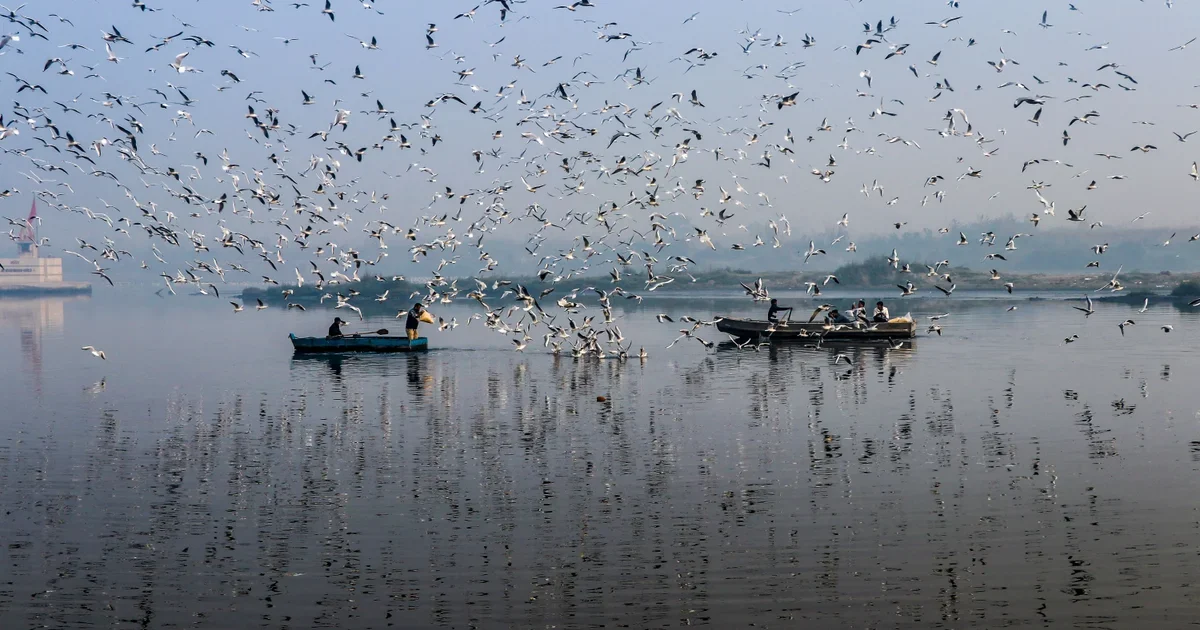
Photo by Aditya gupta on Pexels
In this story
The Yamuna travels 1,376 kilometres from a glacier in Uttarakhand to its meeting with the Ganga at Prayagraj. In Delhi it travels 22. Those 22 kilometres, from the Wazirabad barrage to the Okhla barrage, are about two percent of the river’s length and contribute over 80 percent of its pollution load, according to the Centre for Science and Environment (CSE). By the time the river reaches the first monitoring point inside the city, its dissolved oxygen has fallen to zero.
This is not a story of too little effort. Delhi and the Centre have spent thousands of crores on the river since 1993, through three Yamuna Action Plans and a long list of other projects. This post reads the money against the water: what the latest Delhi Pollution Control Committee (DPCC) readings show, what was built, what has worked and what has not, and what a plan that actually moves the numbers would have to do.
Why is the Delhi stretch the problem?
The answer begins with flow. The Yamuna is a river that Delhi mostly does not have. A barrage at Wazirabad, where the river enters the city, holds back its water for drinking supply. CSE’s briefing, Yamuna: The Agenda for Cleaning the River, notes that there is virtually no water in the river for nine months of the year, and what flows below the barrage is sewage and waste from the city’s drains.
The second part of the answer is drains. Between Wazirabad and Okhla, at least 22 drains discharge into the river. Two of them, the Najafgarh and Shahdara drains, carry 84 percent of the pollution load, according to the same CSE assessment, reported in Kashmir Times. The Najafgarh drain alone carries around 65 percent of the city’s sewage, according to an analysis in Ideas for India.
The river enters Delhi at Palla alive. Dissolved oxygen is close to the prescribed standard. By ISBT, the first monitoring station downstream, the DPCC records show it at zero. Everything that matters happens between those two points.
What does the latest water quality data show?
The DPCC publishes monthly reports from its monitoring points. The July 2026 report, dated 4 August and covered by The Open Press, gives a clear picture of one monsoon-onset month. Samples were taken on 6 July, when flow was still low because the monsoon had been delayed.
Location | Faecal coliform (MPN per 100 ml) | Dissolved oxygen (mg/L) | BOD (mg/L) |
|---|---|---|---|
Palla (enters Delhi) | 2,100 | 4.2 | 2 |
Wazirabad | 3,500 | 3.1 | 4 |
ISBT Bridge | 170,000 | 0 | not reported |
Okhla Barrage | 110,000 | 0 | 44 |
Asgarpur (leaves Delhi) | 320,000 | 0 | 58 |
The yardsticks matter. The Central Pollution Control Board’s bathing criteria need faecal coliform below 2,500 per 100 ml, dissolved oxygen above 5 mg/L and biochemical oxygen demand (BOD) below 3 mg/L. Palla meets the coliform and BOD criteria and just misses the oxygen one. Wazirabad misses all three by a small margin. Everything downstream fails badly: Asgarpur has a coliform count about 128 times the limit and a BOD close to 20 times the limit.
Two further data points give context. DPCC records for 2024, cited by CSE, showed that dissolved oxygen in the midstream and downstream stretches was nil even during the monsoon, that BOD was 40 to 50 times the permissible limit at those points, and that faecal coliform counts exceeded two lakh in the downstream stretch during dry spells. And officials told The Open Press that the water quality in July 2026 showed some improvement over the same period last year. Both are true: there is movement, from a very poor starting point.
What do these measures mean in plain terms?
Three numbers decide whether a river is alive, and each one is easy to picture.
- Dissolved oxygen (DO) is the air in the water. Fish, insects and the bacteria that break down waste all need it. Above 5 mg/L, a river supports life. At zero, nothing that breathes can live there, which is what “dead” means in the reports.
- Biochemical oxygen demand (BOD) measures how much oxygen the organic waste in the water will use up as it rots. A high BOD is a sign that sewage is in the river and is eating the oxygen. Below 3 mg/L is the bathing benchmark. Okhla’s 44 and Asgarpur’s 58 mean the waste in the water would strip it of oxygen many times over.
- Faecal coliform counts the bacteria that come from human and animal waste. They show how much untreated sewage the water carries and how likely a person is to fall ill from contact with it. The bathing limit is 2,500 per 100 ml.
When all three fail together, as they do from ISBT to Asgarpur, the river is not just dirty. It is an open sewer with no capacity to clean itself.
How reliable are the readings?
They are a fair guide with limits. The DPCC takes samples manually at eight key locations, and a monthly report rests on a sample taken on a single day. The July 2026 sample was collected on 6 July, before the monsoon flow had properly arrived, so a different day could give a different reading, especially at Palla and Wazirabad where flow changes quickly. CSE also raises a question about the credibility of the data on how much sewage the city generates, which matters because treatment capacity is judged against it.
None of this changes the conclusion. Readings taken across different months, years and agencies agree on the main points: clean water at the entry point, zero oxygen within a few kilometres, and extreme pollution at the exit. What would help is automatic, continuous monitoring at the same points, published in real time, so that a single day’s sample cannot mislead in either direction.
Why does this matter for Delhi’s own water supply?
Delhi is not only a polluter of the river. It also drinks from it. The Wazirabad barrage is where the city draws a significant part of its drinking water, according to The Open Press, and Wazirabad’s readings in July 2026 were already above the faecal coliform and oxygen benchmarks. CSE’s director general, Sunita Narain, said that a dead Yamuna adds to the burden of providing clean water to Delhi and to the cities downstream. Dirtier water entering the treatment works means higher chemical and energy costs for the water utility, and more risk for the families who live without a reliable tap.
Where does the pollution actually come from?
The pollution is largely sewage, with industrial effluent and solid waste added. Here are the main sources and what is known about each.
Sewage that never reaches a plant
Delhi generates about 3,600 million litres a day (MLD) of sewage. CSE reports that the installed capacity of its 37 sewage treatment plants is 3,033 MLD, expected to reach 3,652 MLD by mid-2025. On paper, the city can treat close to everything it produces. Yet the river does not improve, because a large share of the city’s sewage never gets to a plant. Ideas for India reports that more than 500 unauthorised colonies and 160 villages in Delhi were still unconnected to the sewer grid as of 2025. Their waste goes into stormwater drains, and the drains go into the Yamuna.
Plants that do not meet the standard
Of Delhi’s 37 plants, only 14 meet the prescribed standards, according to the CSE assessment, and 23 do not. A big part of the reason is that the standard moved. Delhi’s effluent limit for BOD and suspended solids was tightened to 10 mg/L, against a national standard of 30 mg/L, because the Yamuna has so little flow to dilute what it receives. Plants built to the older standard now need upgrading.
Treated and untreated water mixed
The city has 22 open stormwater channels that are supposed to carry clean water to the river. They receive untreated waste from unsewered colonies and tankers, and the treatment plants also release treated sewage into them. CSE calls this mixing of treated and untreated water something that must be avoided at all costs, because the plant’s work is undone in the drain.
Septage
Not every house is on a sewer. Households with septic tanks depend on de-sludging vehicles, and Delhi had registered 160 private vehicles by February 2024. CSE says that on average 1.5 million litres of septage a day was being collected and treated, which was about 1 percent of the officially generated wastewater in February 2025, and that it is unclear where the private vehicles take what they collect.
Industry
Ideas for India cites a 2020 study of the Central Pollution Control Board that found all 10 common effluent treatment plants in Delhi’s industrial clusters failing to meet norms, and 14 of the 22 major drains carrying untreated sewage or industrial waste. Industrial pollution is a smaller share by volume but adds toxic loads that sewage plants are not built to handle.
How much money has been spent, and on what?
The money has come in layers, and the totals depend on what is counted. The table below lists the figures that can be tied to a source.
Programme or period | Amount | What it was for |
|---|---|---|
Yamuna Action Plan, Phases I and II (from 1993) | Rs 1,514.70 crore spent | Sewage plants, sewer lines in Haryana, Delhi and Uttar Pradesh. Reported to the Lok Sabha in July 2017. |
Yamuna Action Plan, Phase III (approved December 2011) | Rs 1,656 crore approved | Rehabilitating sewers and modernising plants at Okhla, Kondli and Rithala, with a target of 10 mg/L for BOD. |
2017 to 2022, Delhi | At least Rs 6,857 crore | Yamuna-related projects, as counted by CSE. |
Since 1993, all plans | Nearly Rs 8,000 crore | The estimate used by Ideas for India. |
The first rows are official. The Governance Now report on the Lok Sabha reply gives the Phase I and II spend and the Phase III cost, and the Press Information Bureau release of 1 December 2011 records the cabinet approval. By that date, the release says, 276 schemes including 38 sewage treatment plants had been completed in 21 towns of Uttar Pradesh, Haryana and Delhi, creating 753.25 MLD of sewage treatment capacity. Ideas for India adds that by 2025 over Rs 1,000 crore had been spent under Phase III, delayed by land acquisition, contractor mobilisation and the pandemic, and that the interceptors for the Najafgarh and Shahdara drains were still incomplete.
The totals are not strictly additive: some of the figures overlap, and the 6,857 crore number covers a wider list of projects than the action plans alone. What the table does show is the scale. A river that gets Rs 6,857 crore of attention in five years, and is still a drain, has a problem that money alone is not solving. CSE says in its briefing that there is no evidence the investment has made a difference to the quality of the river’s water, and that cleaning the Yamuna “will require much more than money”.
What has worked?
The honest list is short, but it is not empty.
- Treatment capacity has been built. Delhi can now treat close to all of the sewage it generates on paper. In the 1990s it could not. The YAP phases created hundreds of MLD of capacity across three states.
- Standards have been tightened to fit the river. The 10 mg/L BOD limit for Delhi’s plants reflects a recognition that national norms are too loose for a river with no flow. It is the right standard even if plants lag it.
- Monitoring is public. The DPCC publishes monthly results for each point on the river. That is why this post can quote them. The data make the failure visible, and visibility is the start of accountability.
- Flow helps. When the monsoon brings water, indicators at Palla and Wazirabad improve and officials report better numbers than the previous year. The river recovers when it has water, which is a clue about what a plan should aim for.
What has not worked, and why?
The plans have repeatedly built the visible part, plants and pipes, and left the invisible part, connection, compliance and flow.
- Capacity without connection. Ideas for India points out that many YAP plants were under-used or dysfunctional because the sewer network could not deliver sewage to them. For illustration, a plant designed for 500 MLD that receives only 300 MLD leaves two-fifths of its capacity idle.
- Plants without compliance. With only 14 of 37 plants meeting the standard, treated water itself pollutes.
- Drains left open. The Najafgarh and Shahdara drains take 84 percent of the load, yet the interceptors meant to catch their flow were still incomplete in 2025, according to the Ideas for India account.
- Fragmented responsibility. The Delhi Jal Board runs plants and sewers, the municipal corporations maintain many storm drains, the Delhi Development Authority holds the riverfront land, DPCC and the CPCB regulate effluent, and an upstream board handles water sharing. When the plant, the drain and the regulator belong to different offices, a failure belongs to no one.
- Counting spend, not results. Programmes report rupees spent and MLD created. They do not report whether the oxygen in the river changed. Until funds are linked to a river-quality target, the incentive is to build, not to fix.
What would a plan that works look like?
CSE’s agenda and the evidence above point to a small set of priorities, in order.
- Fix the two big drains first. Najafgarh and Shahdara carry 84 percent of the load. Finish interception and connect their catchments before spreading effort across all 22.
- Connect the unconnected. Bring unauthorised colonies and villages onto the sewer grid, or give them decentralised plants. A tank in the colony costs far less than a trunk sewer to nowhere.
- Bring every plant up to standard. Publish a public list of the 23 non-compliant plants with deadlines, and treat discharge violations by the city’s own utility the way the city treats a factory’s.
- Stop mixing. Keep treated water and untreated drain water apart, and reuse treated water. CSE estimates that only 10 to 14 percent of treated wastewater is reused now.
- Track septage. Fit GPS to de-sludging vehicles so that septage ends up at a treatment point.
- Set one river-quality target and one accountable body. Dissolved oxygen at ISBT and Okhla, and BOD and faecal coliform at the same points, should be the headline measures, reported every month and tied to funding.
- Restore some flow. A river that has water for three months a year cannot dilute anything the rest of the year. Environmental flow release rules need to be part of the plan, not a separate debate.
Other Indian rivers show similar patterns. Our post on the Ganga and its pollution crisis covers the national programme that the Yamuna plans grew out of, and our post on community water conservation and river revival shows what local groups have achieved with far smaller budgets.
Why does this matter beyond Delhi?
The Yamuna is the Ganga’s largest tributary, and the pollution load it carries out of Delhi flows on to Mathura, Agra and Prayagraj, where it meets the Ganga. Cities downstream draw drinking water from it, and the cost of treating that water goes up with every unit of pollution entering at Delhi. It is also a test of whether Indian cities can run an urban river programme to results.
The broader water picture is covered in our post on India’s water crisis. Rivers do not clean themselves faster than cities pollute them, and the Yamuna is the clearest case.
What can you do?
- Read the DPCC monthly report. The Delhi Pollution Control Committee posts it on its website. Look at dissolved oxygen and BOD at Okhla and Asgarpur, not just the headline.
- Find out if your colony is sewered. Ask your RWA or ward councillor whether your area is connected to a sewer and a treatment plant, and where your septic tank is emptied if it is not.
- Use registered de-sludging services. Ask for the vehicle registration and the disposal point. Do not accept a driver who cannot tell you where the tank goes.
- Keep puja material, idols and plastic out of the river. Immersion in tanks arranged by the municipality keeps oil, paint and flowers out of the water. Our post on chemical waste after Holi shows how festival waste ends in drains.
- File a Right to Information request. Ask the Delhi Jal Board for the compliance status of the sewage treatment plant nearest to you, and for the date its upgrade will be complete.
- Save water at home. Less sewage, and less abstraction upstream, both help the river.
- Support citizen groups that monitor the river. Independent data checks the official data, which is how many of the figures in this post became public.
Frequently asked questions
How long is the Yamuna in Delhi?
About 22 kilometres, from the Wazirabad barrage to the Okhla barrage. It is about two percent of the river’s total length.
How much of the Yamuna’s pollution comes from Delhi?
CSE says over 80 percent. Other analyses give 76 to 80 percent. All agree it is the large majority.
Is the Yamuna in Delhi fit for bathing?
No. Only Palla, at the entry point, is close to the bathing criteria. Downstream the dissolved oxygen is zero and faecal coliform counts are far above the limit.
How much has been spent on cleaning the Yamuna?
Phases I and II of the Yamuna Action Plan cost Rs 1,514.70 crore, Phase III was approved at Rs 1,656 crore, and CSE counts at least Rs 6,857 crore on Yamuna-related projects in Delhi between 2017 and 2022. One analysis puts the total since 1993 near Rs 8,000 crore. The figures overlap and should not be added together.
Why does the river stay dirty despite sewage plants?
Because much sewage never reaches a plant, many plants do not meet the current standard, treated and untreated water mix in drains, and the river has little flow to dilute the rest.
Is there any good news?
Yes, some. Delhi has the capacity to treat most of its sewage, the standards are tighter, data are public, and monsoon-season readings improved on the previous year. The task is to connect, comply and measure.
The takeaway
The Yamuna in Delhi shows what happens when a city builds infrastructure faster than it builds accountability. The plants exist, the money has been spent and the river is still dead for most of the year. The next rupee should go to the two big drains, to the colonies that are not on a sewer, and to a single public target for oxygen in the water. A river is clean when fish can live in it, and that is a measurement anyone can check.
Sources: Delhi Pollution Control Committee monthly reports as covered by The Open Press; Centre for Science and Environment, Yamuna: The Agenda for Cleaning the River (May 2025); Press Information Bureau (2011); Lok Sabha reply of July 2017 via Governance Now; Ideas for India (July 2025).
What you can do
- Share the evidenceSend this to one person who should know about environment.Share on WhatsApp
- Give an afternoonTeach, mentor, clean up, or lend your professional skills.Ways to volunteer
- Tell us what's missingKnow a story, a fact we got wrong, or a solution worth spotlighting?Suggest a story
Politically neutral. Every claim sourced. Report a correction.
No comments yet