GRAP Stages Explained: What Each Stage Bans in Delhi-NCR and Why the Smog Returns Every November
The four GRAP stages for Delhi-NCR by AQI band, what each one bans under CAQM's September 2026 schedule, which stage is in force, and what GRAP has achieved.
In this story
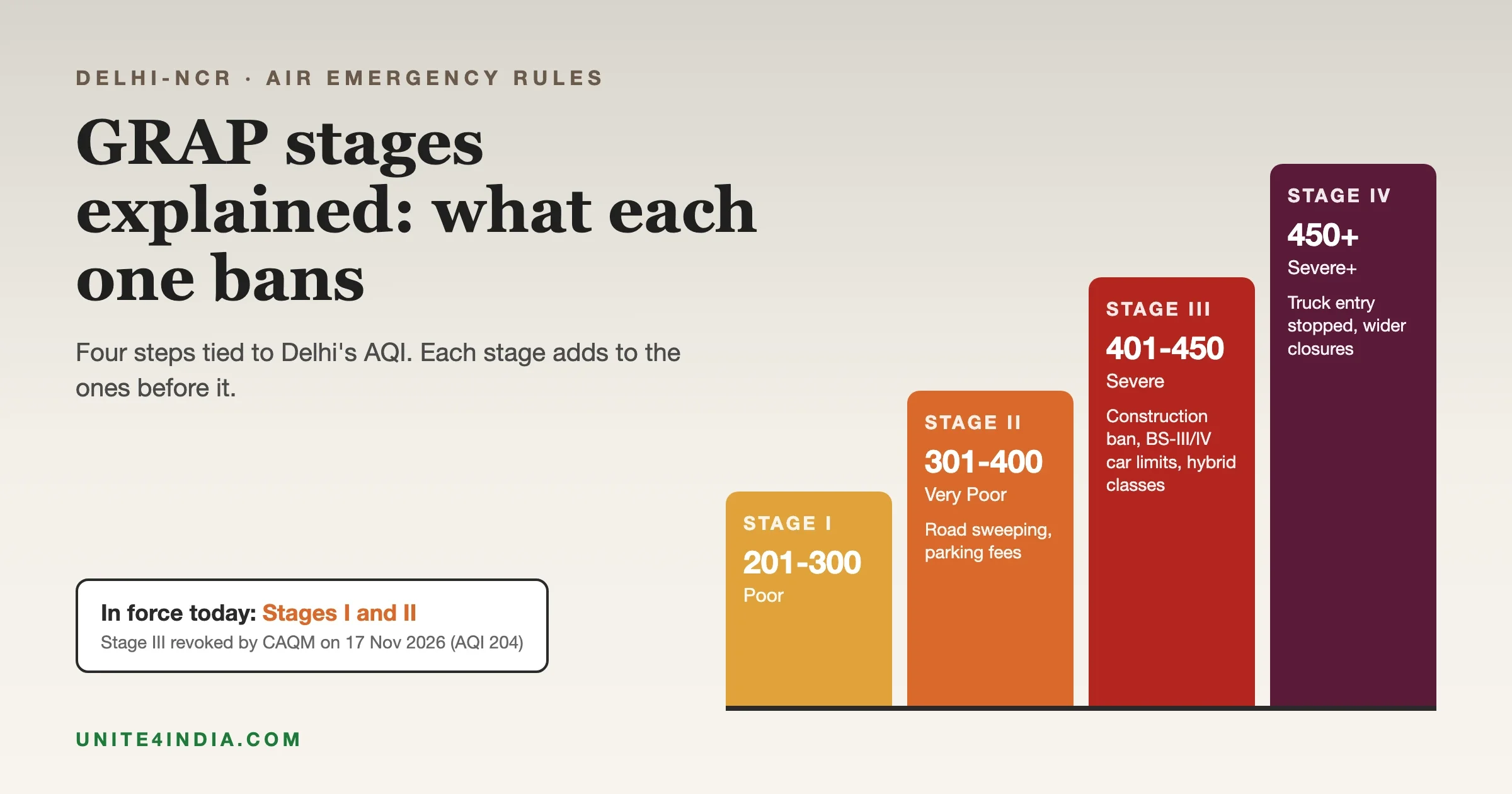
Short answer: GRAP, the Graded Response Action Plan, is Delhi-NCR’s emergency rulebook for bad air. It has four stages tied to Delhi’s AQI: Stage I at Poor (201 to 300), Stage II at Very Poor (301 to 400), Stage III at Severe (401 to 450) and Stage IV at Severe+ (above 450). Each stage adds restrictions on top of the ones before it, from dust control and diesel generator rules at Stage I to a ban on most construction and older cars at Stage III and on truck entry at Stage IV. As of the latest order from the Commission for Air Quality Management (CAQM), dated 17 November 2026, Stages I and II are in force and Stage III has been lifted.
This guide uses the current GRAP schedule, which CAQM revised on 29 September 2026, and the Commission’s own orders for this season. We also look at what GRAP has achieved, where it falls short, and why the smog keeps coming back every November. Checked on 21 November 2026.
What is GRAP and who runs it?
GRAP is a list of actions that agencies in Delhi and the National Capital Region must take when air quality gets worse. It was first notified by the Union environment ministry in January 2017, on the directions of the Supreme Court in the long-running M.C. Mehta case on Delhi’s air.
Today it is run by the Commission for Air Quality Management in National Capital Region and Adjoining Areas, a statutory body set up under the CAQM Act of 2021. Section 12 of that Act lets the Commission issue binding directions. The current GRAP schedule was issued as CAQM Direction No. 104 on 29 September 2026.
CAQM’s Sub-Committee on GRAP watches the air quality data and forecasts. When it decides a stage is needed, it issues an order, and every agency in the NCR, from municipal bodies and traffic police to pollution control boards in Haryana, Uttar Pradesh and Rajasthan, must carry out the actions listed for that stage.
What are the four GRAP stages?
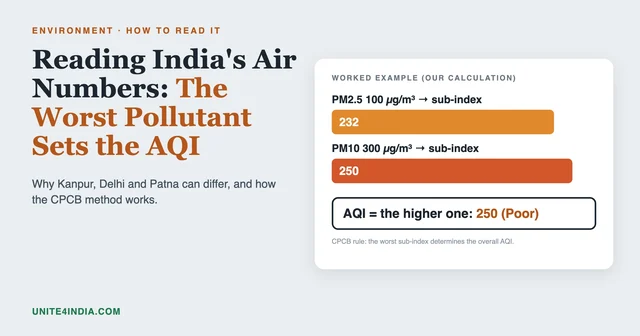
The stages follow the AQI bands that the Central Pollution Control Board (CPCB) uses. If you want to know how that AQI number is worked out, our guide to reading India’s air pollution numbers explains the method.
Stage | Delhi AQI | Category | Headline actions |
|---|---|---|---|
Stage I | 201 to 300 | Poor | Dust control at sites, open burning ban, PUC checks, diesel generator rules, inter-state bus limits, no coal or firewood in tandoors |
Stage II | 301 to 400 | Very Poor | Daily road sweeping and sprinkling, higher parking fees, staggered office timings, electric heaters for guards and staff |
Stage III | 401 to 450 | Severe | Ban on most construction and demolition, stone crushers and mining shut, BS-III petrol and BS-IV diesel cars restricted, hybrid classes up to Class V |
Stage IV | Above 450 | Severe+ | Truck entry into Delhi stopped except clean fuels, linear public projects halted, hybrid classes for more grades, optional odd-even and closures |
Source: CAQM, GRAP schedule revised on 29 September 2026.
The stages are cumulative. In the schedule’s own words, Stage III actions “shall be in addition to those under Stage I and II”. So when you read that Stage III is in force, everything in Stages I and II is in force too.
What does GRAP Stage I ban?
Stage I is the longest list, with 25 actions. Most are about enforcing rules that already exist, rather than new bans. The ones that affect people most directly are:
- Construction dust. Sites must cover materials, carry debris in covered vehicles, use anti-smog guns and sprinkle water. Projects of 500 square metres or more that are not registered on the state’s dust monitoring portal cannot carry on.
- Open burning. Burning of biomass and municipal waste is banned, with the maximum environmental compensation fines, and agencies must watch landfill sites for fires.
- Vehicles. Police must enforce Pollution Under Control (PUC) certificates, impound visibly polluting vehicles and enforce the existing ban on overaged diesel and petrol vehicles. Trucks not bound for Delhi are diverted to the Eastern and Western Peripheral Expressways.
- Diesel generators. Power companies must keep supply steady so that diesel generator sets are not used as a regular source of power. Sets running on gas or LPG are allowed. Sets of 41 to 800 kW must run on dual fuel or have emission control devices fitted. Small portable sets below 19 kW are generally not allowed, except for listed emergency services.
- Inter-state buses. Inter-city and inter-state buses from Haryana, Uttar Pradesh, Rajasthan, Punjab, Himachal Pradesh, Madhya Pradesh, Uttarakhand and Jammu and Kashmir may ply in Delhi-NCR only if they are electric, CNG or BS-VI diesel.
- Hotels and eateries. The existing ban on coal and firewood in tandoors at hotels, restaurants and open eateries must be strictly enforced.
- Firecrackers. Court orders on firecrackers must be enforced.
- Complaints. Agencies must act quickly on complaints made through the 311 app, the Green Delhi app and the SAMEER app.
The September 2026 revision moved two of these down from Stage II to Stage I: the diesel generator rules and the inter-state bus limits. In other words, they now start one band earlier, at Poor air rather than Very Poor.
What changes at GRAP Stage II?
Stage II adds measures aimed at road dust, private cars and people who work outdoors at night:
- Daily mechanised or vacuum sweeping of roads, with water and dust suppressants sprinkled, and targeted action at pollution hotspots.
- More inspections of construction and demolition sites.
- Higher parking fees “to discourage private transport”.
- Resident welfare associations must give electric heaters to security guards, sanitation workers and other staff, so that they do not burn wood or waste to keep warm.
- Staggered timings for public offices in Delhi, Gurugram, Faridabad, Ghaziabad and Gautam Buddha Nagar (Noida). The Centre may stagger its own offices.
Staggered office hours were a Stage III measure until November 2025, when CAQM moved them to Stage II.
What is banned under GRAP Stage III?
Stage III is where daily life changes for most families in the NCR.
Construction and demolition
Dust-generating construction and demolition work is banned across the NCR. That covers earthwork, piling, all demolition, open trench digging, brick and masonry work, ready-mix concrete plants, major welding, painting, plastering and tiling, road construction and moving loose materials. Minor indoor repairs and pothole repairs are allowed. Railways, metro, airports, inter-state bus terminals, defence and national-importance projects, hospitals, linear public projects, sanitation and water projects are exempt.
Stone crushers must close, and “all mining and associated activities in the entire NCR” stop.
Older cars
There are strict restrictions on BS-III petrol and BS-IV diesel (or older) four-wheelers in Delhi and the high vehicle density districts of Gurugram, Faridabad, Sonipat, Ghaziabad and Gautam Buddha Nagar. People with disabilities are exempt. Sonipat was added to this list in the September 2026 revision.
Goods vehicles
BS-IV diesel medium goods vehicles registered in Delhi are restricted, and BS-IV diesel medium and light goods vehicles registered outside Delhi are not allowed into the city. The 2026 revision removed an earlier exemption for vehicles carrying essential goods.
Schools
Schools in Delhi and the four main NCR districts must run classes up to Class V in hybrid mode, so that students can attend online. The choice of the online option rests with students and parents.
Offices
NCR state governments and the Delhi government decide whether public, municipal and private offices should work at 50 percent strength with the rest working from home. This decision moved from Stage IV to Stage III in November 2025.
What happens under GRAP Stage IV?
Stage IV is the emergency level, used when Delhi’s AQI is forecast to stay above 450:
- Entry of heavy goods vehicles into Delhi stops. Trucks running on LNG, CNG, electricity or BS-VI diesel may still enter.
- BS-IV diesel heavy goods vehicles registered in Delhi are banned.
- The construction ban extends to linear public projects, which were exempt at Stage III.
- Hybrid classes extend to Classes VI to IX and XI. Classes X and XII are not listed.
- State governments may consider further emergency steps, such as closing colleges and educational institutions, shutting non-emergency commercial activity and running vehicles on an odd-even basis.
We found no order invoking Stage IV in the 2026 season so far.
Which GRAP stage is in force today?
As of 21 November 2026, Stages I and II are in force across Delhi-NCR. Here is how the season has run, from CAQM’s orders:
Date | Action | Delhi AQI cited by CAQM |
|---|---|---|
21 October 2026 | Stage I invoked | 244 at 2 pm, up from 179 the day before |
30 October 2026 | Separate order for 5 to 20 November: outdoor construction and demolition restricted across NCR; offices in Delhi and five NCR districts to work with up to 50 percent staff present | Based on November peaks in 2018 to 2025 |
2 November 2026 | Stage II invoked | 324, after 261 on 1 November |
6 November 2026 | Stage III invoked | 382, forecast to turn Severe |
17 November 2026 | Stage III revoked; Stages I and II continue | 204 (Poor) |
The separate 30 October order shows a different approach. Instead of waiting for the AQI to cross a line, CAQM looked at daily data for Novembers from 2018 to 2025, saw that the worst air usually arrives in early and mid November, and restricted construction and office attendance for 5 to 20 November in advance. That order ran until 20 November, and we did not find an extension.
Stages change quickly. To see the current stage, check the GRAP orders page on the CAQM website, which lists every order with its date.
How does the AQI forecast trigger a GRAP stage?
The schedule says actions “shall be invoked in advance of the AQI of Delhi reaching to the projected levels of that stage”, where higher AQI levels are likely to last for a longer period. The forecasts come from the India Meteorological Department (IMD) and the Indian Institute of Tropical Meteorology (IITM), which runs an air quality early warning system and a Decision Support System for Delhi that also estimates how much each source, including crop residue fires, adds to pollution over the next three days.
If the AQI crosses a stage’s level without warning, the stage is invoked straight away. Stages are lifted when the AQI improves and the forecast shows it is likely to stay better, but the lower stages stay in place.
In practice, GRAP has often been reactive. ThePrint’s analysis of CAQM orders, published in February 2026, found that in 13 of 17 GRAP impositions between January 2025 and January 2026, the stage came after the AQI had already crossed its threshold. That matters, because measures such as stopping construction work best before a bad spell, not during it.
Why does the smog return every November?
GRAP does not change the weather or the region’s basic emissions, and both peak at the same time.
- Weather. In late autumn, winds drop, nights get colder and the layer of air near the ground becomes shallow. Pollutants have less room to spread out. The same emissions that disperse in July hang over the city in November.
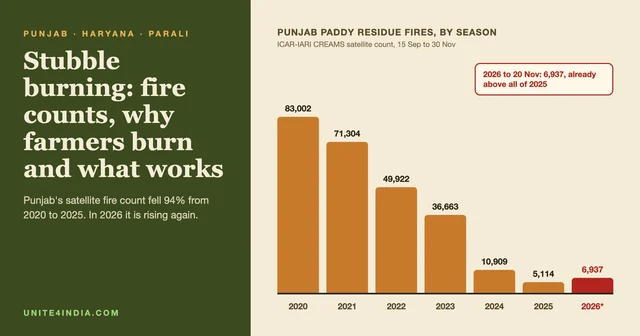
- Crop residue fires. Paddy harvesting in Punjab and Haryana ends in October and November, and burning of stubble adds smoke on some days, depending on the number of fires and the wind direction. We cover this in detail in our guide to stubble burning in Punjab and Haryana.
- Festivals. Firecrackers around Diwali add a short, sharp spike.
- Year-round sources. Vehicles, road and construction dust, industry, power plants and waste burning do not stop in winter. Heating adds to them.
CREA’s monthly snapshot for November 2025 shows how bad that month can be. On its PM2.5-based count, Delhi had 23 Very Poor days, six Severe days and one Poor day, and the monthly average PM2.5 was 215 µg/m³, about twice October’s 107. CREA estimated that stubble burning’s average share of Delhi’s PM2.5 that month was 7 percent, down from 20 percent a year earlier. In other words, even with far fewer farm fires, the city’s own and regional sources kept the air in the worst bands.
The Supreme Court made a similar point this year. Its order of 6 November 2026, in a fresh case on Delhi’s air, recorded data from the amici curiae for 21 October to 3 November showing “a substantial decline in incidents of stubble burning” but a “sharp increase in issues attributable to vehicular emissions”, and directed Delhi, Haryana, Rajasthan and Uttar Pradesh agencies to report on vehicle entry, PUC enforcement and end-of-life vehicles.
Has GRAP actually worked?
The honest answer is: partly, and the evidence is weaker than either side claims.
What looks better
For January to October 2025, CAQM reported that Delhi’s average AQI was 170, the lowest in eight years apart from the lockdown year of 2020. The equivalent figures were 184 in 2024, 172 in 2023, 187 in 2022, 179 in 2021 and 201 in 2018. The same release counted no Severe days in January to October 2025, against three in 2024 and seven in 2018. Average PM2.5 for those ten months was 72 µg/m³, down from 83 in 2024. These numbers were reported by The Tribune on 1 November 2025, citing CAQM.
What does not
2026 has not continued that trend cleanly. An analysis by the citizens’ group Hawa Ka Hisab, based on CPCB’s 4 pm bulletins and reported by UNI on 1 October 2026, found that Delhi’s average AQI for January to September 2026 was 167.6, slightly worse than 164.3 for the same months of 2025. It also pointed out that CAQM’s 30 September 2026 release did not include a nine-month average. We have not seen the government’s own full-year 2026 comparison.
Even in the better years, Delhi’s annual PM10 and PM2.5 are far above the national standard. In 2025, CPCB data analysed by CREA put Delhi’s annual PM10 at 197 µg/m³ and PM2.5 at 96 µg/m³, against standards of 60 and 40. Our clean air programme scorecard shows how slow the long-term decline has been.
Why it is hard to judge
GRAP is switched on when weather is worst, so a simple before-and-after comparison mixes up the effect of the rules with the effect of the wind and temperature. Annual averages also depend on rain, the timing of Diwali and the number of farm fires. No study we found isolates GRAP’s own effect on Delhi’s air with a convincing method.
Enforcement
A rule only helps if it is enforced. CAQM’s enforcement task force reported 124 inspections between 25 September and 10 October 2026, covering 6 construction sites, 54 industrial units and 64 diesel generator sets, with closure proposed for 2 construction projects and 3 industrial units, and 12 units sealed, as reported by All India Radio on 17 October 2026. Those numbers are small for a region the size of the NCR.
The Supreme Court has repeatedly found enforcement wanting. In its order of 25 November 2024 it found “no earnest effort” to enforce the Stage IV truck rules and ordered action against officers who had defaulted. Anumita Roychowdhury of the Centre for Science and Environment summed up the wider worry to ThePrint: “But now, it is as if winter comes and we enact GRAP and then nothing else. It’s not enough.”
What did the Supreme Court change about GRAP?
The Court has shaped GRAP directly over the last two winters:
- 18 November 2024: a bench of Justices A.S. Oka and A.G. Masih ordered that Stage IV continue even if the AQI dropped below 450, until further orders, and said the Commission “cannot wait for improvement of AQI” before acting.
- 25 November 2024: the Court said it would not allow a move down to Stage III or II without a consistent downward trend, asked CAQM to consider relaxing school closures because children were losing mid-day meals and many lacked online access or air purifiers at home, and ordered subsistence allowance for construction workers from labour cess funds.
- 12 December 2024: the Court approved a modified GRAP proposed by the Commission’s sub-committee, which became the comprehensive schedule of 13 December 2024.
- 19 November 2025: the Court accepted CAQM’s proposal to move several measures to earlier stages, saying that “any pro-active action by the Commission aimed at reducing air pollution levels would always be welcome”.
The right to clean air that these cases rely on comes from Article 21 of the Constitution, the right to life, which we explain in our guide to Constitution Day and the rights you can use.
Who pays the price of GRAP?
The cost of each stage falls unevenly.
Construction bans stop the daily wages of lakhs of workers, many of them migrants. The Supreme Court’s order to pay them a subsistence allowance from the construction welfare cess was a response to exactly this. Whether every worker gets that money depends on registration with state welfare boards, which many informal workers lack.
School measures hit poorer children hardest. Hybrid classes are easy for a child with a laptop and broadband, and much harder for one sharing a phone with siblings, or one who relies on the school’s mid-day meal. The move from closures to a hybrid option, with the choice left to parents, is an attempt to balance this.
Vehicle rules affect owners of older cars and small transport operators who cannot easily upgrade. Small traders using diesel generators during power cuts feel the Stage I rules more than large offices with gas sets.
None of this is a reason to drop GRAP. It is a reason to fix the year-round sources so that the emergency brake is needed less often.
What can households do when GRAP is in force?
The GRAP schedule includes a citizen charter for each stage. These steps come from it, in plain words.
Stage | What CAQM asks citizens to do |
|---|---|
Stage I | Check the AQI on the SAMEER app and the current stage on the CAQM website. Keep engines tuned, tyres inflated and PUC certificates up to date. Switch off at red lights. Use public transport or carpool. Segregate waste, do not burn it. Avoid diesel generators and firecrackers. Report polluting activity on the 311, Green Delhi or SAMEER apps. |
Stage II | Prefer public transport and less congested routes. Replace vehicle air filters. Avoid dust-generating building work from October to January. Clean kitchen chimney filters. Avoid outdoor cooking or heating with smoke. Work from home if your job allows it. |
Stage III | Walk or cycle short distances and combine trips. Postpone private gatherings. Do not use coal or wood for heating; give electric heaters to staff. Follow hybrid classes for young children and work-from-home instructions. |
Stage IV | Limit non-essential outdoor activity. Children, pregnant women, older people and people with heart or lung disease should stay indoors as far as possible and wear a mask outdoors. |
Two habits make the biggest difference for most families. First, look at the AQI before planning outdoor exercise or a child’s playtime, and move it to the afternoon on bad days, when the air near the ground is usually better mixed. Second, report waste fires. Small fires in colonies, markets and landfills are a large and very local source in winter, and they are exactly what the complaint apps are meant for.
Common mistakes people make about GRAP
- “Stage III means only Stage III rules apply.” Stages are cumulative. Stage III includes everything in Stages I and II.
- “GRAP is only for Delhi.” It applies across the NCR, including districts in Haryana, Uttar Pradesh and Rajasthan, though some measures are limited to Delhi and named districts.
- “Schools close under Stage III.” Under the current schedule, classes up to Class V move to hybrid mode, with the online option left to parents, not a full closure.
- “All construction stops.” Railways, metro, airports, hospitals, defence and several public projects are exempt at Stage III, and minor indoor repairs are allowed.
- “The stage changes the moment AQI crosses a line.” Stages are meant to be invoked on forecasts, and are lifted only when the improvement looks likely to last. Orders can come before or after the line is crossed.
- “An app showing 500 means Stage IV.” GRAP uses CPCB’s AQI for Delhi. Some apps use the US scale, which reads higher at the same pollution level.
Common questions
What is GRAP in Delhi?
The Graded Response Action Plan, a set of emergency measures that CAQM orders across Delhi-NCR in four stages as the AQI gets worse.
What is banned in GRAP Stage 3?
Most construction and demolition work, stone crushers and mining in the NCR, BS-III petrol and BS-IV diesel four-wheelers in Delhi and five NCR districts, and outside BS-IV diesel goods vehicles entering Delhi. Classes up to Class V move to hybrid mode.
What is banned in GRAP Stage 4?
Everything in Stage III, plus entry of trucks into Delhi except LNG, CNG, electric and BS-VI diesel, Delhi-registered BS-IV diesel heavy goods vehicles, and work on linear public projects. More classes go hybrid, and states may add odd-even and closures.
Which GRAP stage is in Delhi today?
As of 21 November 2026, Stages I and II, after Stage III was revoked on 17 November. Check the CAQM GRAP orders page for the latest.
At what AQI is GRAP Stage 3 imposed?
When Delhi’s AQI is forecast to be Severe, 401 to 450, and likely to stay there.
Can I drive my BS-IV diesel car under GRAP Stage 3?
Not in Delhi or in Gurugram, Faridabad, Sonipat, Ghaziabad and Gautam Buddha Nagar, unless you are a person with a disability. BS-VI diesel and BS-IV petrol cars are not covered by this restriction.
Who decides the GRAP stage?
The Sub-Committee on GRAP of the Commission for Air Quality Management, using IMD and IITM forecasts and CPCB’s AQI.
What we could not confirm
We could not read CPCB’s daily AQI bulletins for 18 to 20 November 2026 because the CPCB website was not reachable securely from our tools, so we give no AQI for those days. We did not find CAQM’s original release on the January to October 2025 figures, which is no longer online, and rely on The Tribune’s report of it. Figures for January to October 2026 from the environment ministry appeared in news summaries, but we did not open the primary source, so we leave them out. We could not confirm the often-repeated claim that stages are invoked exactly three days ahead; the schedule says only “in advance”. We did not compare the 2022 and 2023 versions of GRAP.
Sources
- CAQM, revised GRAP schedule, 29 September 2026, including stage actions and the citizen charter.
- CAQM, GRAP orders, 21 October, 2 November, 6 November and 17 November 2026.
- CAQM order of 30 October 2026 for 5 to 20 November.
- Supreme Court order of 6 November 2026 and order of 12 December 2024 in the M.C. Mehta matters.
- CREA, November 2025 monthly air quality snapshot.
- The Tribune, 1 November 2025, citing CAQM’s January to October 2025 figures.
- UNI, 1 October 2026, on the Hawa Ka Hisab analysis.
- ThePrint, February 2026, on reactive GRAP impositions.
- All India Radio, 17 October 2026, on CAQM enforcement.
- LiveLaw, 18 November 2024, and the Supreme Court order of 25 November 2024.
For the bigger picture of where Delhi’s pollution comes from and what has worked elsewhere, read our guide to air pollution in India.
Checked on 21 November 2026.
What you can do
- Share the evidenceSend this to one person who should know about environment.Share on WhatsApp
- Give an afternoonTeach, mentor, clean up, or lend your professional skills.Ways to volunteer
- Tell us what's missingKnow a story, a fact we got wrong, or a solution worth spotlighting?Suggest a story
Politically neutral. Every claim sourced. Report a correction.
No comments yet