How the Indian Monsoon Works: Onset, Withdrawal and Why It Decides the Farming Year
How the Indian monsoon works, how IMD declares onset and withdrawal, and why it decides the farming year, with IMD data from the 2026 season.
In this story
Short answer: the Indian monsoon is a seasonal wind and rain system. Moist winds from the Indian Ocean blow towards the hot Indian land mass between June and September and bring most of India’s yearly rain. The India Meteorological Department (IMD) says it normally sets in over Kerala around 1 June. The rain then spreads north, and the winds turn back from north-west India in September. The farming year depends on it because about half of India’s net sown area has no irrigation and relies on rain, and the June to September rain also fills the reservoirs. This guide explains how the monsoon works, how IMD decides when it has arrived, and what happened in 2026.
What the monsoon is
The word comes from an Arabic word for “season”. In India it means the south-west monsoon, which brings rain between June and September. The Reserve Bank of India (RBI) says this four-month season receives around 75 percent of the annual rainfall. IMD measures it against a “long period average” (LPA). For 1971 to 2020, the all-India LPA for June to September is 868.6 millimetres.
When you hear that the monsoon was “normal”, “deficient” or “excess”, the comparison is with that average. IMD calls the all-India season deficient when rainfall is below 90 percent of the LPA.
How the monsoon works
This section is a plain description of the usual textbook explanation. IMD’s own 2026 report names the main pieces, such as low pressure systems and the large-scale climate patterns, but it does not set out the physics step by step.
- Land heats faster than the sea. In summer, the land mass of north and central India gets much hotter than the Indian Ocean around it. Warm air over land rises, and pressure near the ground falls.
- Moist air flows in. Air over the cooler ocean is at higher pressure, so it moves towards the low pressure over land. It carries a lot of water vapour from the Arabian Sea and the Bay of Bengal.
- The rain belt moves north. The belt of heavy rain near the equator shifts north in the northern summer and brings the monsoon winds with it.
- Hills force the air up. When moist air meets the Western Ghats or the Himalayas, it is pushed up, cools and drops its water as rain.
- Low pressure systems carry rain inland. Systems that form over the Bay of Bengal move across the country and bring bursts of rain. IMD counted 14 low pressure systems in the 2026 season, six of them monsoon depressions.
- Breaks and spells. The rain is not even. Wet spells are followed by dry spells, and a long dry spell in a key month can hurt crops.
- Retreat. As the land cools in autumn, the pressure pattern reverses, and the winds withdraw, starting from north-west India.
Other parts of the global climate also change the monsoon from year to year. IMD’s season report mentions El Niño and Southern Oscillation (ENSO) and the Indian Ocean Dipole (IOD) conditions, and says its forecasts for them were broadly consistent with what happened. These are patterns of ocean temperature in the Pacific and Indian Oceans that affect rainfall over India.
How IMD decides the monsoon has arrived
IMD does not declare onset by guesswork. It has set criteria. According to its onset page, the declaration for Kerala needs these conditions together:
- Rain: after 10 May, at least 60 percent of 14 listed stations in Kerala and nearby areas report 2.5 millimetres of rain or more for two consecutive days. Onset is declared on the second day.
- Winds: westerly winds should be deep, up to 600 hectopascals (about 4 kilometres up), over a set box of the Arabian Sea. The wind speed near the ground should be of the order of 15 to 20 knots over 5 to 10 degrees north and 70 to 80 degrees east.
- Cloud and heat (outgoing longwave radiation): a satellite-based measure should be below 200 watts per square metre in a defined box.
The criteria must be met together. That is why the “arrival” is sometimes declared a day or two later than the first heavy showers.
The normal calendar
Stage | Normal date | Source |
|---|---|---|
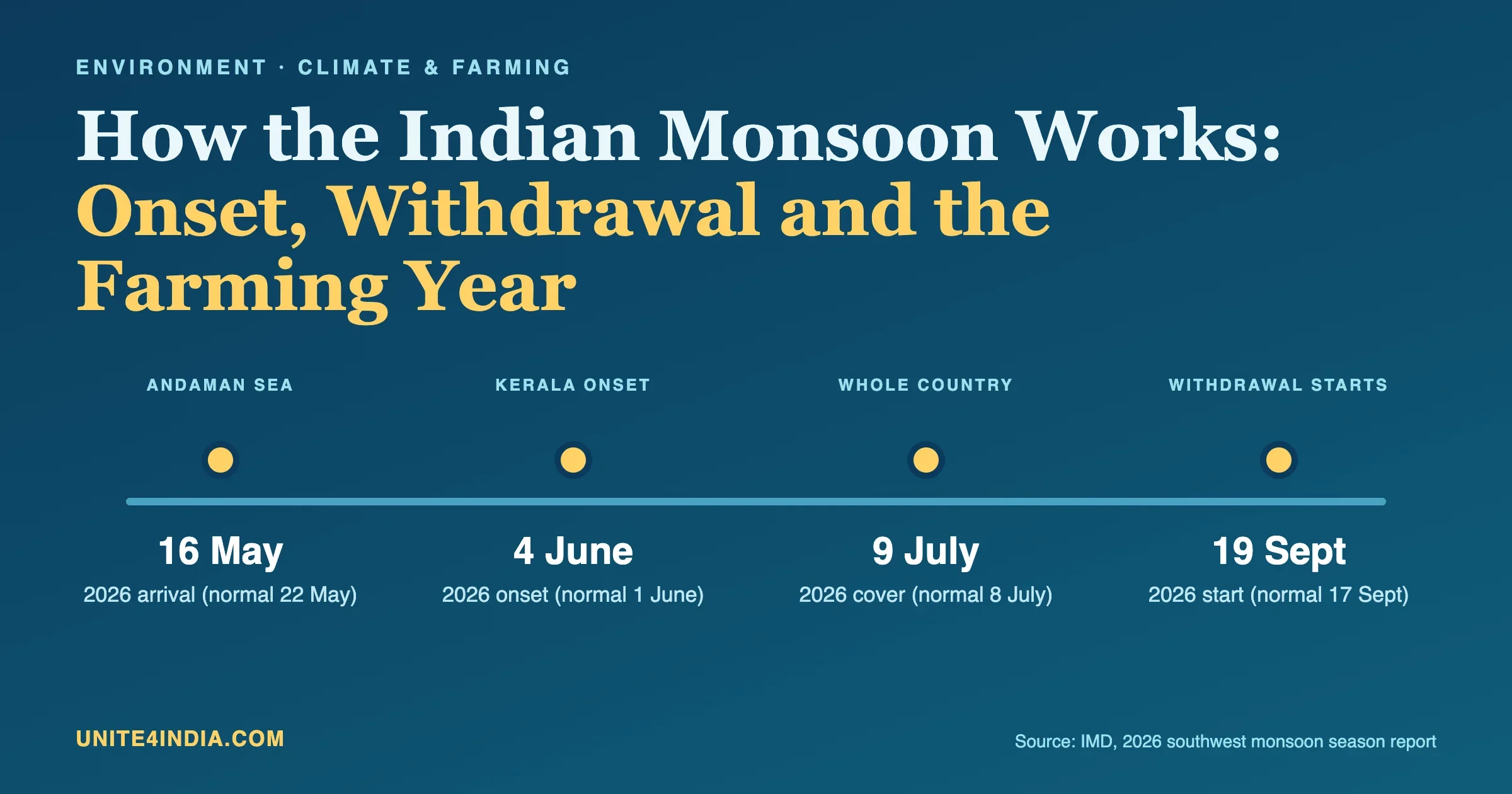
Onset over the Andaman Sea | 22 May | IMD, 2026 season report |
Onset over Kerala | 1 June | IMD onset page and 2026 report |
Covers the whole country | 8 July | IMD, 2026 season report |
Withdrawal begins from west Rajasthan | 17 September | IMD, 2026 season report |
The IMD onset page we read still says the monsoon covers the entire country “around 15 July”. The 2026 report uses 8 July as the normal date. We use the 2026 report. We did not find the normal date for complete withdrawal in the sources we read, so we leave it out.
What happened in 2026: a case study from IMD data
IMD’s 2026 season report gives a clear picture of how a monsoon can behave. The numbers below are all from that report.
The season total
- All-India rainfall from June to September was 759.4 millimetres, which is 87 percent of the LPA. That is deficient. IMD says it is the 4th lowest since 2001 and the 13th lowest since 1901.
- Rain came unevenly across the country. Out of 36 meteorological subdivisions, 18 (53 percent of the area) got normal rain, 17 (42 percent) got deficient rain, and one, Odisha (5 percent), got excess.
- Out of 741 districts, 312 (42 percent of the area) had normal rain, 282 (38 percent) were below normal and 34 (5 percent) were significantly below normal. 90 districts (12 percent) had excess rain and 16 (2 percent) had substantially above-normal rain.
The regions
Region | Long period average (mm) | 2026 rainfall (mm) | Percent of average |
|---|---|---|---|
All India | 868.6 | 759.4 | 87 |
Northwest India | 587.6 | 553.0 | 94 |
Central India | 978.0 | 952.8 | 97 |
East and Northeast India | 1,367.3 | 1,016.3 | 74 |
South Peninsula | 716.2 | 542.0 | 76 |
Monsoon core zone | 826.0 | 779.9 | 94 |
IMD says rainfall over East and Northeast India was the lowest since 1901, and the South Peninsula had its 4th lowest since 1901. Central India got normal rain. The monsoon core zone, which IMD describes as most of the rain-fed agriculture regions, got 779.9 millimetres, just below the lower limit of its normal range of 782.8 to 881.2 millimetres.
The months
Month | Average (mm) | 2026 rain (mm) | Percent of average |
|---|---|---|---|
June | 165.3 | 106.8 | 65 |
July | 280.5 | 283.3 | 101 |
August | 254.9 | 213.3 | 84 |
September | 167.9 | 155.1 | 92 |
A weak June, a normal July and a weak August is the pattern that matters most for farming. We explain why below.
The timeline
- 16 May: the monsoon reached the Andaman Sea about six days early.
- 4 June: onset over Kerala, three days later than the normal date of 1 June. IMD notes that its forecast of Kerala onset was 8 days early compared with the actual date.
- By 30 June: the monsoon covered most parts of the country.
- 9 July: it covered the entire country, against a normal date of 8 July. Even so, IMD says the advance was delayed by about 7 to 10 days over Maharashtra, Gujarat, Madhya Pradesh, Chhattisgarh and Odisha, and about 5 to 10 days over the north-east.
- 19 September: withdrawal began from west Rajasthan, two days later than the normal 17 September.
IMD says its seasonal forecast was accurate and within the forecast error limit. The press reported the forecast as 90 percent of the LPA, with an error margin of 4 percent, and the actual result was 87 percent.
The 2026 story shows a point that is easy to miss. The date of arrival in Kerala is a headline, but it does not predict the season. In 2026 the onset was three days late, the country was covered on almost the normal date, and the season still ended deficient because of what happened between those dates.
Month by month in 2026, region by region
The season total hides how much changed from month to month. IMD’s report breaks it down by region and by district area.
Region (percent of average) | July 2026 | August 2026 | September 2026 |
|---|---|---|---|
Northwest India | 96 | 91 | 117 |
Central India | 133 | 84 | 103 |
East and Northeast India | 71 | 83 | 75 |
South Peninsula | 75 | 73 | 73 |
Central India was well above average in July and below it in August. Northwest India was strong in September. The South Peninsula stayed low in all three months. IMD says August 2026 “deteriorated again across much of the country”, a reversal from the improvement in July.
The district-level picture shows the same thing. This table shows the share of the country’s area in each rainfall category, using IMD’s monthly district counts.
Month | Large excess | Excess | Normal | Deficient | Large deficient |
|---|---|---|---|---|---|
June | 3% | 8% | 19% | 41% | 28% |
July | 11% | 13% | 29% | 33% | 13% |
August | 6% | 12% | 29% | 39% | 13% |
September | 13% | 15% | 23% | 32% | 16% |
In June, deficient and large deficient districts together covered 69 percent of the area. That is the month when many farmers sow kharif crops, so a late and thin June matters even if later months recover. Percentages are rounded and a small share of the area had no data.
The report also notes that there were 77 low pressure system days in the season against a normal of 57, which means the weather systems that carry rain were active even though the total was low. More systems do not guarantee more rain at every place, because the rain falls where each system passes.
Reading a monsoon forecast
IMD issues a seasonal forecast before the monsoon. For 2026 the press reported an April forecast of 92 percent of the LPA, later revised to 90 percent with a model error margin of 4 percent. IMD’s own season report says the forecast was accurate and within the forecast error limit. The actual result was 87 percent.
A few habits help when you read forecasts:
- Look for the range, not only the number. A forecast of 90 percent with a 4 percent margin means a range of roughly 86 to 94 percent.
- Know which area it covers. The seasonal forecast is for all India. Regional forecasts are separate.
- Remember that a forecast is not a district guide. It does not say where the rain will fall or when.
- Do not mix the onset forecast with the season forecast. In 2026, IMD says the onset forecast was 8 days earlier than the actual onset, and the seasonal forecast was still accurate.
A short glossary
- Long period average (LPA): the average rainfall over a long reference period. IMD uses 1971 to 2020 for all India.
- Onset: IMD’s declaration that the monsoon has arrived, based on rain, wind and cloud criteria.
- Advance: the northward spread of the monsoon across the country.
- Withdrawal: the retreat of the monsoon, beginning from north-west India.
- Low pressure system and depression: weather systems, often from the Bay of Bengal, that bring spells of rain. IMD counted 14 in 2026, six of them monsoon depressions.
- Meteorological subdivision: one of 36 areas IMD uses for rainfall reports.
- Monsoon core zone: the part of the country that includes most of its rain-fed agriculture.
Why the monsoon decides the farming year
Half the farmland depends on rain
An RBI bulletin from October 2023 says nearly half of India’s net sown area is rain-fed, citing Land Use Statistics for 2019-20. The same bulletin says the net irrigated area is only slightly more than half of the total. Kharif crops, sown with the monsoon, account for around 50 percent of India’s foodgrain production, and the kharif season has the highest dependency on monsoon rainfall.
The IIMR paper we used in our millets guide lists the crops that took over farmland in several states: rice, cotton, soybean, maize and sunflower. Most of these are kharif crops that need the June to September rain. Our guide on millets and India’s food map shows how dryland grains were once the main answer to a weak monsoon.
Timing matters as much as total
A season total of 100 percent can still hurt if the rain arrives at the wrong time. A weak June can delay sowing in many regions. A dry August can stress crops that are flowering. IMD’s 2026 report shows this clearly: June was at 65 percent of normal and August was at 84 percent, while July was normal. For farmers in Maharashtra, Gujarat, Madhya Pradesh, Chhattisgarh and Odisha, the report records a delay of 7 to 10 days in the advance of the monsoon. The report does not give the effect on crops. That would need agriculture data, which we did not use.
Reservoirs and the winter crop
The RBI bulletin says the south-west monsoon is essential for reservoir storage, which supports irrigation through the year. So a poor monsoon affects the winter crop as well as the kharif crop. Soil moisture and water stored in dams and tanks carry over into the next season.
A bad monsoon is a farm-income story
The RBI says a normal monsoon supports crop production and rural consumption, and a deficit or erratic monsoon can lower productivity and change the crop pattern. Our ground report from Yavatmal on erratic monsoons in Vidarbha shows how rain, debt and the lack of support combine on a single farm. A rainy season can also bring harm of its own. Our state story on Himachal Pradesh records the monsoon toll that hill states carry.
Regions behave differently
IMD uses four broad regions: Northwest India, Central India, East and Northeast India, and the South Peninsula. The long period averages in the table above show how different they are. East and Northeast India has the highest average at 1,367.3 millimetres, and Northwest India has the lowest at 587.6 millimetres. In 2026 the regions went different ways: Northwest and Central India were within or near their normal ranges, while East and Northeast India and the South Peninsula were below normal.
IMD also reports month by month. In July 2026, Central India got 133 percent of its average, while the other three regions were below. In September 2026, Northwest India got 117 percent. These swings explain why a country-level “87 percent” can hide wet and dry stretches in the same week.
How to follow the monsoon yourself
- Use IMD’s own reports. IMD publishes forecasts, a daily rainfall record and a season summary on mausam.imd.gov.in.
- Look at your region and your district. The all-India figure hides local differences.
- Watch June and August. They show the sowing month and the flowering month for many kharif crops.
- Check the category. IMD uses different normal bands for different regions, such as 92 to 108 percent for Northwest India and 94 to 106 percent for Central India in its 2026 report.
- Treat Kerala onset as one date, not the season. It tells you the monsoon has started, not how it will go.
Common questions about the Indian monsoon
When does the monsoon start in India?
Normally over Kerala around 1 June, after reaching the Andaman Sea in late May.
When does the monsoon end?
Withdrawal normally begins from west Rajasthan around 17 September. The monsoon then retreats south over the following weeks.
How much of India’s rain comes from the monsoon?
The RBI says around 75 percent of the annual rainfall.
What is the long period average?
The average rainfall over a long period. For June to September, 1971 to 2020, IMD gives 868.6 millimetres for all India.
What does a deficient monsoon mean?
All-India rainfall below 90 percent of the long period average. In 2026 it was 87 percent.
Why does the monsoon matter for farmers?
Nearly half of the net sown area has no irrigation, kharif crops are around half of foodgrain production, and the rain fills reservoirs for the dry months.
What is the monsoon core zone?
IMD describes it as the zone that includes most of the rain-fed agriculture regions in the country.
Is a late onset a bad sign for the season?
Not by itself. In 2026 the onset over Kerala was three days late, the whole country was covered one day late, and the season total was 87 percent. A late onset can go with a good season, and an early one can go with a weak season. The total depends on how the rain falls over the whole four months.
Why is the same percentage “normal” in one region and “below normal” in another?
IMD uses different bands for different regions, because the rain varies more in some places than others. In its 2026 report, normal is 92 to 108 percent of the average for Northwest India and 94 to 106 percent for Central India. For all India, below 90 percent is deficient. So 94 percent is normal for Northwest India, but the same figure would sit close to the edge in other regions.
Can one month make or break the season?
It can matter a great deal for farmers, even when the season total looks fine. A poor June can delay sowing, and a poor August can hit crops at a sensitive stage. The 2026 report shows June at 65 percent of normal, July at 101 percent and August at 84 percent. The effect on crops depends on the crop, the soil and whether the field has irrigation.
Where can I find daily monsoon updates?
On the IMD website at mausam.imd.gov.in, which carries forecasts, rainfall records and the season summary reports.
What we could not confirm
We used IMD’s 2026 season report and onset page, plus one RBI bulletin from October 2023. The report has some small differences between its summary and its tables for regional percentages, so we used the table values. We did not find the normal date for complete withdrawal of the monsoon, so it is not stated. The IMD onset page and the 2026 report give different normal dates for covering the whole country, and we followed the report. The explanation of how the monsoon works is the standard textbook account, not a quote from IMD. We did not use crop-level or income data for 2026, so we do not state what the deficit did to yields or prices.
Sources
- India Meteorological Department, Salient Features of the 2026 Southwest Monsoon Season.
- India Meteorological Department, onset criteria page.
- Reserve Bank of India Bulletin, Production Weighted Rainfall Index and Agriculture Production: Relationship Re-visited (19 October 2023).
Checked on 11 November 2026.
What you can do
- Share the evidenceSend this to one person who should know about environment.Share on WhatsApp
- Give an afternoonTeach, mentor, clean up, or lend your professional skills.Ways to volunteer
- Tell us what's missingKnow a story, a fact we got wrong, or a solution worth spotlighting?Suggest a story
Politically neutral. Every claim sourced. Report a correction.

No comments yet