Stubble Burning in Punjab and Haryana: Fire Counts, Why Farmers Burn and What Works
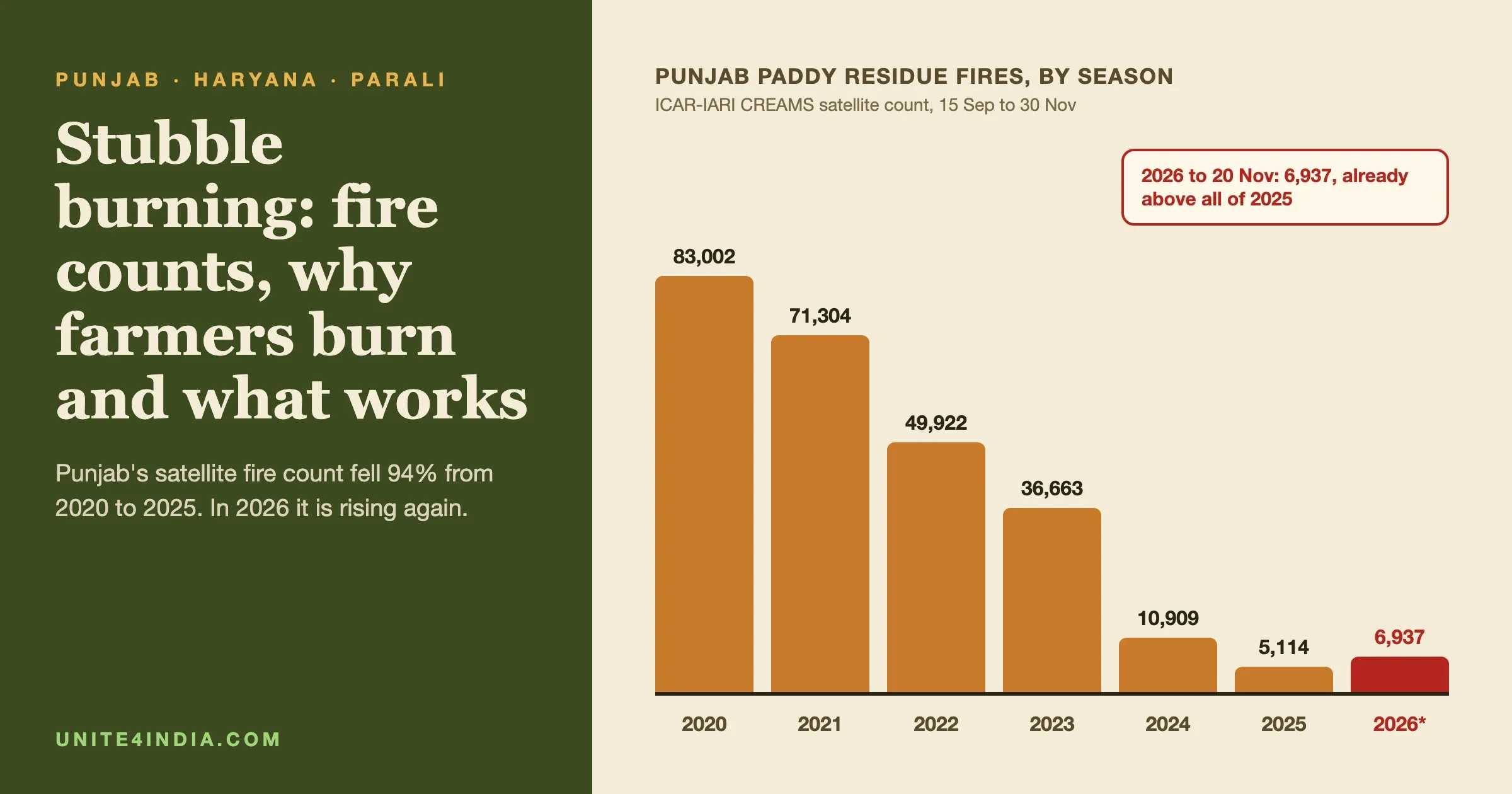
Punjab's stubble fires fell from 83,002 in 2020 to 5,114 in 2025, then rose again in 2026. Why farmers burn, what stubble adds to Delhi's air, and what works.
In this story
Short answer: satellites counted 5,114 paddy stubble fires in Punjab and 662 in Haryana in the 2025 season, down from 83,002 and 4,202 in 2020, according to ICAR-IARI’s CREAMS bulletins. This season has turned the other way in Punjab: 6,937 fires by 20 November 2026, already more than all of 2025. Farmers burn because the gap between the paddy harvest and wheat sowing is about three weeks, machines to handle the straw cost money and diesel, and the alternatives do not pay them. What works is a mix of machines that sow wheat into the straw, buyers who pay for straw, shorter-duration rice, and enforcement, not any single fix.
This guide sets out the fire counts, how much stubble smoke adds to Delhi’s air, the farmer’s side of the story, and the evidence on what has worked. Every number is dated, and we mark what we could not confirm. Checked on 21 November 2026.
How many stubble fires were there this year?
The Indian Agricultural Research Institute (ICAR-IARI) counts crop residue fires from satellites through its CREAMS laboratory, for the window from 15 September to 30 November. Its bulletin for 20 November 2026 counted 16,070 burning events across seven states since 15 September. Of these, 6,937 were in Punjab, 307 in Haryana, 1,831 in Uttar Pradesh, 6 in Delhi, 1,786 in Rajasthan, 229 in Uttarakhand and 4,974 in Madhya Pradesh.
For Punjab and Haryana, here are the full seasons since 2020, from the CREAMS bulletin of 30 November 2025, and this season so far:
Season (15 Sep to 30 Nov) | Punjab | Haryana |
|---|---|---|
2020 | 83,002 | 4,202 |
2021 | 71,304 | 6,987 |
2022 | 49,922 | 3,661 |
2023 | 36,663 | 2,303 |
2024 | 10,909 | 1,406 |
2025 | 5,114 | 662 |
2026 (to 20 Nov) | 6,937 | 307 |
Source: ICAR-IARI CREAMS rice residue fire bulletins, 30 November 2025 and 20 November 2026.
Compared on the same dates, Punjab had 5,046 fires by 20 November 2025 and 6,937 by 20 November 2026, a rise of about 37 percent. This is the first year-on-year rise in Punjab since 2021. Punjab’s worst day this season was around Diwali, with 1,152 fires on 8 November. Haryana, by contrast, is at about half of last year’s level.
Punjab’s own pollution control board figures, as reported on 19 November 2026, show 6,718 incidents up to 18 November. The board’s teams inspected 6,244 flagged fields and found evidence of fire in 2,664. The difference with CREAMS comes from cut-off dates and from the gap between a satellite hotspot and a confirmed burnt field.
Are the satellite counts telling the whole story?
Probably not, and the government’s own agencies have said as much.
The official count relies on polar-orbiting satellites (MODIS and VIIRS) that pass over Punjab at fixed times, around early afternoon. If farmers burn later in the day, many fires are missed. Several studies suggest this is now happening:
- A study by ISRO’s Space Applications Centre, using geostationary satellite data, found that farmers had shifted burning “from early afternoon to evening hours, likely to avoid detection by polar satellites”, as reported by ThePrint in December 2025.
- A CEEW release of 28 October 2026 says peak burning shifted from about 1.30 pm in 2020 to about 5 pm in 2024. In its Haryana survey, 77 percent of farmers who had seen burning in their village said it happens between 4 pm and 10 pm.
- NASA-affiliated scientist Hiren Jethva, working with geostationary data, has argued that the true Punjab count in 2025 could be 10 to 11 times the official figure.
- iFOREST’s analysis of Sentinel-2 imagery found that the area burnt in Punjab fell by only about 37 percent, from a peak of 31,447 square km in 2022 to about 20,000 square km in 2025, a far smaller drop than the fire count suggests.
In 2025 the Commission for Air Quality Management (CAQM) itself ordered a “triple action” of FIR, fine and red entry against violators after satellite data showed fires being lit late in the evening.
So the honest reading is this: stubble burning has fallen since 2020, but by how much is uncertain. The 90 percent fall in fire counts and the 37 percent fall in burnt area are both real measurements of different things.
How much does stubble burning add to Delhi’s pollution?
It depends on the day. The Indian Institute of Tropical Meteorology’s Decision Support System (DSS) estimates each source’s share of Delhi’s PM2.5 every day in winter, and the stubble share swings with the number of fires and the wind.
- 2026 so far: CSE’s analysis of DSS data, reported by Down To Earth, put the stubble share at 11.5 percent on 1 November, 8.6 percent on 2 November, a peak of 16.2 percent on 4 November and about 8 percent on 6 November. On 11 November, IITM’s own page showed stubble at 9.19 percent and Delhi’s transport at 20.17 percent.
- 2025: the DSS share peaked at 22.4 percent on 12 November 2025. CSE estimated that the average over 1 October to 30 November 2025 was only about 4.2 percent.
- 2024 and earlier: a figure of 35 percent is often quoted as the 2024 peak. We could not open the parliamentary reply it comes from, so we do not rely on it.
IITM warns on its own page that the uncertainty in satellite fire detection “will be carried forward” into its estimate. If evening fires are missed by satellites, the stubble share is also likely to be understated.
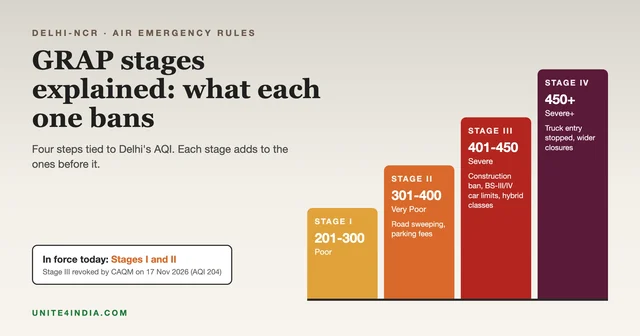
Two things follow. First, on a bad November day, smoke from fields can be a large share of what Delhi breathes. Second, over a whole season it is a smaller share than local sources such as vehicles, dust and industry. In November 2025, CREA estimated that stubble’s average share of Delhi’s PM2.5 was 7 percent, yet Delhi still had six Severe days that month. Both facts matter. Blaming farmers alone lets Delhi off the hook, and ignoring the fires ignores the worst days. For how the city’s emergency rules respond to those days, see our explainer on GRAP stages in Delhi-NCR.
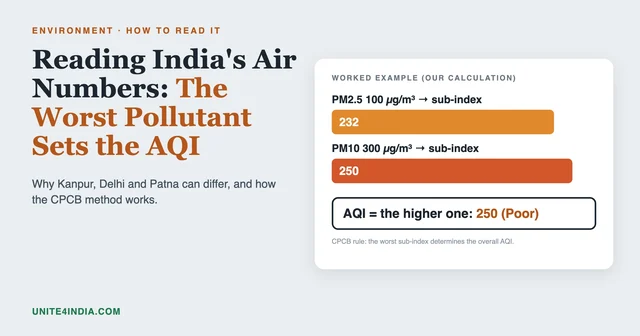
Smoke also hurts the people nearest to it. Villages in Punjab and Haryana breathe the fires first, and their air rarely makes the national news. Our guide to reading air pollution numbers explains why the same smoke shows up differently in different cities.
Why do farmers in Punjab and Haryana burn stubble?
Because, on most farms, it is the cheapest and fastest way to clear a field in a very short window. Here is how that window came about.
The paddy-wheat cycle
Punjab grows paddy in the kharif season and wheat in the rabi season, year after year. In 2025 Punjab’s paddy area was a record 32.46 lakh hectares, including 6.80 lakh hectares of basmati, according to agriculture ministry data reported by ThePrint. The state’s 2023 action plan put the paddy straw produced each year at around 2 crore tonnes.
Researchers at Punjab Agricultural University describe a window of about three weeks between paddy harvest and wheat sowing. Combine harvesters cut the grain and leave loose straw and tall stubble that a normal seed drill cannot work through.
The 2009 groundwater laws
Punjab’s water table was falling fast because farmers were transplanting paddy in April and May, the hottest months, and pumping groundwater to flood the fields. The Punjab Preservation of Subsoil Water Act, 2009 bans sowing paddy nurseries before 10 May and transplanting before a date the state notifies, with a penalty of Rs 10,000 per month per hectare. Haryana’s 2009 Act is similar, with a default transplanting date of 15 June.
The laws worked for water, but they pushed the paddy harvest later, closer to wheat sowing and into the weeks when cooler, calmer weather traps smoke over north India. For 2026, Punjab allowed direct seeding from 15 May and staggered transplanting by zone from 1, 5 and 9 June, according to a state announcement reported in April 2026.
Long-duration varieties
Varieties such as Pusa-44 take around 160 days to mature, use more water and leave more straw. Punjab announced a ban on Pusa-44 from kharif 2024 and enforced a sale ban again for 2025. PAU’s short-duration variety PR-126 matures in about 93 days after transplanting and saves three to four weeks over older varieties, PAU’s vice-chancellor said in May 2025; about 43 percent of Punjab’s paddy area was under PR-126 in kharif 2024. Shorter varieties give the farmer more time between crops, which makes non-burning options easier.
The cost
Managing straw without fire costs money. CEEW’s analysis of custom hiring centres puts a super seeder at about Rs 2.4 lakh under the 2025 scheme guidelines, and it needs a tractor of about 60 HP costing around Rs 12 lakh. Hiring a super seeder with tractor and driver costs a farmer about Rs 2,000 per acre, of which diesel alone is about Rs 900. Farmers who need repeated passes pay Rs 4,000 to 4,500 per acre, according to CEEW’s October 2026 release.
For a small farmer, owning the machine makes no sense: CEEW estimates the cost of owning a super seeder and tractor at Rs 63,050 per acre on a 1-acre farm, falling to Rs 3,530 per acre on 25 acres. That is why the system depends on hiring centres, and why the hiring queue in a three-week window is a real constraint.
A match costs nothing.
What is the farmers’ side of the story?
Many farmers say they are being blamed for a problem that is not mainly theirs, and asked to pay for fixing it.
- They grow paddy because the system pays for it. Assured procurement of paddy and wheat at minimum support price makes the paddy-wheat cycle the safest income in Punjab, which is part of the story we told in our piece on Punjab’s farm crisis.
- They were told to transplant later. The 2009 water laws, which they had to follow, squeezed the window.
- The alternatives cost them, not the cities that benefit. Farm unions have long asked for compensation per quintal or per acre. In 2020 unions in Malwa asked for Rs 200 per quintal. In 2024 Punjab asked the Centre to fund Rs 2,500 per acre for farmers who do not burn, with the Centre paying 60 percent; the Centre turned it down.
- Incentives that exist are hard to get. Haryana raised its incentive for managing straw without burning from Rs 1,000 to Rs 1,200 per acre in 2025. CEEW’s survey found about 80 percent of farmers knew of it, but only 42 percent applied, and only 57 percent of those who applied had been paid.
- Straw buyers do not pay. CEEW found that only 7 percent of Haryana farmers who baled their straw were paid by buyers, and 31 percent paid about Rs 1,000 per acre to have it cleared.
There is another side too. Many farmers have stopped burning. CEEW’s survey of 1,588 Haryana farmers in early 2026 found 39 percent used straw as fodder, 38 percent baled it and 32 percent used in-field machines. Only 6 percent admitted to burning, though 26 percent said burning happened in their village.
What actually works to stop stubble burning?
No single fix has worked. The fall since 2020 came from several things at once. Here is what the evidence says about each.
Approach | What it is | Evidence | The catch |
|---|---|---|---|
In-situ machines | Super seeder, happy seeder and others that sow wheat into the straw or mix it into soil | Over 3.53 lakh machines supplied under the CRM scheme; fire counts fell as they spread | Tractor power, diesel cost and hiring queues in a three-week window |
Ex-situ use | Baling straw for biomass power, pellets, compressed biogas, brick kilns | Co-firing mandates and pellet plant subsidies now in place | Buyers rarely pay farmers; only some planned biogas plants run |
Shorter rice varieties | PR-126 and others in place of Pusa-44 | Saves three to four weeks; about 43 percent of Punjab paddy area in 2024 | Farmers worry about yield and procurement |
Bio-decomposer | Microbial spray to break down stubble in the field | Government reports wide use | PAU trials and a 2024 peer-reviewed study found little benefit |
Penalties | Fines, FIRs, red entries, MSP bar | Thousands of cases each season | Recovery is low; may push burning to evenings |
Incentives | Per-acre payments for not burning | Haryana pays Rs 1,200 per acre | Low uptake and slow payment |
Machines under the Crop Residue Management scheme
The central Crop Residue Management (CRM) scheme began in 2018-19. It pays 50 percent of the cost of machines for individual farmers and 80 percent for cooperatives, farmer producer organisations, panchayats and custom hiring centres. Projects that set up a supply chain for straw get 65 percent support, up to Rs 1.5 crore.
According to PIB on 7 September 2026, the Centre released Rs 4,233.84 crore under the scheme from 2018-19 to 2025-26, and over 3.53 lakh machines and over 43,535 custom hiring centres were set up. The same release says fires fell by 93 percent in Punjab and 91 percent in Haryana in 2025 compared with 2021, which matches the CREAMS counts (5,114 against 71,304 and 662 against 6,987).
Machines clearly helped. The catch is that a machine sitting in a centre is not the same as a machine in the field on the day a farmer needs it.
Paying for straw: ex-situ use
The more lasting fix is to make straw worth something. Several rules now push in that direction:
- CAQM has directed thermal power plants within 300 km of Delhi to co-fire 5 to 10 percent biomass, and the Ministry of Power issued a co-firing policy on 7 November 2025. Pellets for those plants must contain at least 50 percent paddy straw.
- CAQM has directed brick kilns in the region to use at least 20 percent paddy-straw pellets from 1 November 2025, rising to 50 percent by 1 November 2028.
- The Centre sanctioned Rs 37.16 crore for 34 pellet plants, 27 in Punjab and 7 in Haryana. The 2023 CRM guidelines share the cost of straw supply chains: 65 percent government, 25 percent industry and 10 percent farmer or aggregator.
The weak link is price. As noted above, few farmers are paid for their straw. Haryana raised its industrial straw target from 1.1 to 2.3 million tonnes, but CEEW found that only 3 of 7 planned compressed biogas plants were running. Until a farmer can sell straw for more than it costs to bale and move, burning stays tempting.
Shorter-duration rice
PR-126 and other short varieties give farmers three to four extra weeks. That is the single change that most directly widens the window. The risk is that farmers return to longer varieties when they fear lower yields or rejection at procurement, so the shift needs steady advice and assured buying.
The bio-decomposer: weaker than claimed
IARI’s Pusa bio-decomposer is a microbial solution sprayed on stubble. The government says a field is ready for sowing in about 20 days, and reported its use on 7.70 lakh hectares in 2022. But Punjab Agricultural University’s trials in 2020 and 2021 found “no considerable reduction” in the time taken to decompose stubble and no significant effect on yield, as PTI reported in 2022. A peer-reviewed study by Katyal and colleagues in the journal BioResources (2024), covering four Punjab sites from 2020 to 2022, found that most decomposition came from mixing straw into the soil, and that wheat yield with and without the decomposer was similar. Twenty days is also most of the window farmers have.
Penalties and enforcement
Environmental compensation for stubble burning was doubled by rules notified on 6 November 2024:
Land held | Earlier, per incident | Since November 2024 |
|---|---|---|
Under 2 acres | Rs 2,500 | Rs 5,000 |
2 to under 5 acres | Rs 5,000 | Rs 10,000 |
5 acres or more | Rs 15,000 | Rs 30,000 |
Punjab’s figures up to 18 November 2026, as reported on 19 November, show 2,033 FIRs, environmental compensation imposed in 2,361 cases worth Rs 1.18 crore of which Rs 42.1 lakh was recovered, red entries in land records in 2,149 cases, and prosecution started against 41 officials for failing to act.
Haryana flags violators on its Meri Fasal Mera Byora portal, which bars them from selling their crop at MSP for two seasons. In September 2025 a Supreme Court bench led by Chief Justice B.R. Gavai, hearing the Delhi air pollution case, suggested that sending “at least some people behind the bar” would send “the right message”, and asked the Centre to consider penal provisions. We found no final order on that.
Penalties have a place, especially against repeat violators with large holdings. But the evidence on evening burning suggests that heavier enforcement can push fires out of the satellites’ view rather than out of the fields.
What can readers do?
- If you farm: book a hiring centre’s machine early, ask the agriculture department about the CRM subsidy for your cooperative or panchayat, and consider PR-126 or another short-duration variety recommended by PAU or your state university. In Haryana, apply for the per-acre incentive and keep records of how you managed the straw.
- If you live in a city: remember that the fires are one source among many. Vehicles, dust and waste burning near you are on most days a bigger share of what you breathe, and those are things you can act on.
- If you run a business that uses fuel: paddy straw pellets and briquettes are now a mandated fuel for power plants and brick kilns in the region. Buyers who pay farmers a fair price for straw are the most direct way to make burning unnecessary.
- If you write or share news: quote the stubble share for a specific day and source, not as a fixed number. A single day’s 16 percent and a season’s 4 percent are both true.
Common mistakes people make about stubble burning
- “Stubble burning causes Delhi’s pollution.” It is a major contributor on some November days, but over a season local sources such as vehicles, dust and industry contribute more.
- “Fires are down 90 percent, so the problem is solved.” The satellite fire count is down sharply, but burnt area has fallen far less, and burning has shifted to evening hours that the satellites miss. And in 2026 Punjab’s count rose again.
- “The 2009 law fixed transplanting on 10 June.” The law lets the state notify the date. The date has changed over the years and is now staggered by zone.
- “Farmers just need to be fined.” Fines exist and are being imposed, but recovery is low, and fines do not change the three-week window or the cost of machines.
- “The bio-decomposer is a cheap fix.” Independent trials in Punjab found it made little difference to decomposition time or yield.
Common questions
How many stubble burning cases were there in Punjab in 2025?
5,114, according to ICAR-IARI’s CREAMS count for 15 September to 30 November 2025. Haryana had 662.
How many stubble fires has Punjab had in 2026?
6,937 between 15 September and 20 November 2026, already more than the whole of 2025.
What percentage of Delhi pollution is from stubble burning?
It changes daily. IITM’s system put it at a peak of 22.4 percent on 12 November 2025 and 16.2 percent on 4 November 2026, while CSE estimated the average for October and November 2025 at about 4 percent.
Why is stubble burning done in October and November?
Because the paddy harvest ends then, and farmers have about three weeks to clear fields before wheat sowing.
What is the fine for stubble burning?
Rs 5,000 per incident for under 2 acres, Rs 10,000 for 2 to 5 acres and Rs 30,000 for 5 acres or more, under rules notified in November 2024. States may also file FIRs and make red entries.
What is parali?
Parali is the common name in north India for paddy stubble and straw left after harvest.
What is a super seeder?
A tractor-mounted machine that cuts and mixes paddy straw into the soil and sows wheat in one pass, so the field does not need to be cleared by fire.
What we could not confirm
We could not read daily values directly from IITM’s Decision Support System, so the 2026 daily shares come from CSE’s analysis as reported by Down To Earth, and from IITM’s homepage for 11 November. The often-quoted 35 percent peak for 2024 comes from a parliamentary reply we could not open. Punjab’s 2026 enforcement figures come from a news report of the state board’s data, not the board’s own release. We did not find a credible price for a happy seeder. We did not open Hiren Jethva’s paper and rely on interviews describing it. Punjab’s paddy straw volume of about 2 crore tonnes comes from the state’s 2023 action plan; we did not find a newer official figure.
Sources
- ICAR-IARI CREAMS, rice residue fire bulletins, including the bulletin of 20 November 2026 and the bulletin of 30 November 2025.
- PIB, 7 September 2026: CRM scheme funds, machines and fire reductions; co-firing directions.
- PIB, 4 December 2025: CRM scheme subsidy rates and biomass co-firing policy.
- PIB, November 2024: revised environmental compensation for stubble burning.
- PIB, 3 June 2025: brick kiln co-firing direction.
- PIB, 1 July 2023: CRM guidelines for straw supply chains.
- PIB, 21 March 2023: Pusa bio-decomposer.
- PIB, September 2023: Punjab’s action plan and straw volume.
- Punjab Preservation of Subsoil Water Act, 2009 and Haryana Preservation of Sub-Soil Water Act, 2009 (FAOLEX copies).
- CEEW, 28 October 2026: Haryana survey, burning times, costs, incentives; and CEEW annexure on custom hiring costs.
- Katyal et al., BioResources 19(4), 2024: bio-decomposer field trials in Punjab.
- Down To Earth, 11 November 2026: CSE analysis of DSS stubble shares.
- CSE, December 2025: season average stubble share.
- IITM Air Quality Early Warning System and Decision Support System.
- ThePrint, 3 December 2025: ISRO study on evening burning.
- Scroll, 9 December 2025: iFOREST burnt-area analysis.
- ThePrint/PTI, 25 September 2022: PAU trials of the bio-decomposer.
- Punjab 2026 enforcement figures, 19 November 2026.
- LiveLaw, 17 September 2025: Supreme Court remarks.
- The Tribune, 24 May 2025: PR-126.
- The Tribune, 4 November 2024: Punjab’s incentive demand.
For the wider picture of where India’s air pollution comes from, read our guide to air pollution in India and our clean air programme city scorecard.
Checked on 21 November 2026.
What you can do
- Share the evidenceSend this to one person who should know about environment.Share on WhatsApp
- Give an afternoonTeach, mentor, clean up, or lend your professional skills.Ways to volunteer
- Tell us what's missingKnow a story, a fact we got wrong, or a solution worth spotlighting?Suggest a story
Politically neutral. Every claim sourced. Report a correction.
No comments yet