The Lost Art of Indian Miniature Painting
Indian miniature painting - across Mughal, Kangra, Rajput, and Deccan schools - collapsed when royal patronage ended in 1858. This is the story of that collapse, what survived in museums and living craft communities, and how organisations like Dastkar and Mahindra Kulakriti are rebuilding the tradition.
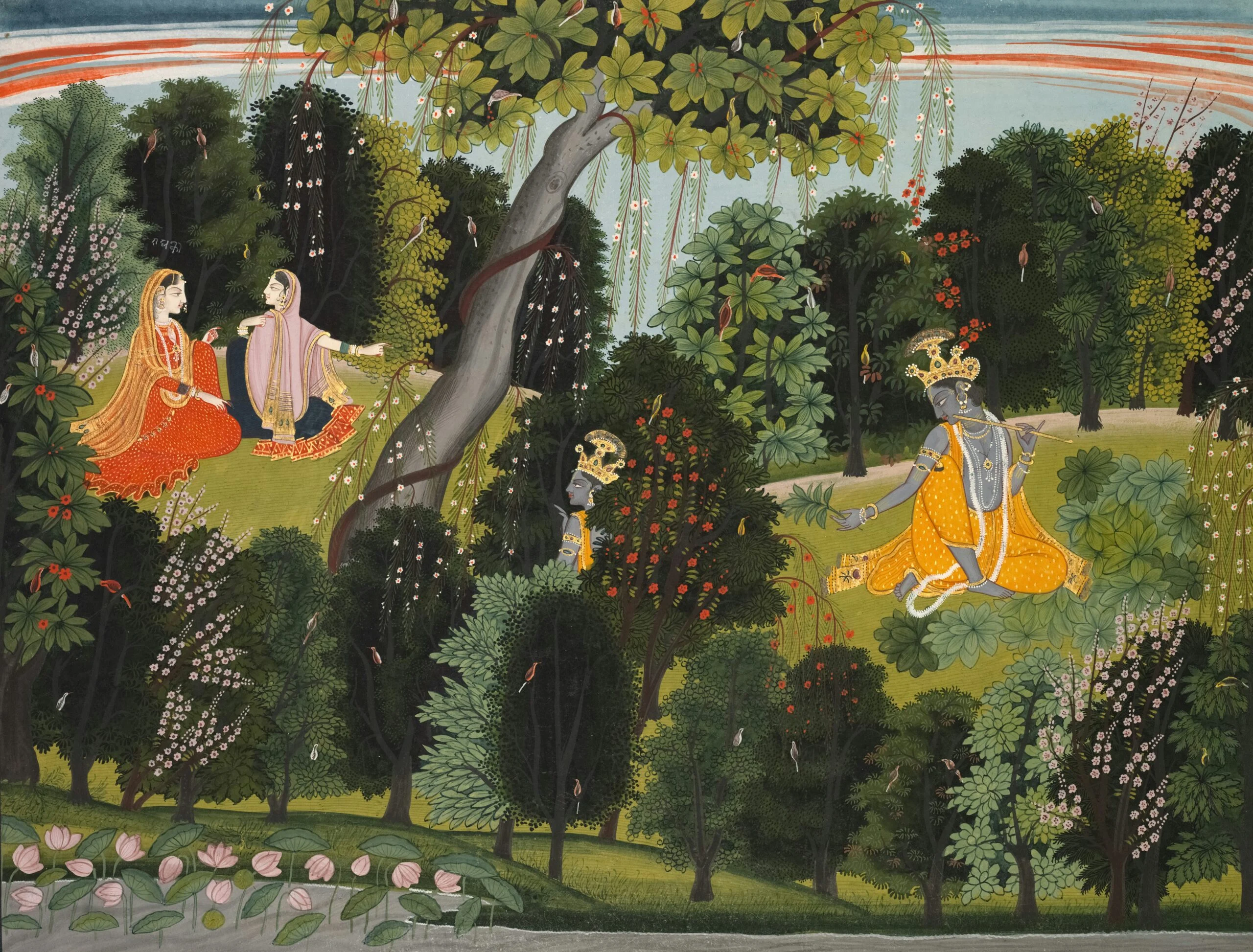
India lost something irreplaceable in 1858. When the British Crown dissolved the Mughal court and absorbed the last Nawabi kingdoms into the empire, it did not merely end political dynasties. It severed the financial lifelines of thousands of artists whose entire world, their tools, their pigments, their commissions, depended on royal patronage. Indian miniature painting, one of the most technically refined visual traditions in human history, went into a slow eclipse that lasted nearly a century.
This is the story of that eclipse, and of the quiet revival that has been underway since the 1980s.
What Is Indian Miniature Painting?
Miniature painting refers to highly detailed, small-format works executed on paper, cloth, ivory, or palm leaf, using natural pigments and fine brushes, sometimes made from just two or three squirrel hairs. The scale is intimate: many masterpieces fit within the span of a hand. The detail is extraordinary: individual pearls on a courtier’s necklace, the grain of wood on a throne, the specific curvature of a Kangra woman’s eye.
These were not decorative objects. They were documentation of power, devotion, and narrative. Emperors commissioned illustrated manuscripts. Poets had their verses rendered in paint. Devotional movements produced entire series depicting the life of Krishna. Battle scenes, darbar gatherings, hunting expeditions, portraits of nobles, all were recorded in pigment on a scale that demanded weeks or months of work per folio.
Five major schools define the tradition:
- Mughal School (16th–19th century): Akbar commissioned the Hamzanama, a 1,400-folio illustrated epic, in the 1560s. The Mughal style synthesized Persian, Central Asian, and indigenous Rajput influences into a distinctive naturalistic court art. Jahangir’s court artists produced some of the earliest systematic wildlife studies in Asian art history.
- Rajput School (17th–19th century): Centred in the kingdoms of Rajasthan, the Rajput tradition diverged toward bold colour, stylised forms, and intensely devotional content. The Mewar school produced dramatic Ramayana and Mahabharata series; the Kishangarh school developed an elongated stylisation of faces still immediately recognisable today.
- Kangra School (18th–19th century): Emerging from the Pahari hill courts of Himachal Pradesh, Kangra reached its peak under Raja Sansar Chand. Its hallmark is lyrical romanticism: the Gita Govinda in pale greens and soft blues, women rendered with sculptural delicacy. Art historians consider it the last great flowering before colonial disruption.
- Pahari School (17th–19th century): Encompassing the courts of Guler, Basohli, Chamba, and Nurpur. The earlier Basohli style features characteristic beetle-wing emerald inlays for jewellery. The Guler school introduced the refined naturalistic drawing that would define the later Kangra aesthetic.
- Deccan School (16th–18th century): The Sultanates of Bijapur, Golconda, and Ahmadnagar produced a school influenced by Persian, Ottoman, and African visual cultures. Notable for unusual colour combinations, flattened spatial depth, and subjects drawn from Sufi poetry and mysticism.
The Collapse of Patronage: 1858 and After
The Sepoy Mutiny of 1857, and the Crown’s subsequent assumption of direct rule in 1858, ended the Mughal line with the exile of Bahadur Shah Zafar to Rangoon. Over the following two decades, a cascade of kingdom annexations, under the Doctrine of Lapse or direct military pressure, extinguished court after court across Rajasthan, Himachal Pradesh, and the Deccan.
For miniature painters, this was an extinction-level event. The entire economic architecture of their craft depended on royal commissions. An artist in Kangra might spend six months painting a single manuscript folio; his livelihood came from the raja’s treasury. When the raj ended, so did the treasury, the commission, and the demand.
When the raj ended, so did the treasury, the commission, and the demand. The sophisticated pictorial vocabulary of Mughal and Kangra began to dissolve within a single lifetime.
Compounding the disruption was the arrival of photography. Lord Dalhousie’s India already had daguerreotype studios in Calcutta and Bombay by the 1840s. By the 1860s, the British colonial administration actively promoted photography as the rational, modern replacement for court portraiture. Princes who might once have commissioned painted portraits now sat for photographs. The social function of the miniature, recording the image of power, had been technologically superseded.
Artist families faced three options: adapt, migrate, or abandon the craft. Some shifted to producing tourist-trade images for the growing British market. Others found employment under what became known as the Company School, a hybrid style blending Indian technique with European botanical-illustration preferences. The pattern of forced adaptation is not unique to painting: India’s textile heritage traditions underwent a parallel crisis of patronage collapse during the same colonial period.
The compositional conventions that distinguished a Mewar Ramayana from a Bundi Ramayana, the precise way light fell on a white muslin garment, the grammar of gesture inherited across generations, began to dissolve within a single lifetime. By the early 20th century, the tradition had largely passed from living practice to museum storage.
What Survived: The National Museum Delhi Collection
The National Museum of India in New Delhi holds one of the world’s most significant collections of Indian miniature paintings, over 14,000 works spanning the Mughal, Rajput, Pahari, Deccan, and Company schools. The collection includes Akbar-era Hamzanama folios, Jahangir-period naturalistic studies of birds and flora, and rare Basohli manuscripts with intact beetle-wing inlay.
What makes the National Museum collection invaluable is not only its scale but its depth of documentation. Many folios come with colophons, inscriptions recording the artist’s name, the patron’s name, the date of completion, and sometimes the purpose of the commission. These colophons confirm that miniature painting was not anonymous craft but a named, professional practice with master-apprentice lineages and documented careers spanning multiple generations.
Other major collections include:
- The Chhatrapati Shivaji Maharaj Vastu Sangrahalaya in Mumbai, particularly strong in Deccan school works
- The City Palace Museum in Udaipur, holding Mewar folios in the hereditary custody of the Mewar royal house
- The Mehrangarh Museum Trust in Jodhpur, with one of the finest Marwar school collections and active digitisation work
- The Bhuri Singh Museum in Chamba and the Himachal Pradesh State Museum in Shimla, documenting the Pahari thread
Digital access has improved, with several folios accessible through the Google Arts and Culture platform. However, a large proportion of India’s miniature heritage remains inadequately catalogued, and conservation funding is chronically insufficient.
The Living Craft: Artists Who Kept the Thread
The tradition never fully died. In a handful of locations, artists maintained the practice, often in reduced, adapted forms, across the colonial period and into independence.
Nathadwara, in Rajasthan, is the most prominent example. The town is the seat of the Shrinathji temple, and its artists, the Nathadwara school, have continuously produced pichwai paintings, large devotional works on cloth depicting Krishna, for at least three centuries. The devotional function preserved the economic basis: pilgrims and devotees created a stable, local market that did not depend on court commission. Nathadwara pichwai artists today form one of the largest concentrations of active traditional painters in India.
Bhatiyani family workshops in Udaipur and Jaipur maintained manuscript illustration skills across generations. The technical knowledge, the preparation of paper with alum and starch, the grinding of lapis lazuli for ultramarine, the making of brushes from squirrel tail hair, was transmitted even when artistic standards declined under commercial pressure.
In the Kangra valley, a small number of families in Palampur and Dharamsala continued to paint through the 20th century. Their work was largely unknown outside the valley until craft development programmes in the 1970s brought renewed attention and documentation.
Contemporary Revivals: Dastkar and Mahindra Kulakriti
The organised revival of Indian miniature painting gained institutional momentum in the 1980s, driven by two parallel forces: the crafts preservation movement and private-sector cultural philanthropy.
Dastkar, the Delhi-based craft organisation founded in 1981, took an early and sustained interest in endangered textile and visual arts traditions. Its approach combined market linkage with craft documentation: identifying surviving master artists, documenting their techniques, creating selling platforms through craft fairs and retail partnerships, and supporting the training of new apprentices. Dastkar’s annual Nature Bazaar and Dilli Haat presence gave miniature painters direct access to urban consumers willing to pay for authentic traditional work.
Dastkar’s documentation projects created records of dying techniques that had no other archive: the specific sequences for preparing paper, the recipes for natural pigments, the compositional grammar that distinguished one school from another. This intangible knowledge is now partially preserved in written and photographic form. The challenge of preserving living practical traditions against institutional neglect is one that India’s endangered languages face in parallel: when the last fluent speakers die, the interpretive code dies with them.
Mahindra Kulakriti, the cultural initiative of the Mahindra Group launched in 2012, has funded artist residencies, supported master-apprentice training programmes, and produced high-quality documentation of traditional arts including Indian miniature painting. Its platform has provided digital storefronts for artisans who previously had no means of reaching collectors outside their immediate geography.
The economic impact has been real if modest. A skilled miniature painter working in the Mughal tradition can earn between Rs 15,000 and Rs 80,000 per piece depending on scale, detail, and market access. Artists with gallery representation earn considerably more. The revival is not a return to the scale of court patronage; it is the construction of a new patronage system built from individual collectors, cultural institutions, and diaspora buyers.
The Technical Challenge: Preserving Material Knowledge
The recovery of miniature painting is not simply a matter of artistic intention. It requires the reconstruction of specific material knowledge that was interrupted by the colonial period.
Traditional Indian miniature painting used pigments derived from natural sources:
Pigment | Source | School Association |
|---|---|---|
Lapis lazuli | Badakhshan mines (Afghanistan) | Mughal, Pahari |
Malachite | Copper ore | Deccan, Rajput |
Vermilion | Cinnabar (mercury sulphide) | All schools |
Indian yellow | Cow urine (now banned) | Mughal |
Gold leaf | Beaten gold | Mughal, Kangra |
Beetle-wing green | Jewel beetle elytra | Basohli |
Many of these materials are now difficult or extremely hard to source authentically. Indian yellow, the luminous golden pigment produced from the urine of cows fed on mango leaves, was banned in 1908 on animal welfare grounds; no synthetic equivalent has replicated its characteristic warmth and translucency. Lapis lazuli from Badakhshan now costs more than silver by weight. Beetle-wing inlay requires the Jewel Beetle (Sternocera spp.), which cannot be commercially farmed.
Contemporary artists navigate this through selective authenticity, using natural pigments where available, and informed substitution where original materials are inaccessible. Several paper-making workshops in Sanganer (Rajasthan) and Kagzi Mohalla in Aurangabad continue to produce hand-made wasli paper suitable for miniature work, and supporting them is inseparable from supporting the painting tradition itself.
What Is at Stake: The Archive at Risk
India’s miniature painting tradition represents more than artistic heritage. It is a historical archive whose interpretive keys are embedded in living practice.
Mughal-era natural history folios, Jahangir’s studies of a zebra, a turkey cock, a dying squirrel, a nilgai, are primary scientific documents. They predate systematic European natural history by decades and record species in their 17th-century distribution ranges. Ecologists and historians of science now consult them for baseline environmental data.
Rajput illustrated manuscripts of the Mahabharata and Ramayana are iconographic records of how these texts were visualised in specific courts at specific moments. Deccan school portraits of Bijapur sultans and Golconda nobles are primary-source evidence for the material culture of civilisations that left fewer architectural remains than their northern counterparts. The specific fabrics, jewellery forms, and musical instruments depicted in these works are often the only surviving documentation of what those objects looked like.
When a living tradition dies, these interpretive keys go with it. A conservator who cannot read the visual grammar of a Kangra composition cannot date it, authenticate it, or understand what the patron intended to communicate. The living craft, the ability to produce new work in the tradition, is also the interpretive infrastructure for understanding the historical corpus.
How Other Countries Protect Living Art Traditions
India is not alone in confronting the challenge of sustaining endangered craft traditions through periods of economic disruption. Japan’s response offers a directly instructive model. Since 1950, Japan has operated its Living National Treasures programme (Ningen Kokuho), formally designating master practitioners of endangered traditional arts - including lacquerwork, ceramics, textile dyeing, and calligraphy - as bearers of intangible cultural property. Designated artists receive an annual government stipend and are required to train successors and document their techniques. The programme has demonstrably prevented the extinction of several craft lineages that had no other economic basis for survival. South Korea operates a parallel system under its Intangible Cultural Heritage Act of 1962, with similarly documented success in sustaining traditional performing arts and craft techniques across generational change. India’s National Handicrafts and Handlooms Museum and the Crafts Council of India represent partial analogues, but neither carries the formal designation authority or the guaranteed training-succession mandate that makes the Japanese and Korean models effective. The gap is a policy choice, not a resource constraint.
What Citizens Can Do
The revival of Indian miniature painting is not a problem that government alone can solve. The tradition was built on individual patronage; it will be rebuilt the same way.
- Commission, do not merely appreciate. Purchasing original miniature paintings from living artists, not mass-produced prints, creates the economic demand that sustains the craft. Even modest purchases of work by student artists matter more than admiring the tradition from a distance.
- Support verified craft organisations. Dastkar, the Crafts Council of India, and state-level bodies like the Rajasthan Small Industries Corporation channel support to authentic artisans rather than the replica trade.
- Visit the collections. The National Museum Delhi, the Mehrangarh Museum in Jodhpur, and the City Palace Museum in Udaipur hold world-class collections that are chronically undervisited by Indian citizens. Admission revenue matters for conservation funding advocacy.
- Advocate for school curricula. India’s art education curriculum has historically marginalised traditional visual arts in favour of Western academic forms. Advocacy for the inclusion of miniature painting history in school syllabuses would create the next generation of informed patrons.
- Document what is around you. Many Indian families hold miniature paintings, in family collections, framed on walls, stored in trunks, without knowing what they have. The Archaeological Survey of India and state museums accept citizen documentation contributions. Photograph, describe, and submit what you find.
Action at Every Layer
Personal: Commission one original work from a living miniature artist this year rather than a reproduction. Share and credit the artist by name when you photograph it. RWA/community: Invite a local miniature painter to demonstrate at a community event or apartment common area; a single live demonstration converts passive appreciation into active patronage. Ward/city: Petition your municipal corporation or ward committee to include miniature painting workshops in public library or cultural centre programming; several cities already fund such sessions through district cultural funds. National: Write to your MP requesting that India formally adopt a Living Craft Masters designation programme - modelled on Japan’s Ningen Kokuho - with guaranteed training-succession funding for designated artists in endangered visual traditions.
The artists who painted the Hamzanama folios did not know they were building a national heritage. They were skilled professionals executing a commission for a powerful patron, in a tradition they had learned from their fathers and would teach to their sons. The chain broke in 1858. What the revival movements of the last four decades have been attempting, painstakingly, under-resourced, against the tide of mass reproduction and digital distraction, is to weld that chain back together.
It is not nostalgia. It is the recognition that a civilisation which cannot read its own visual language has lost something more than art. It has lost one of the primary ways it once made sense of the world.
What you can do
- Share the evidenceSend this to one person who should know about this issue.Share on WhatsApp
- Give an afternoonTeach, mentor, clean up, or lend your professional skills.Ways to volunteer
- Tell us what's missingKnow a story, a fact we got wrong, or a solution worth spotlighting?Suggest a story
Politically neutral. Every claim sourced. Report a correction.

No comments yet