TelanganaRestoring Village Tanks and Piping Water to Every Home, and What Is Still Unfinished
Telangana restored thousands of village irrigation tanks and built a state-wide piped water grid. What the evidence shows, what is still disputed, and where children's nutrition and water quality lag.
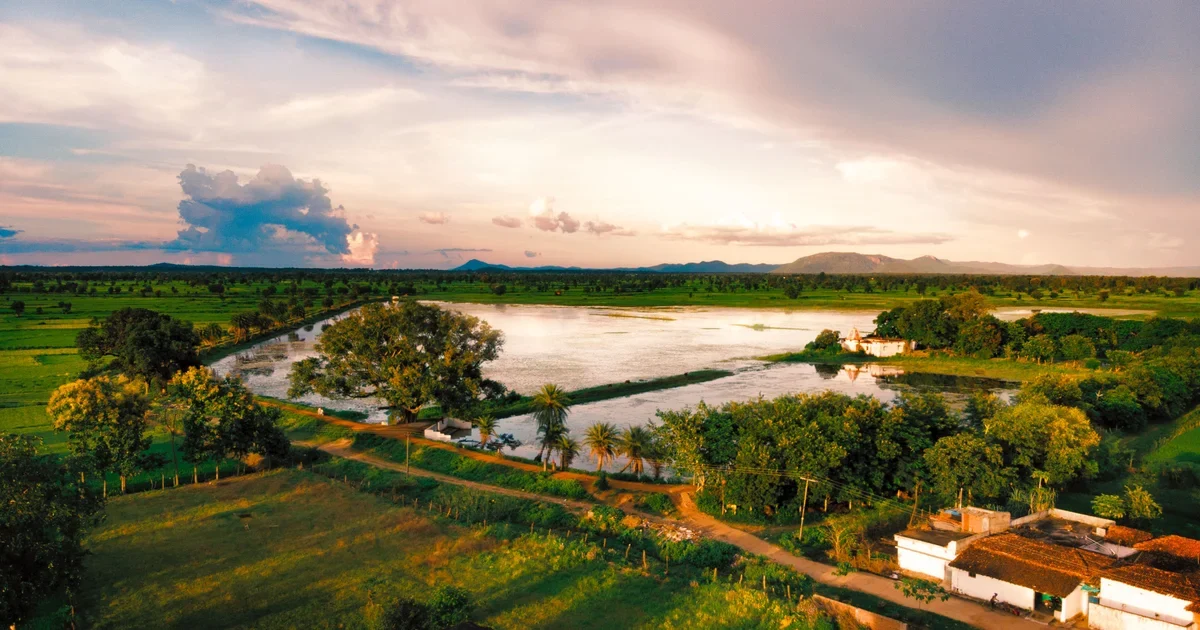
A village waterbody amid farmland in rural India. Photo by Vijit Bagh on Pexels.
In this story
What is the Telangana story?
Telangana became India’s 29th state on 2 June 2014, carved out of Andhra Pradesh. It has about 3.5 crore people (Census 2011), a capital in Hyderabad that is one of India’s main technology hubs, and a rural interior of hard rock, thin soil and unreliable rain. In much of the state, groundwater sits deep and wells fail in dry years. Two programmes, Mission Kakatiya and Mission Bhagiratha, were built around that problem.
That geography explains the two programmes that define the state’s first decade. Mission Kakatiya set out to restore the village irrigation tanks that Telangana’s farmers once depended on. Mission Bhagiratha set out to pipe treated drinking water to every rural home. Both are about the same plain question: how does a dry state give its people reliable water?
The answer is partly impressive and partly contested. Some figures come from independent surveys. Others come from the state or from agencies linked to government, and a few are disputed by the Union government. This article keeps those sources apart, so that you can see what is measured and what is claimed. It also looks at the gaps, because a state that has fixed water has not automatically fixed child nutrition.
Why did Telangana’s tanks matter so much?
For centuries, farmers in the Deccan plateau collected rain in small earthen tanks, called cheruvu or kunta. A tank holds monsoon runoff, feeds channels to nearby fields and recharges wells around it. A single tank may irrigate a few hundred acres, and one village might share it among many families.
In the last half century these tanks decayed. Silt filled them, bunds (the earth walls) cracked, sluices rusted and channels were encroached. Farmers drilled borewells instead. NITI Aayog’s case study on the programme says most of Telangana’s tanks had run dry by 2014, groundwater use had risen and the water table near them had fallen. Falling water tables are a trap: each farmer digs deeper, pumping costs rise, and small farmers who cannot afford a deeper borewell lose out first.
What did Mission Kakatiya do?
The state launched Mission Kakatiya in 2014-15. The target was to restore 46,531 minor irrigation tanks and bring back the 255 TMC (thousand million cubic feet) of water allocated to minor irrigation, according to the NITI Aayog case study. The method was simple and physical:
- Desilting. Silt was dug out so the tank could hold more water.
- Strengthening bunds. Earth walls were rebuilt and raised where they had weakened.
- Repairing sluices and weirs. Broken gates and outlets were fixed so water could be released in a controlled way.
- Re-sectioning channels. Canals from the tank to fields were cleared so water reached the tail end.
Work went in phases, and tanks with a larger command area that had not been covered by another scheme were given priority. District committees brought irrigation, agriculture, fisheries, revenue and groundwater departments together. The silt had a second use: farmers were encouraged to carry it to their fields as a soil conditioner.
How many tanks were restored?
The NITI Aayog case study says 22,500 tanks had been restored by March 2018. Later totals may be higher, and the count depends on the date and on what is counted as a completed tank, so the current figure is best taken from the Telangana irrigation department’s dashboard. What is clear is that this was one of the largest community-tank restoration drives in India.
What did restored tanks change for farmers?
The same NITI Aayog case study reports that the programme cut “gap ayacut” by 63%, raised groundwater levels and helped farmers diversify crops. Gap ayacut means land that has a canal or tank on paper but does not actually get water. The study lists lower fertiliser use, better soil moisture and growth in fisheries and livestock among the effects.
It is fair to read this with care. The case study is a best-practice summary that draws on the state’s own irrigation department, not a field experiment. It tells us what the state reported, which is useful, but it does not show how much of the change came from tanks and how much came from rainfall, borewells or crop prices.
Independent evaluation has been slow to arrive. A randomised evaluation run by researchers with the Telangana irrigation department studied 92 tanks across 15 districts between 2017 and 2020. Half were restored in an early phase and half were delayed, which lets researchers compare them fairly. The J-PAL project page lists the outcomes it measures: yields of paddy, cotton and maize, farm income, water tables and village water prices. At the time of writing, the page says results are forthcoming. In 2018 the state also signed an agreement with the research institute ICRISAT to assess soil, water and farm effects of the first two phases, including silt nutrients across 30 districts. Public results from that work are hard to find.
Until those studies publish, the honest summary is this: the state and a government think-tank report clear gains; independent proof of how large they are is still pending.
What did the auditors find?
The Comptroller and Auditor General (CAG) reviewed the programme from its launch to March 2017. As reported by the Deccan Chronicle, auditors examined 145 tanks in 15 divisions and raised two concerns. First, some tanks used mainly for recreation, rather than irrigation, were taken up in the first two phases even though they were not priority tanks. Second, silt removal fell short of the plan. The state said farmers were not interested in taking the silt, and the auditors said that explanation did not match the guidelines, which called for priority to tanks where farmers agreed to carry it.
Such findings are normal in a large public works programme and do not cancel the gains. They do show the point where a good idea can slip: choosing which tanks come first, and making sure the silt actually leaves the tank bed. A programme that spends on desilting but leaves the silt on the bund loses part of its benefit in the next monsoon.
What is Mission Bhagiratha?
Mission Bhagiratha, launched in 2015, aimed to give every rural household in the state a piped, treated drinking water supply from rivers and large reservoirs, instead of relying on hand pumps and borewells. According to Down To Earth’s 2022 report, the grid is divided into 26 segments, with about 50 water treatment plants, roughly one per assembly constituency, and 98% of habitations designed to receive water by gravity or with limited pumping. The state has put the cost at around Rs 46,000 crore and the pipeline length at more than 2 lakh km, in statements reported by the Tribune.
The reason for the design is fluoride. Groundwater in parts of Telangana, especially Nalgonda and neighbouring districts, carries high fluoride, which damages teeth and bones over years of drinking. The Down To Earth report, citing the national water quality dashboard, found 1,041 settlements across 28 of the state’s 31 districts with groundwater above permissible fluoride levels at the time of writing. Treating surface water at a plant and sending it by pipe avoids that source entirely.
Does the tap actually work?
This is where an independent source helps. The Union Jal Shakti Ministry hired the survey firm Nielsen to assess whether household taps under the Jal Jeevan Mission were functional. For Telangana, the 2020-21 functionality assessment surveyed 4,800 households in 320 villages across 32 districts. A tap counted as functional only if it gave at least 55 litres per person a day, met the national drinking water quality standard (BIS 10500) and ran regularly. The results, with the national average beside them:
Indicator (2020-21 survey) | Telangana | India |
|---|---|---|
Households with a functional tap connection | 76.1% | 47.8% |
Households with potable water | 86.0% | 61.3% |
Households receiving 55 litres per person a day or more | 90.6% | 83.5% |
Households reporting regular supply | 95.5% | 87.2% |
Villages with functional water and sanitation committees | 93.8% | 48.5% |
The survey concluded that Telangana’s performance was well above the national average. Note what the table also says. About one household in four did not have a fully functional tap on the survey’s strict test, and 14% did not receive water judged potable. A figure of 76% is an achievement, and it is not 100%.
What is disputed about the claims?
In late September 2022 the state said Mission Bhagiratha had been reviewed by the Union government, that every household got 100 litres per person a day and that all villages received uninterrupted daily supply. The Union Jal Shakti Ministry replied on 1 October that these statements were misleading, that it had not assessed the scheme, and that the award the scheme received covered only the rural household water supply category, as The News Minute reported. Both governments are political actors, and neither statement is a field audit.
The independent 2020-21 survey is the best neutral reading we have, and it supports a strong but incomplete picture. A fresh independent survey on the same method would settle the disagreement. The current national Jal Jeevan Mission dashboard also lists the state’s reported tap coverage, and readers can check it directly.
What does it mean for a farming family?
Picture a small farmer with two acres near a tank that has not held water for a decade. Her family relies on one borewell, which fails in March. If the tank is desilted and the bund holds, the monsoon fills it, the borewell recovers for longer, and a second crop becomes possible. If the channel to her field is still blocked, or if she is at the tail end and the water never arrives, the restoration changes little for her. This is why the reduction in gap ayacut matters more than the number of tanks: it counts land that actually receives water.
The same logic applies to the tap. A pipeline that reaches the village but not her street, or a plant that shuts for repairs for a week, leaves her carrying pots again. Water policy is judged at the last house, not at the headworks.
Did more water change what Telangana grows?
Yes, by a lot, though the causes are argued over. The Economic Survey 2025-26 reports that Telangana’s cultivated area rose from about 1.31 crore acres in 2014 to about 2.2 crore acres in 2022-23, as reported by Siasat citing the survey. Paddy output moved from 72 lakh tonnes in 2019-20 to about 135 lakh tonnes in 2024-25, and the 2025 kharif season was projected at 148.3 lakh tonnes from 67.57 lakh acres, according to The South First in October 2025.
Who deserves the credit is a political argument. The survey links the growth to flagship projects, which include Mission Kakatiya and the Kaleshwaram lift irrigation project. The current state government has credited farmer-support schemes and free power for part of it. Kaleshwaram has its own public debate over cost and engineering that this article does not assess. A tank restoration, a lift canal, free electricity for borewells and a good monsoon can all raise paddy output at once, and separating them needs the kind of study that is still pending.
What is the downside of a paddy boom?
Paddy is a thirsty crop, and a state that produces more than it can store faces its own trouble. The South First report said Telangana’s target for procuring paddy in the 2025-26 kharif season was 80 lakh tonnes, while the Centre’s approved limit stood at 53.73 lakh tonnes. Food Corporation of India godowns in the state, with a capacity of 22.61 lakh tonnes, were about 96% full, and the state asked for more railway rakes and storage. When grain cannot move, mills slow down and farmers face the risk of distress sales.
This is the common problem of success in Indian water policy. Once water is reliable, farmers choose the crop with an assured price, which is rice, and the system must then handle the surplus. Crop diversification, local processing and storage deserve the same planning that tanks and pipes received.
How should a reader judge a water programme?
Three questions help. First, what was counted: pipes laid and tanks desilted are inputs, while water at the tap and water in the field are outcomes. Second, who counted: a department reporting on itself, a government think-tank summarising that report, and a survey firm visiting 4,800 homes are three different levels of evidence. Third, what else changed in the same years: rainfall, electricity supply, crop prices and migration all move farm output, so a rise in production alone does not prove that one programme worked.
By that test, the Nielsen tap survey is the strongest piece of evidence in this story, because it measured outcomes at the household door. The tank figures are weaker because they rest on state-reported inputs and a summary built from them. That is not a charge against the programme. It is a reason to want the randomised study published.
Where does Telangana still fall short?
The water story is stronger than the health story. The fifth National Family Health Survey (2019-21) state fact sheet shows progress on some measures and slippage on others:
Indicator | NFHS-4 (2015-16) | NFHS-5 (2019-21) |
|---|---|---|
Institutional births | 91.5% | 97.0% |
Households using clean cooking fuel | 67.3% | 91.8% |
Population using improved sanitation | 52.3% | 76.2% |
Under-five mortality (per 1,000 live births) | 31.7 | 29.4 |
Children under five who are stunted | 28.0% | 33.1% |
Children under five who are wasted | 18.1% | 21.7% |
Children aged 6 to 59 months who are anaemic | 60.7% | 70.0% |
The first four rows show a state that is delivering services. The last three rows show child nutrition getting worse between the two surveys, with one child in three stunted and seven in ten children anaemic. These numbers cover the years before and during the Covid period, so part of the rise may reflect the pandemic and survey timing. They still match the pattern seen in our explanation of why stunting persists across India: clean water and toilets help, but a child needs enough varied food, iron, and regular health checks as well.
Three more gaps stand out:
- Fluoride in the remaining sources. Piped water solves fluoride only where the pipe reaches and the plant works. Villages that still depend on a local borewell remain exposed.
- Women’s health. The same fact sheet shows 57.6% of women aged 15 to 49 anaemic in 2019-21, up from 56.6% earlier.
- Maintenance. Pipes, pumps and treatment plants cost money every year. The Down To Earth report described faults that engineers needed two to three days to fix. A tap that works in year one and fails in year five loses the benefit.
What can other states learn from Telangana?
- Start with what already exists. Tanks were a local asset waiting to be repaired. Restoring them cost far less than building new dams and delivered water close to the village.
- Use measured standards, not announcements. The Nielsen functionality survey tested quantity, quality and regularity at the household tap. That is a better yardstick than counting pipes laid.
- Treat the silt as a resource. Fertile silt is free soil conditioner. The programme works best when farmers actually carry it away.
- Plan for the crop that follows the water. Reliable irrigation leads to more paddy. Storage, procurement and alternative crops need planning in the same budget cycle.
- Pair water with nutrition. Telangana’s NFHS-5 numbers show that safe water and child nutrition are linked but not the same problem.
- Commission independent studies and publish them. The randomised tank study finished data collection years ago. Readers cannot judge the programme until results are public.
Other states have tackled water, health and local government in their own ways. Our stories on Madhya Pradesh and Indore, Kerala’s health and literacy model and Jharkhand show how different the starting points are. Drinking water quality is the theme of our piece on the drink-from-the-tap standard.
What you can do
- Look up your village or ward tank. Ask the gram panchayat or the irrigation department when it was last desilted and who maintains the channel. A tank with a user committee lasts longer.
- Test your drinking water. If you live in a fluoride-affected area, ask the local health or rural water supply office for a test. Boiling does not remove fluoride, and a household filter that does needs regular maintenance.
- Check the tap against the standard. Is the supply daily, is it at least 55 litres per person, does it look and smell clean? Report gaps to the water supply helpline with dates.
- Take the silt. If you farm near a tank being desilted, ask the local officer how to collect the silt for your field. It improves soil and keeps the tank clear.
- Get children weighed and checked monthly. Use your nearest Anganwadi centre. Ask about iron and folic acid tablets, and about supplementary nutrition for children and mothers.
- Join the village water committee. The Nielsen survey found these committees in almost every sampled Telangana village. Attend a meeting and ask to see the accounts for maintenance.
- Ask for the evidence. Write to your state irrigation or rural water office and ask for the latest evaluation of tank restoration or piped supply in your district.
Frequently asked questions
What is Mission Kakatiya?
It is the Telangana government’s programme, launched in 2014-15, to restore the state’s minor irrigation tanks by desilting, repairing bunds and sluices, and clearing channels. The original target was 46,531 tanks.
How many tanks were restored?
NITI Aayog’s case study reports 22,500 tanks restored by March 2018. The count depends on the date and on how a completed tank is defined.
Has Mission Kakatiya been independently evaluated?
A randomised study of 92 tanks was run between 2017 and 2020, and ICRISAT signed an agreement in 2018 to assess the first two phases. At the time of writing, the J-PAL page lists results as forthcoming.
What is Mission Bhagiratha?
It is a state-wide piped drinking water grid, begun in 2015, that treats river and reservoir water at about 50 plants and supplies rural households by pipe.
Does every Telangana household have working tap water?
Not on the strict national test. The 2020-21 independent survey found 76.1% of sampled households had a functional tap, against 47.8% for India. The state and the Union government disagree on how complete and how well measured the supply is.
Is child malnutrition a problem in Telangana?
Yes. NFHS-5 (2019-21) found 33.1% of children under five stunted and 70.0% of children aged 6 to 59 months anaemic, both higher than in NFHS-4.
The bottom line
Telangana chose to start with water, and chose old, low-cost answers: repair the village tank, treat river water and send it down a pipe. Independent measurement shows the tap programme works better than the national average, and state and government-linked reports show a large return from the tanks. The same data show unfinished work: a tap that functions for three households in four, a rising grain surplus the system struggles to hold, and children whose growth did not improve with the water. A state is not done when it fixes the infrastructure of water. It is done when the child in the last village is well fed, and the next study, whatever it finds, is made public.
What you can do
- Share the evidenceSend this to one person who should know about health.Share on WhatsApp
- Give an afternoonTeach, mentor, clean up, or lend your professional skills.Ways to volunteer
- Tell us what's missingKnow a story, a fact we got wrong, or a solution worth spotlighting?Suggest a story
Politically neutral. Every claim sourced. Report a correction.

No comments yet