Community Solutions: 7 Indian Community-Led Programmes With Measured Results, and What Each Number Really Shows
Seven Indian community programmes in water, sanitation, health, education, livelihoods and heat, each with its numbers, its source and an honest note on what the evidence can and cannot prove.
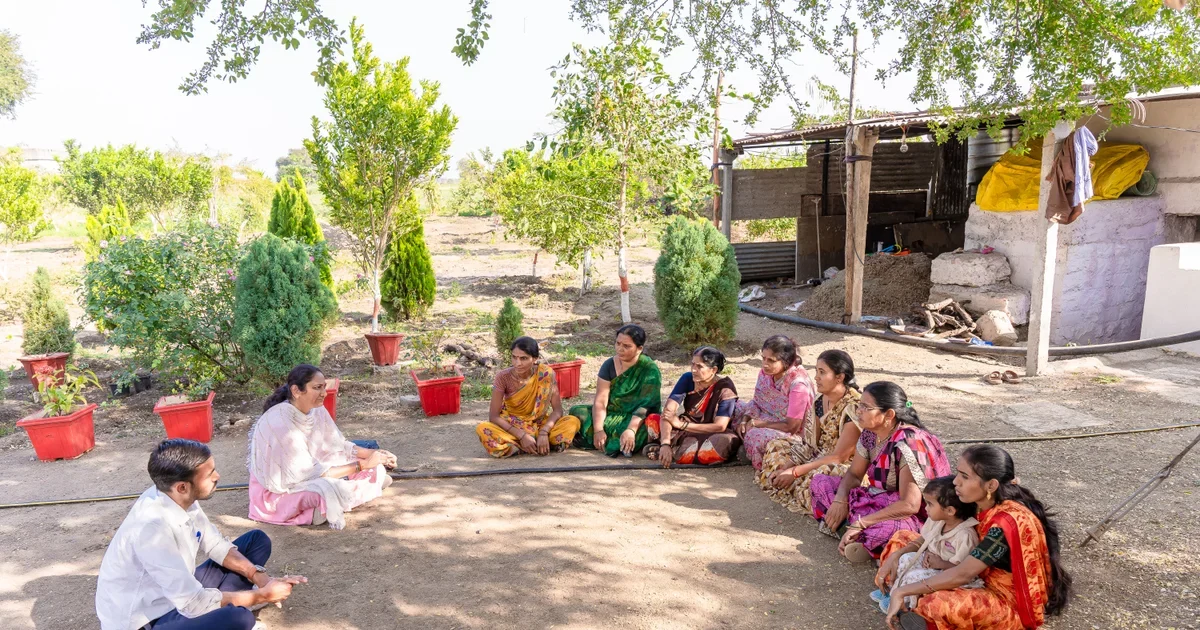
A community meeting in rural Nagpur, Maharashtra. Photo by EqualStock IN on Pexels.
In this story
Which community-led solutions in India have measured results?
India is full of local projects that people call success stories. Fewer of them come with numbers that someone outside the project has checked. This roundup picks seven community-led programmes in water, sanitation, health, education, livelihoods and urban heat, and gives for each the result, the source and the limits of the evidence. Some results are strong, such as a controlled trial in Maharashtra that cut newborn deaths. Some are mixed, such as a sanitation programme that raised toilet use and children’s height but did not reduce diarrhoea. One is a village whose famous figures come from its own leader. Reading them side by side shows what makes community programmes work, and how to judge the next success story you hear about.
We have already covered one famous example, the women solar engineers trained at the Barefoot College. You can read that piece at Barefoot College and the solar grandmothers, so it is left out here.
Programme | Area | Strength of evidence |
|---|---|---|
SEARCH home-based newborn care, Gadchiroli | Health | Controlled field trial, peer-reviewed (Lancet, 1999) |
Pratham’s Teaching at the Right Level | Education | Six randomised evaluations (J-PAL) |
Gram Vikas water and sanitation, Odisha | Sanitation | Matched cohort study, 90 villages (2019) |
JEEViKA self-help groups, Bihar | Livelihoods | Quasi-experiment, 400 villages (2011 survey) |
Mahila Housing Trust cool roofs, Ahmedabad | Urban heat | Small field study, 16 households (2017) |
Hiware Bazar water budgeting, Maharashtra | Water | Village-reported figures |
Paani Foundation Water Cup, Maharashtra | Water | Programme-reported totals only |
Can village health workers cut newborn deaths? The Gadchiroli trial
In the Gadchiroli district of Maharashtra, the doctor couple Abhay and Rani Bang and their organisation SEARCH tested a simple idea: train local women to care for newborns at home, because hospitals were too far for most families. The trial, published in The Lancet in 1999, compared 39 intervention villages with 47 control villages. The abstract sets out the results.
- Village health workers visited homes and managed birth asphyxia, low birth weight, cold and breastfeeding problems, and diagnosed and treated newborn sepsis.
- At the start (1993 to 1995) the newborn death rate was 62 per 1,000 live births in the intervention area and 58 in the control area.
- By the third year, 93% of newborns received home care, and the neonatal mortality rate in the intervention area was 25.5 per 1,000, a net reduction of 62.2% against the control area. Infant mortality fell to 38.8 per 1,000 (a net reduction of 45.7%).
- Deaths from newborn sepsis fell from 16.6% of cases to 2.8% after village workers began treating it.
- The care cost US$5.3 per newborn, and averted one death for every 18 newborns cared for in 1997 to 1998.
What the evidence can and cannot show. The authors chose the villages rather than assigning them at random, so differences between the groups cannot be fully ruled out. Still, the baseline rates were similar, and the effect was large. A later review of five controlled trials from South Asia found that home visits by community health workers for newborn care were linked to a lower risk of newborn death (relative risk 0.62), as reported in the 2010 systematic review. The Gadchiroli model went on to influence wider policy on home-based newborn care. The lesson is to train local people to do a few well-defined tasks, supervise them regularly, and give them the tools to treat the commonest killer.
Can community programmes fix children’s learning? Teaching at the Right Level
Pratham, an education nonprofit, built a method called Teaching at the Right Level (TaRL). Instead of teaching a child the grade syllabus, it groups children by what they can actually read and calculate, and teaches from there. J-PAL, the poverty research network, has tested it in six randomised evaluations across seven Indian states since 2001.
- The baseline is stark. In rural India in 2018, over 96% of children were enrolled in primary school, but only half of grade five students could read a grade two text, and 52% could correctly solve a two-digit subtraction with borrowing.
- In Uttar Pradesh, short learning camps roughly doubled the number of children who could read a paragraph or story. The camps ran about 10 days each, for 2 to 3 hours a day, with 3 to 5 camps a year, totalling 30 to 50 instructional days.
- J-PAL says the approach has produced some of the largest effects measured in education research, and that it now reaches more than 60 million students across India and Africa.
What the evidence can and cannot show. J-PAL’s page gives no single effect size and no cost per child, so this article does not quote one. It does say something useful about what fails: training teachers or handing out materials alone did not raise learning in the Indian evaluations. The gains came when teachers had clear goals, used data on each child, got on-site mentoring and met to share practice. For families, the takeaway is that foundational reading and arithmetic can be fixed in weeks, not years, if the teaching starts where the child is.
Does a community sanitation programme improve health? Gram Vikas in Odisha
Gram Vikas, an Odisha nonprofit, runs a programme that gives every household in a village a toilet, a bathing room and piped water. It has one rule: piped water is switched on only after every household has built a toilet, and the village pays for upkeep. The organisation says it has run the programme in more than 1,000 villages since 2002.
A matched cohort study published in 2019 checked whether it worked, five years or more after the programmes were set up. The study compared 45 programme villages with 45 matched control villages, covering 2,398 households with a child under five, and the abstract reports the following.
Measure | Gram Vikas villages | Control villages |
|---|---|---|
Households with improved toilets | 85% | 18% |
Adults using toilets | 74% | 13% |
Child faeces safely disposed | 35% | 6% |
Child height-for-age score | +0.17 higher | reference |
Child worm (helminth) infection | lower (adjusted odds 0.44) | reference |
Child diarrhoea | no difference (adjusted odds 0.94) | reference |
What the evidence can and cannot show. This is a good example of an honest result. The programme worked on the thing it controls, which is toilet building and toilet use, and the study found modest gains in child height and fewer worm infections. It did not find fewer cases of diarrhoea, which is what most people expect from sanitation. The authors say the reasons need more research. The finding is also a caution for toilet-building campaigns that count toilets and stop there. The distinctive feature, making water supply depend on a community-wide commitment, is a design worth studying, because it ties each household’s benefit to the whole village’s effort.
Can women’s self-help groups reduce debt? JEEViKA in Bihar
JEEViKA, Bihar’s rural livelihoods programme, began in 2007 with funding from the state and the World Bank. It organises poor women into self-help groups of 10 to 15 members who save small sums every week and lend to each other. After five to six months each group gets a one-time grant of Rs 50,000 and can link to banks at about 24% annual interest, against 60% to 120% from informal moneylenders. Ten to fifteen groups form a village organisation.
An evaluation column by Upamanyu Datta, based on a 2011 survey, compared 200 villages where JEEViKA started in 2008 with 200 matched villages that had not yet been reached, surveying 10 households in each.
- The average outstanding high-cost loan (monthly interest of 4% or more) was Rs 5,000 for programme households against Rs 14,500 for control households.
- More programme households owned mobile phones, watches, cows and bullocks, with no difference in land, buffaloes or jewellery.
- Women’s voice grew: 9% attended panchayat meetings (5.5 percentage points higher than in control villages), 79% gave an opinion on children’s education (10 points higher) and 83% said they would or did act against domestic violence (9 points higher).
What the evidence can and cannot show. The author notes that the design is not the gold standard. It was not randomised and relied on women’s memory of 2008 conditions. Income, consumption and savings were not measured, so the study cannot say whether families became richer, only that they carried less costly debt and had more say. It also found no evidence that households diversified their livelihoods. Anyone citing JEEViKA as a poverty cure should note this. The reliable claim is narrower: group lending at a fair rate cut reliance on moneylenders and raised women’s participation. Our story on Kerala and Kudumbashree describes a similar women’s network built over many more years.
Can slum households beat the heat? Cool roofs in Ahmedabad
Ahmedabad’s slums have homes with tin, asbestos or plastic roofs that trap heat. The Mahila Housing Trust (MHT), which works with women in informal settlements, tested low-cost cool roofs. A study published in 2020 measured indoor temperatures in 16 households over seven days in October 2017, using data loggers from 10 am to 5 pm. The paper compared four roofs with cool-roof treatments to twelve with ordinary roofs.
- A Modroof (a modular insulated roof) averaged about 2.0 degrees Celsius cooler indoors than a tin roof, and about 3.0 degrees cooler than an asbestos roof, going by the reported mean temperatures.
- Thermocol insulation under an asbestos roof was about 1.9 degrees cooler than tin and 2.4 degrees cooler than asbestos.
- White reflective paint on tin lowered temperatures by about 1.1 degrees.
- Compared with concrete roofs, none of the treatments was cooler, and one ventilation design ran hotter than every control.
What the evidence can and cannot show. This is a small study, with four intervention homes, and it ran in October, after the monsoon, not in the peak heat of May. The paper’s text claims larger differences in places than its own averages show, which is why we quote the averages. News reports mention reductions of 3 to 5 degrees, but we could not trace those figures to a study. The honest summary is that cheap cool roofs lower indoor heat by a degree or two compared with tin and asbestos, and that the women-led delivery model deserves a bigger, summer-season trial. The need is real: our report on heatwaves and outdoor workers shows how little protection many homes and workplaces give.
Can a village manage its own water? Hiware Bazar
Hiware Bazar, in Maharashtra’s Ahmednagar district, is the best-known case of a village saving its water. A watershed programme began there in 1992. Sarpanch Popatrao Pawar described the method in a 2007 interview with Down To Earth: watershed works across about 400 hectares, and a yearly water budget based on recharge data, readings from six observation wells and four rain gauges, taken monthly. Cropping choices follow the budget, with drinking water for people and animals as the first priority. Schools run a water literacy course, and the gram panchayat enforces water norms.
Pawar reported that groundwater rose from about 36 metres below ground to about 15 metres, and that per capita income rose from Rs 832 to Rs 24,000 a year. A watershed programme report states that 168 families were below the poverty line in a 1992 survey, against only 3 of 226 families later.
What the evidence can and cannot show. These figures come from the village’s own leader and from programme documents, and income numbers differ across reports in units and dates, so they should be read as a strong local account and not as a verified study. The method is the real lesson: measure the water first, then decide what to grow, and make the village assembly the rule-maker. That is a transferable idea even if each figure needs checking. The same logic of local control over water appears in our story on Rajasthan and the right to information.
Can a competition mobilise villages? Paani Foundation’s Water Cup
The Paani Foundation runs the Satyamev Jayate Water Cup, in which villages in Maharashtra compete to build soil and water conservation works through voluntary labour. The foundation’s own account says that, between 2016 and 2019, over 6,000 villages across 76 blocks took part and created more than 550 billion litres of water storage capacity. Its figures for individual years differ between pages, and we found no independent evaluation, so the totals are the programme’s own.
Storage capacity is also not the same as water actually available in a dry year. The sensible reading is that the competition mobilised an unusually large number of villages for physical work, which is itself a result worth noting. Whether it raised groundwater, crop income or drinking water security needs outside measurement, ideally comparing participating villages with similar villages that did not take part.
What do these seven programmes have in common?
- A narrow, clear task. Home visits to newborns, grouping children by reading level, a water budget. None tried to fix everything at once.
- Local people do the work. Village health workers, community volunteers, women’s groups and sarpanches carried the programmes, not outside experts.
- The community has a stake. Gram Vikas tied water to village-wide toilet building, and Hiware Bazar tied farming to a shared water budget.
- Supervision and data. Gadchiroli supervised workers fortnightly, and TaRL worked only when teachers used data and got mentoring.
- Honest limits. The best-evidenced programmes include results that disappoint, such as Gram Vikas on diarrhoea or JEEViKA on income, and that honesty makes the good results believable.
Related reading on this site includes why stunting persists, where home visits and water and sanitation both appear, and Curitiba’s bus system, another model of a practical, local-scale fix.
Why do community programmes find it hard to scale?
A programme that works in 39 villages or 200 villages meets new problems at 20,000. The seven examples above hint at the main ones. The first is supervision. Gadchiroli’s results depended on fortnightly visits to workers, and the TaRL evidence says that handing out materials without mentoring did not work. When a state takes over a model, the supervision is often the first thing to thin out, because it is slow, local and hard to count in a report.
The second is the match between the design and the money. Gram Vikas works because the village pays for upkeep and the water connection depends on every household joining. A government scheme that gives toilets to individual households without that collective link may produce fewer of the gains. The third is measurement. Without a comparison group, nobody knows whether a state-wide rollout is working, and the scheme can drift for years. The fourth is people. A strong sarpanch like the one in Hiware Bazar, or a charismatic founder, can carry a village far, but a design that needs one extraordinary person is hard to copy.
None of this is an argument against community-led work. It suggests that the question to ask of any scale-up is simple: which part of the original model has been kept, and which part has been dropped to save money?
How were these seven chosen?
The selection is not a ranking of India’s best programmes. We looked for community-led work with a published number from a source we could read, in six areas the readers of this site care about: water, sanitation, health, education, livelihoods and housing. Where the best evidence was a trial, we used it. Where it was only a village’s own figures or a programme’s own totals, we said so and ranked them lower in the table. Several well-known programmes were left out because we could not find a figure with a clear source. The seven also lean towards Maharashtra, Bihar and Odisha, which reflects where studies have been done and not where good work is happening. If you know a programme with an independent evaluation that belongs on this list, the next roundup can include it.
How can you judge a community success story?
Use five quick questions when you read a claim about a village or a programme:
- Compared with what? A before-and-after figure is weaker than a comparison with similar villages.
- Who counted? Numbers from an outside study carry more weight than numbers from the programme or its leader.
- Which outcome? Toilets built, water stored and loans given are activities. Child height, deaths, reading levels and debt are results.
- How long afterwards? Gram Vikas was checked five years on, which is more telling than a first-year survey.
- What did not work? A report with no disappointments is probably missing something.
What you can do
- Support programmes that publish results. Before you donate, ask for an outside evaluation or at least a clear before-and-after with a comparison group.
- Volunteer locally. Pratham and similar groups use community volunteers for learning camps. Offer a few hours a week to teach reading and arithmetic.
- Join or start a women’s group. If you are in a village, ask the state rural livelihoods mission how to form or join a self-help group.
- Ask for a water budget. Request that your gram panchayat track rainfall and groundwater levels and share them at the gram sabha.
- Check newborn care. Ask your ASHA worker or health centre about home visits for newborns, and make sure every baby in your family is visited in the first week.
- Insulate a roof. If you live in a tin or asbestos-roofed home, ask local groups about reflective paint or insulation, and compare indoor temperatures before and after.
- Share evidence, not only stories. When you pass on a success story, share the source and say who measured the result.
Frequently asked questions
What is the best-evidenced community health programme in India?
The Gadchiroli home-based newborn care trial is among the best. A 1999 Lancet paper reported that neonatal mortality in intervention villages fell to 25.5 per 1,000, a net reduction of 62.2% against control villages.
Did Gram Vikas reduce child diarrhoea?
The 2019 study found no difference in diarrhoea, though it found higher toilet use, lower worm infection and slightly better child height-for-age scores.
What is Teaching at the Right Level?
It is a method that groups children by learning level instead of grade, tested in six randomised evaluations across seven Indian states. In Uttar Pradesh learning camps roughly doubled the number of children who could read a paragraph or story.
Are Hiware Bazar’s income figures verified?
They come from the village’s sarpanch and programme documents, and different reports give different units and dates, so treat them as a local account and not as a verified study.
Do self-help groups raise incomes?
The Bihar evidence shows lower high-cost debt and more participation by women, but income was not measured, so the study cannot confirm higher incomes.
Where can I read about the Barefoot College solar programme?
See our earlier piece on Barefoot College and the solar grandmothers.
The bottom line
Community-led programmes in India can save newborns, teach children to read, build toilets that get used, cut moneylender debt and cool a slum home by a degree or two. The best of them were measured by people other than their founders, and the best of those reports admit what did not work. When you hear about the next village miracle, ask for the comparison, the source and the failure, and then support the programmes that can answer.
What you can do
- Share the evidenceSend this to one person who should know about poverty.Share on WhatsApp
- Back what worksVolunteer time or skills with groups doing this work.Ways to volunteer
- Tell us what's missingKnow a story, a fact we got wrong, or a solution worth spotlighting?Suggest a story
Politically neutral. Every claim sourced. Report a correction.

No comments yet