India's Sports Stories: Kabaddi, From Village Courts to a Global TV Franchise
Kabaddi has been played in Indian villages for centuries. In 2014, a TV franchise turned it into prime-time television. This is the story of how a contact sport from UP's mud courts became one of India's most-watched leagues, and what that journey means for rural economic mobility.
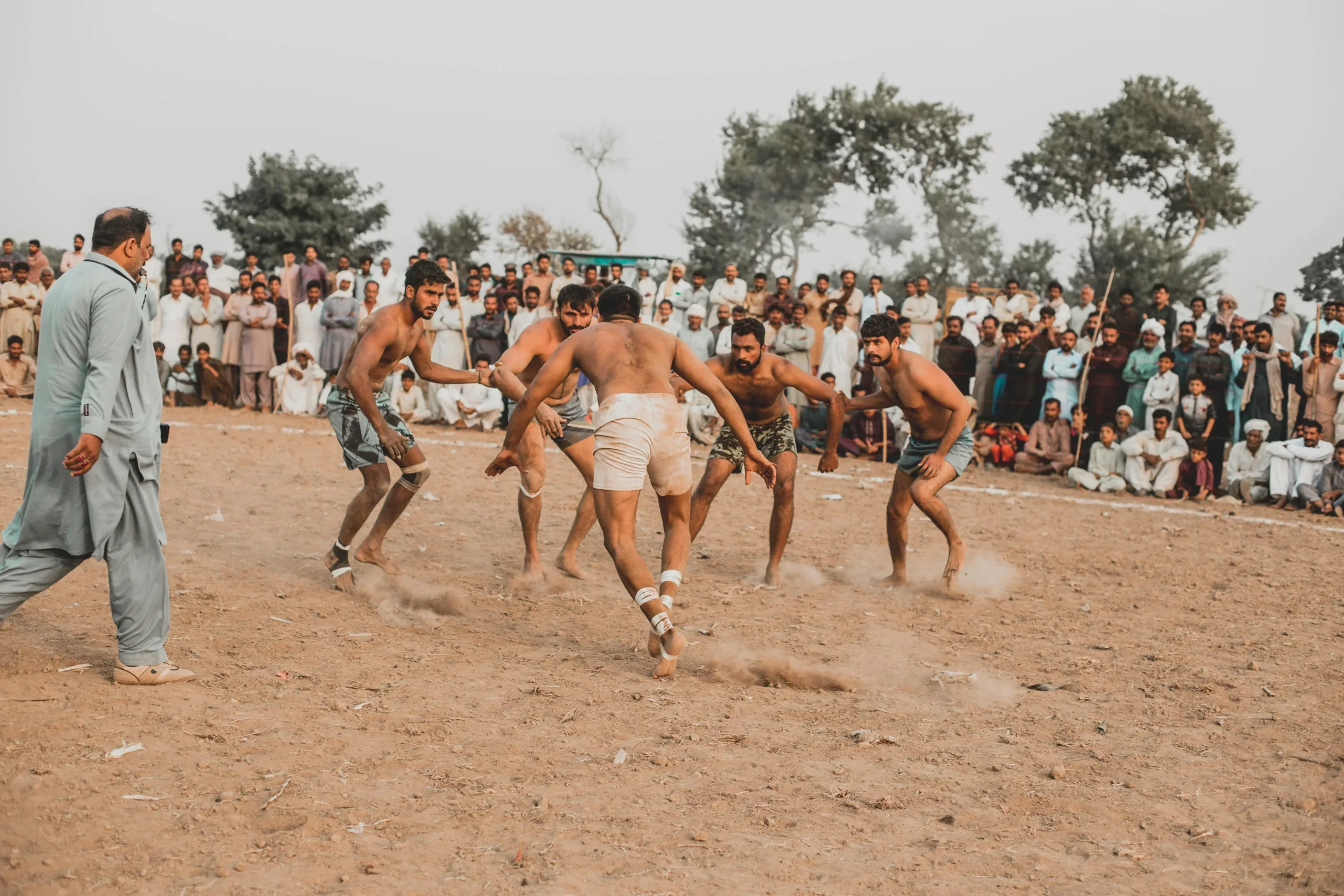
In the summer of 1993, a boy named Anup Kumar was playing kabaddi in the dust outside his village in Sonipat, Haryana. The field had no boundary lines. There were no referees, no sponsors, no prize money. The other players were farmers’ sons and labourers’ children. Nobody was watching except the other boys waiting their turn. Twenty-one years later, Anup Kumar walked onto the mat as captain of the Jaipur Pink Panthers in the inaugural Pro Kabaddi League season, broadcast live on Star Sports to 435 million viewers across India. That arc, from a village in Sonipat to prime-time television, is not just one man’s story. It is the story of what happened when India decided that one of its oldest rural sports deserved a franchise.
The Village Game: Origins in the Mud
Kabaddi is among the oldest competitive contact sports on the Indian subcontinent. Its origins are contested, historians trace it to the Mahabharata period, where a version of the sport appears in folk accounts of Abhimanyu’s lone charge into the Kaurava formation, but its modern structure as a team sport crystallised in Maharashtra and Tamil Nadu in the 19th century. The game spread through akhadas, the traditional wrestling and physical training grounds that dotted every large village across north and west India.
The rules are straightforward. Two teams of seven each occupy opposite halves of a court. A raider crosses into the opponent’s half, tries to tag as many defenders as possible, and must return before exhaling the held breath that proves a continuous play, all while chanting “kabaddi, kabaddi” to demonstrate that breath. Defenders try to tackle the raider before he returns. Tagged defenders are out; if the raider is tackled, he is out. The team that eliminates all seven opponents scores a “lona”, seven bonus points.
What made kabaddi distinct from other rural sports was its accessibility. It required no equipment, no standardised court (village games were played in fields, school grounds, even paddy-harvested plots), and no footwear. The physicality rewarded strength, agility, and tactical intelligence simultaneously. A raider needed explosive acceleration to break past a defensive line, the lung capacity to hold breath under physical stress, and the tactical awareness to identify which defender to tag first to force the formation apart. It was, and remains, a sport that punishes athletic fraud. Either you can hold your breath and break free, or you cannot.
By the time the All India Kabaddi Federation was formed in 1950, the sport had formal rules but remained essentially rural and regional. It entered the Asian Games in 1990 in Beijing, where India won gold, a result India has replicated at every Asian Games since. Yet for decades after that, kabaddi remained largely invisible to urban India. It played in school competitions, state championships, and rural tournaments, drawing enormous crowds in Bihar, Haryana, Maharashtra, and Tamil Nadu, but virtually no television coverage, no sponsorship infrastructure, and no path for talented rural players to convert skill into income.
“We played for nothing except pride. There was no money in kabaddi for us, only the hope that the government job quota for sportspersons might one day apply.”
2014: The League That Borrowed the IPL Blueprint
The Pro Kabaddi League did not emerge from the sport’s governing body. It emerged from a media company’s reading of viewership data. Mashal Sports, a joint venture between Anand Mahindra’s Mahindra Group and Charu Sharma, pitched the concept to Star Sports in 2013. The idea was explicit: replicate the Indian Premier League’s franchise-based, franchise-auctioned, city-anchored model for a sport that had zero existing professional infrastructure but enormous grassroots talent depth.
Star Sports agreed. The first PKL season launched on 26 July 2014, with eight franchise teams: Jaipur Pink Panthers, U Mumba, Bengaluru Bulls, Patna Pirates, Puneri Paltan, Telugu Titans, Dabang Delhi, and Bengal Warriors. Each franchise was owned by a corporate entity, Abhishek Bachchan’s company owned Jaipur Pink Panthers, the Ronnie Screwvala-backed entity owned U Mumba, bringing the entertainment industry’s promotional muscle into a sport previously surviving on state government patronage.
PKL Season | Year | Teams | Cumulative Viewership (India) |
|---|---|---|---|
Season 1 | 2014 | 8 | 435 million |
Season 2 | 2015 | 8 | 400 million |
Season 4 | 2016 | 12 | 700 million+ |
Season 5 | 2017 | 12 | 980 million |
Season 9 | 2022 | 12 | 2.2 billion (Star Sports + Disney+ Hotstar) |
The decision to broadcast games in prime-time evening slots, 8 PM to 10 PM, was deliberately counterintuitive. Sports broadcasters typically cede prime time to entertainment programming. Star Sports committed prime-time slots specifically because the analysis showed that rural and semi-urban audiences, who constituted the natural base for kabaddi, watched television in those slots. The sport was not being forced into a gap; the schedule was engineered around the audience’s existing habits.
The Viewership Milestone: When Kabaddi Beat FIFA
The number that changed the conversation came in 2016. BARC India’s viewership data for PKL Season 4 showed that the league’s cumulative television audience had crossed 700 million impressions for the season, a figure that exceeded the total Indian viewership of the 2014 FIFA World Cup (approximately 670 million cumulative impressions across all matches). Sports editors who had treated kabaddi as a rural curiosity now had a number they could not dismiss.
The comparison with the IPL is more nuanced. The IPL remains India’s largest sporting property by revenue, sponsorship value, and urban audience reach. But PKL Season 5 in 2017 delivered viewership that the league described as comparable to IPL per-match averages in rural markets, a meaningful claim in a country where the rural-urban split in television households was still approximately 55-45. PKL was reaching audiences in districts where cricket had always been followed but never fully owned as a local identity. In Bihar, Haryana, Uttar Pradesh, and Punjab, the heartlands of kabaddi recruitment, the PKL was not just popular. It was producing local heroes.
Anup Kumar and Pardeep Narwal: The Faces the Villages Watched
Two players defined the PKL’s first decade in ways that extended beyond sporting statistics.
Anup Kumar from Sonipat became India’s most recognised kabaddi player before the PKL existed. He had won the Asian Games gold medal multiple times, captained the national side, and was considered technically the most complete raider of his generation, not the fastest or most powerful, but the most difficult to read. His ability to use feints, ankle holds, and directional changes to escape defensive formations was studied by coaches across the country. When PKL launched and he anchored Jaipur Pink Panthers to the first season title, his face appeared on hoardings in districts where the game had been played for generations. For rural audiences watching, the message was unambiguous: a man who had grown up the way they grew up was now on prime-time television.
Pardeep Narwal arrived a season later and represented something different, raw power combined with statistical dominance. From Muradnagar in Uttar Pradesh, Narwal became the PKL’s all-time leading raider in terms of raid points, crossing 1,500 raid points in PKL history, a record that still stands. He was the first kabaddi player to be auctioned for Rs 1 crore in the PKL player auction, and by Season 8 his auction price reached Rs 1.65 crore, figures that his own father, a daily-wage labourer, would not have earned in a decade of work.
- Pardeep Narwal career raid points (PKL): 1,500+ (all-time record as of 2024)
- Narwal’s PKL auction price trajectory: Rs 30 lakh (Season 3) → Rs 1 crore (Season 6) → Rs 1.65 crore (Season 8)
- Jaipur Pink Panthers Season 1 PKL champions: Anup Kumar (captain), Rajesh Narwal, Nitin Tomar
- Patna Pirates won three consecutive PKL titles (Seasons 3, 4, 5), the only team to achieve this
The auction system, borrowed directly from IPL, created a visible salary structure for the first time in Indian kabaddi. Before PKL, the only financial path for a talented kabaddi player was a government job through the sports quota, typically at Railways or police forces, paying Rs 25,000-40,000 per month. PKL changed that ceiling dramatically. Top players now earn between Rs 80 lakh and Rs 2 crore per season, with brand endorsements on top. The income gap between a PKL star and a state-level player remained vast, but the existence of a visible top end changed the aspirational mathematics of the sport.
The Rural Pipeline: Scouts, Akhadas, and the Village Road to the Auction
PKL franchises did not build their talent from scratch. They tapped a pipeline that had existed for decades but had no commercial outlet. Village akhadas in Haryana, UP, Bihar, and Maharashtra had been producing kabaddi players at scale since the sport entered school and national competitions in the 1970s. State associations had maintained their own leagues with tiny prize money. District-level tournaments drew genuine talent but offered nothing beyond trophies and the possibility of a government job reference.
PKL franchises began deploying scouts at state-level tournaments almost immediately after Season 1. The scouting model was low-cost relative to cricket: state kabaddi tournaments have no entry barriers, no membership requirements, and attract talent from genuinely rural backgrounds. A franchise scout attending a Haryana State Kabaddi Championship could identify a raider from a village with a population of 3,000 who had been playing since the age of eight and had never been seen by anyone outside his district. By Season 3, the auction pools began showing players from genuinely remote addresses, not just district capitals and state university towns, but villages in Muzaffarnagar, Saharanpur, Gaya, and Shivamogga.
The caste composition of PKL rosters is not data that the league publishes, but journalist investigations and player interviews have consistently noted that kabaddi draws heavily from OBC (Other Backward Class) and Scheduled Caste communities across north India, communities that have historically been excluded from cricket’s urban, equipment-dependent entry requirements. Kabaddi’s physicality rewards body types common in agricultural communities. Its zero-equipment entry point means that economic barriers that shape rural access to formal opportunity do not operate here in the same way. The PKL, by making the sport commercially valuable, turned this demographic concentration from a social observation into an economic fact: these communities now had a sport producing Rs-crore players from their villages.
Beyond PKL: Asian Games, the World Championship, and Soft Power
India has won every Kabaddi World Championship since the tournament began in 2004. The record stands at seven titles across both men’s and women’s categories through 2016. India’s men’s team has also won every Asian Games kabaddi gold medal since the sport was introduced in 1990, a streak of nine consecutive golds through the 2023 Asian Games in Hangzhou. No other Indian sport carries a comparable international record of sustained dominance.
The PKL has begun generating diaspora interest as well. Star Sports international feeds carry PKL matches to South Asian diaspora audiences in the UK, Middle East, and North America. Kabaddi has grassroots leagues in Canada, particularly in the Punjabi communities of Ontario and British Columbia, that predate PKL, these existed as village-culture events within the diaspora. PKL now functions as the professional reference point that gives those grassroots games a commercial anchor and something to aspire toward.
In 2016, the International Kabaddi Federation had 30 member nations. By 2023, that number had grown to over 50. The growth is partly PKL-driven, franchise ownership models from Iran, South Korea, and Japan have explored kabaddi as a sport to develop domestically, partly because the low equipment cost makes grassroots development cheaper than most contact sports. Japan’s Kabaddi Federation, founded in 1979, is the oldest outside South Asia and has fielded national teams at every World Championship since 2004; South Korea’s inclusion of kabaddi in its national school sports programme since 2019 demonstrates how structured state investment in an indigenous Asian sport can build grassroots depth rapidly. The sport’s potential as an indigenous Indian contribution to global athletic culture has not been lost on government bodies: the Khelo India programme has listed kabaddi among its priority sports for infrastructure investment at the district level.
What Kabaddi’s Rise Actually Means
The easy narrative about PKL is that it made kabaddi glamorous. That is true but incomplete. The harder and more significant story is what the commercialisation of kabaddi did to the economics of rural athletic talent.
Before PKL, the ceiling for a talented kabaddi player from a village in Muzaffarnagar was approximately Rs 5 lakh per year, if they were good enough for a government sports quota posting. That ceiling held for generations. The choice facing families with athletic sons was not between sport and university; it was between sport and farm labour, with sport offering a slightly better government job at the end. PKL did not eliminate that ceiling for most players, state-level players still earn little, but it created a visible ladder with rungs between village tournament and Rs-crore auction, with Junior PKL, Women’s PKL, and the state franchise leagues now constituting intermediate steps on that ladder.
The change in how villages relate to the sport is observable in enrolment data. The All India Kabaddi Federation reported a 40 percent increase in registered players between 2014 and 2020, from approximately 10 million to 14 million registered practitioners. Some of that increase reflects improved registration infrastructure, but field reports from coaches and state association officials consistently cite PKL visibility as a driver: parents who once discouraged athletic careers are now facilitating them because they can see the income possibility at the top end.
India’s relationship with its rural sports has historically been extractive in the other direction, talent was produced by villages, celebrated by the state during Asian Games gold medal runs, and then returned to the village with a certificate and a job at Railways. PKL introduced a commercial feedback loop: the sport produces talent, the talent produces viewership, the viewership produces sponsorship revenue, and a portion of that revenue flows back to the players, including players who grew up in those same villages. It is not equity. But the direction of flow has changed, and the change has altered the aspirational calculus of rural India in ways that sustained state-level social investment can amplify, when the institutional will exists.
The Unfinished Story
PKL remains financially fragile by global sports league standards. It is heavily dependent on Star Sports’ willingness to carry it in prime time, which is itself contingent on advertising revenue from a category of brands, rural-facing FMCG, telecom, two-wheelers, that are more volatile than the premium brands that sustain cricket. The league’s total revenue (approximately Rs 500 crore annually at its peak) is roughly one-twentieth of the IPL. Player salaries beyond the top 20 are modest. Women’s kabaddi has a championship but not yet a commercial league of equivalent scale.
The infrastructure gap is also real. District-level facilities for kabaddi in Bihar and UP remain inadequate. The Khelo India investments are early and unevenly distributed. The pipeline that produced Anup Kumar and Pardeep Narwal continues to operate largely through village akhadas and school competitions, not through purpose-built academies with professional coaches, physiotherapists, and video analysis tools that would be standard in any equivalent European sport.
But in the ten years since that first PKL season, something irreversible happened. A sport played in the mud outside villages for generations acquired a price tag. The players who had played for nothing except pride now had market value. And in a country where rural Indians face compounding disadvantages in accessing formal systems, a sport that closed one of those gaps, imperfectly, for a few, with all the commercial distortions a franchise league introduces, deserves to be counted as a social intervention as much as an entertainment product.
Anup Kumar retired from professional kabaddi in 2021. He now coaches. Pardeep Narwal, still in his late twenties, continues to raid for franchise teams. In villages across Haryana, UP, and Bihar, boys who were born the year PKL launched are now old enough to try out for Junior PKL. They grew up watching the sport on prime-time television. Some of them will make it. That, more than any viewership statistic, is what the Pro Kabaddi League actually built.
What You Can Do
Kabaddi’s commercial revival happened because a media company recognised economic value in a rural sport. But the pipeline that feeds that league - the akhadas, the school tournaments, the district competitions - depends on civic choices made at every level.
Personal: If you have children or young people in your household or neighbourhood, remove the financial-barrier argument against kabaddi as a sport. It costs nothing to play and the PKL has created a visible income path at the professional level. Encourage akhada training the same way urban families encourage cricket coaching. RWA/community: Petition your housing society or village panchayat to mark a dedicated kabaddi court in any open ground; a 13×10 metre patch of cleared flat earth is the only infrastructure required. One accessible court within walking distance changes who gets to practise daily. Ward/city: Write to your ward councillor requesting that Khelo India kabaddi infrastructure funds be tracked and spent at the ward level; many of these allocations sit unspent because no citizen group monitors them. National: Support the demand that Women’s Pro Kabaddi League receive equivalent broadcast prime-time investment to the men’s league; women’s kabaddi has the same talent depth and the same rural economic mobility story, but without commercial visibility, that story remains incomplete.
India’s Sports Stories
This is the first entry in Unite4India’s Sports Stories series, tracing the social and economic journeys of Indian sports from village origins to national identity. Each entry in this series examines a sport not just as entertainment but as a lens on class, mobility, infrastructure, and what India chooses to celebrate. Follow Unite4India to read the next entry in the series.
What you can do
- Share the evidenceSend this to one person who should know about this issue.Share on WhatsApp
- Give an afternoonTeach, mentor, clean up, or lend your professional skills.Ways to volunteer
- Tell us what's missingKnow a story, a fact we got wrong, or a solution worth spotlighting?Suggest a story
Politically neutral. Every claim sourced. Report a correction.
No comments yet